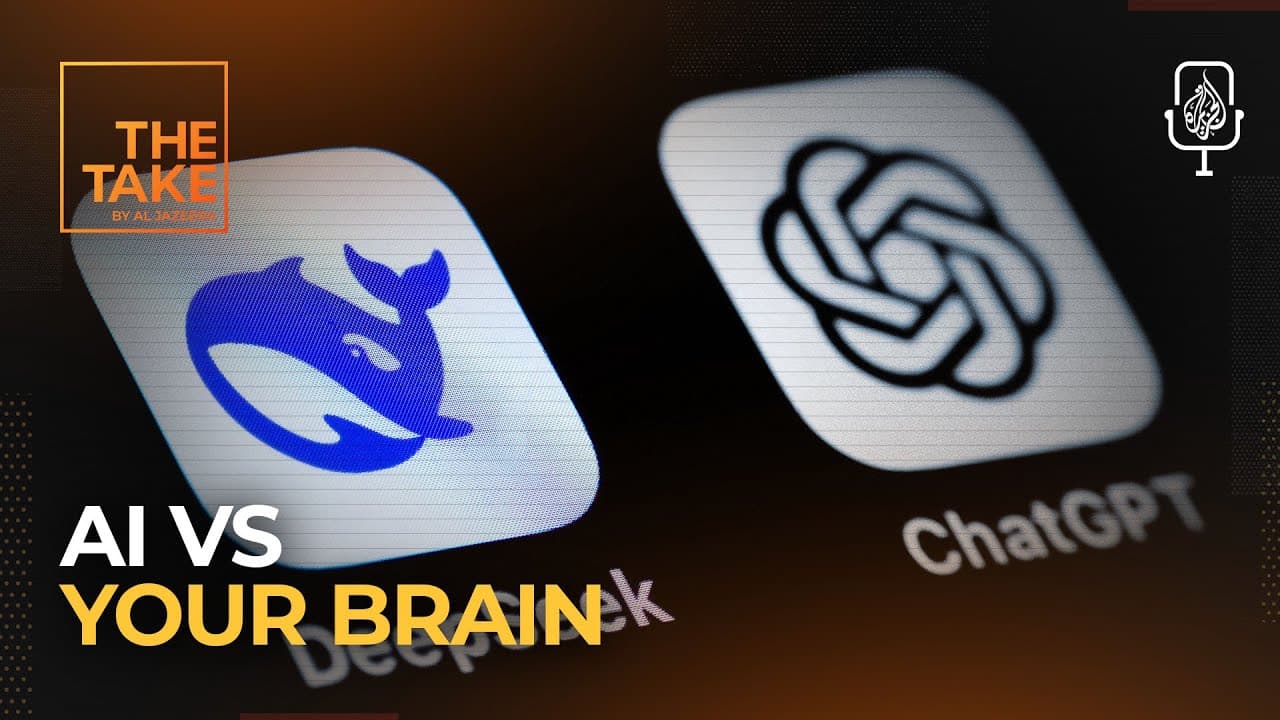
Is ChatGPT hurting our critical thinking skills? | The Take
TL;DR
AI tools like ChatGPT may hinder critical thinking and creativity.
Transcript
Alazer podcasts. Today, AI makes life easy. But is it breaking our brains? When we let large language models write essays or code for us, we're giving up something that feels, at least to me, pretty central to humanness. How real are concerns that AI chatbots diminish our ability to learn? And what can you do about it? I'm Manuel Rapalo and this is... Read More
Key Insights
- AI tools, while convenient, may shift users from active information seekers to passive consumers, potentially impacting critical thinking skills.
- An MIT study found that students using AI tools struggled to recall their own writing, unlike those relying on traditional research methods.
- AI-generated responses tend to homogenize answers, leading to less creative and more uniform outputs.
- EEG studies show that brain connectivity decreases when relying on AI, affecting areas related to attention and creativity.
- Long-term effects of AI on cognitive functions remain largely unknown, highlighting the need for more research.
- Cognitive offloading, a practice as old as human history, is now more pronounced with AI, raising concerns about over-reliance.
- AI's role in education is debated; it may help productivity but reduce motivation, according to a Harvard study.
- Open AI and other tech companies have yet to fully address potential cognitive impacts of their tools, raising ethical concerns.
Install to Summarize YouTube Videos and Get Transcripts
Explore YouTube Video Summarizer or Get YouTube Transcript Extractor
Questions & Answers
Q: How does AI affect critical thinking skills?
AI tools like ChatGPT can make users passive consumers of information, reducing the need for critical thinking. By providing ready-made answers, they can diminish the user's engagement with the material, leading to a potential decline in the ability to analyze and synthesize information independently.
Q: What did the MIT study reveal about AI and memory recall?
The MIT study found that students using AI tools like ChatGPT struggled to remember their own writing. This was not an issue for those who relied on traditional research methods. The study suggests that the ease of AI-generated responses might hinder the cognitive processes involved in memory recall.
Q: How does AI impact creativity according to the study?
AI-generated responses tend to be homogenized, leading to less creative outputs. The study found that AI users often converged on similar answers, reducing originality. Brain studies showed decreased connectivity in regions associated with creativity, indicating that reliance on AI might dampen creative thinking.
Q: What is cognitive offloading and how does AI contribute to it?
Cognitive offloading refers to using tools to extend cognitive capabilities. AI contributes by taking over tasks traditionally performed by the brain, such as writing or problem-solving. While it can relieve cognitive load, over-reliance on AI might lead to a decline in cognitive skills over time.
Q: What are the ethical concerns regarding AI's impact on cognition?
The ethical concerns revolve around the potential cognitive decline due to over-reliance on AI tools. Companies like Open AI have not fully addressed these issues, raising questions about their responsibility in mitigating negative cognitive impacts and ensuring that AI tools are used to augment rather than replace human cognition.
Q: How does AI affect productivity and motivation according to research?
A Harvard study suggests that while AI tools can increase perceived productivity, they may also reduce motivation. Users might feel more productive due to the ease of task completion, but the reliance on AI can lead to a decrease in intrinsic motivation to engage deeply with tasks.
Q: What are the potential long-term effects of AI on cognitive functions?
The long-term effects of AI on cognitive functions are still largely unknown due to the novelty of the technology. Researchers are concerned about how continuous reliance on AI from a young age might impact cognitive development, memory, creativity, and critical thinking skills over a lifetime.
Q: What role should AI play in education according to experts?
Experts suggest that AI should be used as a tool to augment learning rather than replace traditional methods. Students should first engage with material independently to develop critical thinking skills before using AI to enhance their understanding. This approach could help maintain cognitive skills while benefiting from AI's capabilities.
Summary & Key Takeaways
-
AI tools like ChatGPT are being scrutinized for potentially diminishing critical thinking skills. An MIT study highlights how reliance on AI can affect memory and creativity. The study found that students using AI struggled with recalling their own work, unlike those using traditional methods.
-
The homogenizing effect of AI-generated responses leads to less creative outputs. Brain studies show decreased connectivity in users reliant on AI, affecting attention and creativity. Despite AI's convenience, the long-term cognitive impacts remain largely unexplored, necessitating further research.
-
Cognitive offloading through AI is a modern extension of historical practices, but over-reliance is concerning. AI's role in education and work shows mixed effects on productivity and motivation. Tech companies have yet to address these cognitive concerns, raising ethical issues.
Read in Other Languages (beta)
Share This Summary 📚
Summarize YouTube Videos and Get Video Transcripts with 1-Click
Try YouTube Summary with ChatGPT & Claude or YouTube Transcript Generator
Explore More Summaries from Al Jazeera English 📚





Summarize YouTube Videos and Get Video Transcripts with 1-Click
Try YouTube Summary with ChatGPT & Claude or YouTube Transcript Generator