Angle of x' axis in Minkowski spacetime | Special relativity | Physics | Khan Academy
TL;DR
In special relativity, when we let go of assumptions about absolute time and space, we can reconcile the observation that the speed of light is constant. This leads to the creation of space-time diagrams with angled axes.
Transcript
- [Voiceover] We have been doing some interesting things in the last few videos. We let go of our Newtonian assumptions that the passage of time is the same in all initial frame of reference that time is absolute that one second in my frame of reference is the same as one second passing in your frame of reference. We even let go of the idea that sp... Read More
Key Insights
- 🙂 Letting go of assumptions about absolute time and space in special relativity leads to the reconciliation of the constant speed of light in all frames of reference.
- 👾 Space-time diagrams with angled axes provide a better representation of the relationship between different frames of reference.
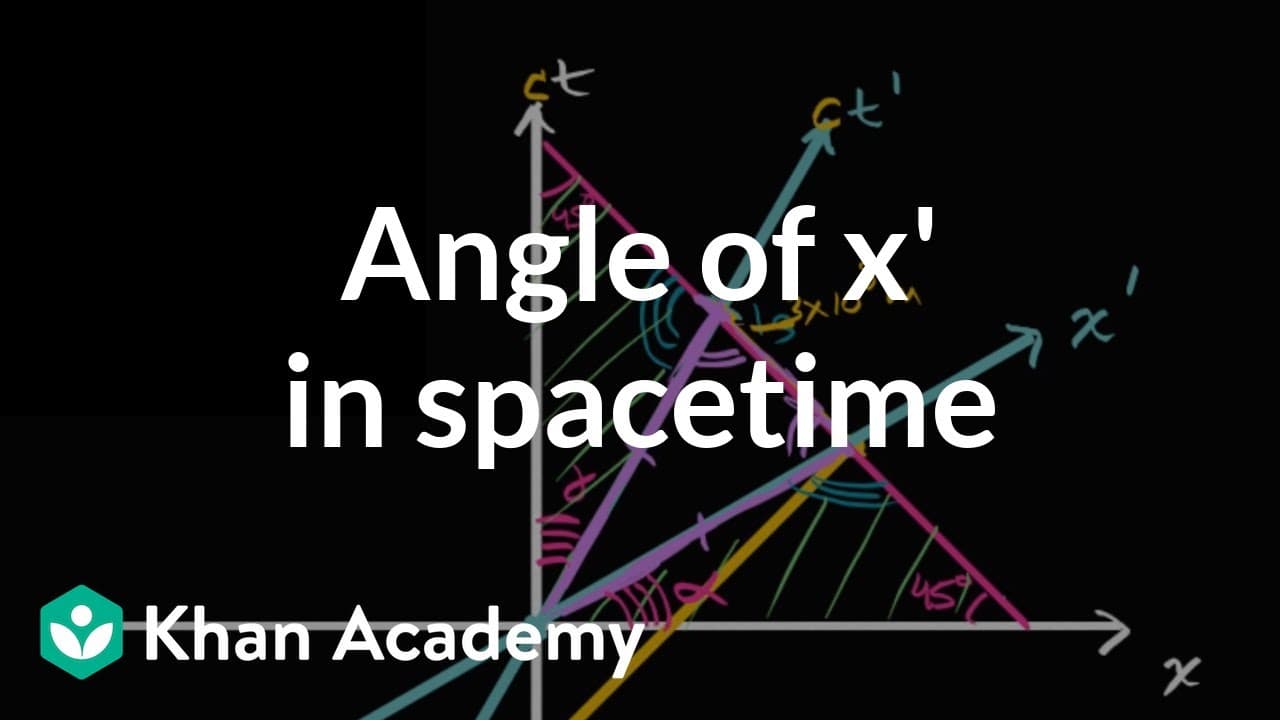
- 😰 The angle between the x' and x axes, as well as between the t' and t axes, is the same and represents a symmetry in the space-time diagram.
Install to Summarize YouTube Videos and Get Transcripts
Explore YouTube Video Summarizer or Get YouTube Transcript Extractor
Questions & Answers
Q: How does letting go of assumptions about absolute time and space help reconcile the observation of the constant speed of light?
Letting go of assumptions about absolute time, space, and velocity for light allows us to create space-time diagrams with angled axes, which accurately represent the observations of the constant speed of light in all frames of reference.
Q: Why is the angle between the x' and x axes the same as the angle between the t' and t axes?
The angle between the x' and x axes is the same as the angle between the t' and t axes because these angles represent the same symmetry in the space-time diagram. It is a result of the constant speed of light in all frames of reference.
Q: How can we determine that the triangle formed by the ct' axis, x' axis, and the line representing the path of light is an isosceles triangle?
The triangle is isosceles because the hash marks on both the ct' axis and x' axis represent the same measurement of three times 10 to the eighth meters. This equality of sides confirms that it is an isosceles triangle.
Q: How does the angle between the path of light and the x' axis change as the frame of reference moves closer to the speed of light?
As the frame of reference gets closer to the speed of light, the x' axis gets more squashed up around the 45-degree line representing the path of light. This means the angle between the path of light and the x' axis becomes more severe.
Summary & Key Takeaways
-
The previous videos challenged assumptions about absolute time and space and established that the speed of light is constant in all inertial frames of reference.
-
By letting go of these assumptions, space-time diagrams are created with angled axes, allowing for a better understanding of the relationship between different frames of reference.
-
The angle between the x' and x axes, as well as between the t' and t axes, are the same, and the path of light in these diagrams is always at a 45-degree angle.
Read in Other Languages (beta)
Share This Summary 📚
Summarize YouTube Videos and Get Video Transcripts with 1-Click
Try YouTube Summary with ChatGPT & Claude or YouTube Transcript Generator
Explore More Summaries from Khan Academy 📚



Summarize YouTube Videos and Get Video Transcripts with 1-Click
Try YouTube Summary with ChatGPT & Claude or YouTube Transcript Generator