Statistical and non statistical questions | Probability and Statistics | Khan Academy
TL;DR
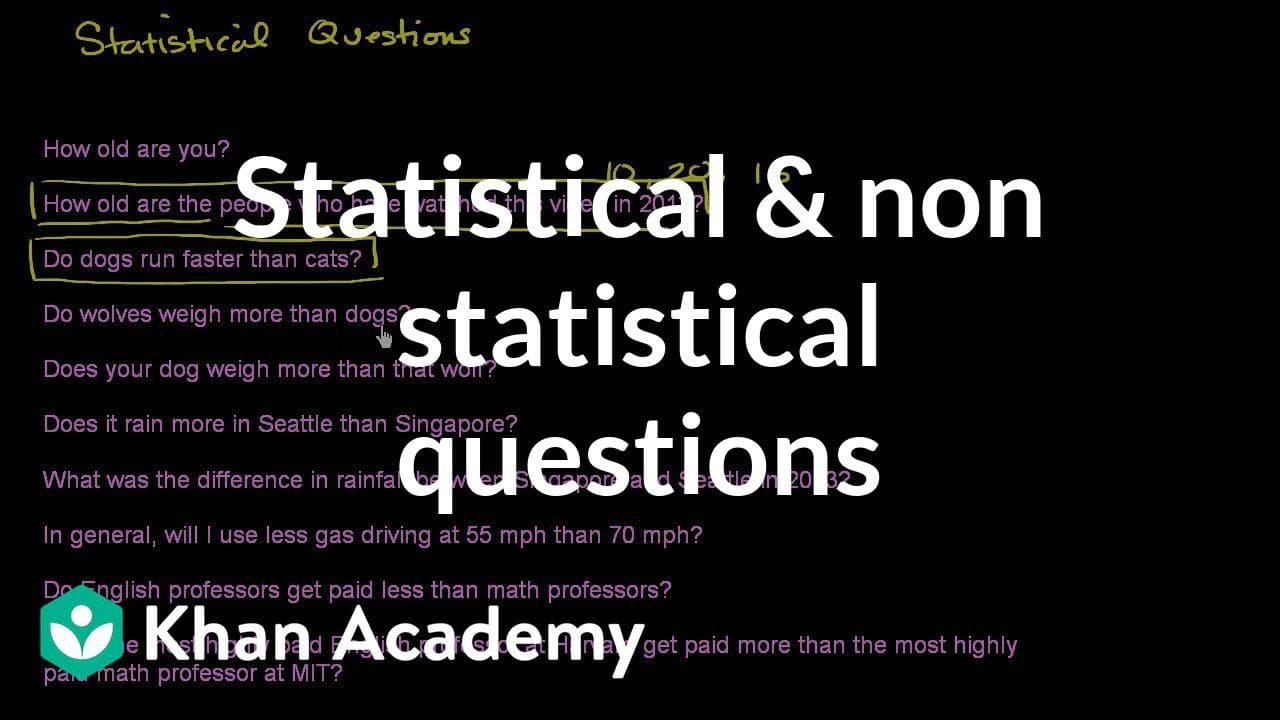
This video discusses the differences between statistical questions, which require the use of statistics, and non-statistical questions.
Transcript
- [Instructor] What I want to do in this video is think about the types of questions that we need statistics to address and the types of questions that we don't need statistics to address. And we could call the ones where we need statistics as statistical questions, statistical questions. And I'll circle the statistical questions in yellow. And I e... Read More
Key Insights
- 🔨 Statistical questions involve variability in data and require statistical tools to analyze and make conclusions.
- 😥 Non-statistical questions have a single answer without variability or involve comparing specific individual data points.
- ⁉️ Statistical questions often involve comparing traits or characteristics of populations or groups, while non-statistical questions focus on specific individuals or data points.
- 💨 Statistics provide a way to determine central tendencies such as averages or medians to make meaningful comparisons and conclusions.
- 🤩 Variability in data is a key factor in determining whether a question is statistical or not.
- 🏑 Statistical questions can help make informed decisions, predictions, and comparisons in various fields and contexts.
- 🚱 Non-statistical questions are more straightforward and do not require statistical analysis.
Install to Summarize YouTube Videos and Get Transcripts
Explore YouTube Video Summarizer or Get YouTube Transcript Extractor
Questions & Answers
Q: Can we answer the question "How old are you" without statistics?
Yes, because this question is asking about the age of a specific person, which has a single answer without variability.
Q: Why is "How old are the people who have watched this video in 2013" a statistical question?
This question involves variability as there are multiple people of different ages watching the video. To determine a general age range, statistical tools like averages or medians are needed.
Q: Is the question "Do wolves weigh more than dogs" a statistical question?
Yes, because it involves comparing the weights of a whole population of wolves and dogs, where there is variation in the weights. Statistical tools are required to determine averages or medians for comparison.
Q: Why is comparing the weight of a particular dog to a particular wolf not a statistical question?
This question is not statistical because it involves comparing specific individual data points, where there is no variability. The weights of the dog and wolf can be directly measured.
Summary & Key Takeaways
-
The video distinguishes between statistical questions, which involve variability in data and require statistical tools to answer, and non-statistical questions that have a single answer without variability.
-
Examples of statistical questions include determining the age distribution of video viewers, comparing the speeds of dogs and cats, and finding the average weight of wolves compared to dogs.
-
Non-statistical questions, on the other hand, involve comparing specific individual data points, such as the weight of a particular dog and a particular wolf.
Read in Other Languages (beta)
Share This Summary 📚
Summarize YouTube Videos and Get Video Transcripts with 1-Click
Try YouTube Summary with ChatGPT & Claude or YouTube Transcript Generator
Explore More Summaries from Khan Academy 📚



Summarize YouTube Videos and Get Video Transcripts with 1-Click
Try YouTube Summary with ChatGPT & Claude or YouTube Transcript Generator