What Causes Thrashing in Operating Systems?
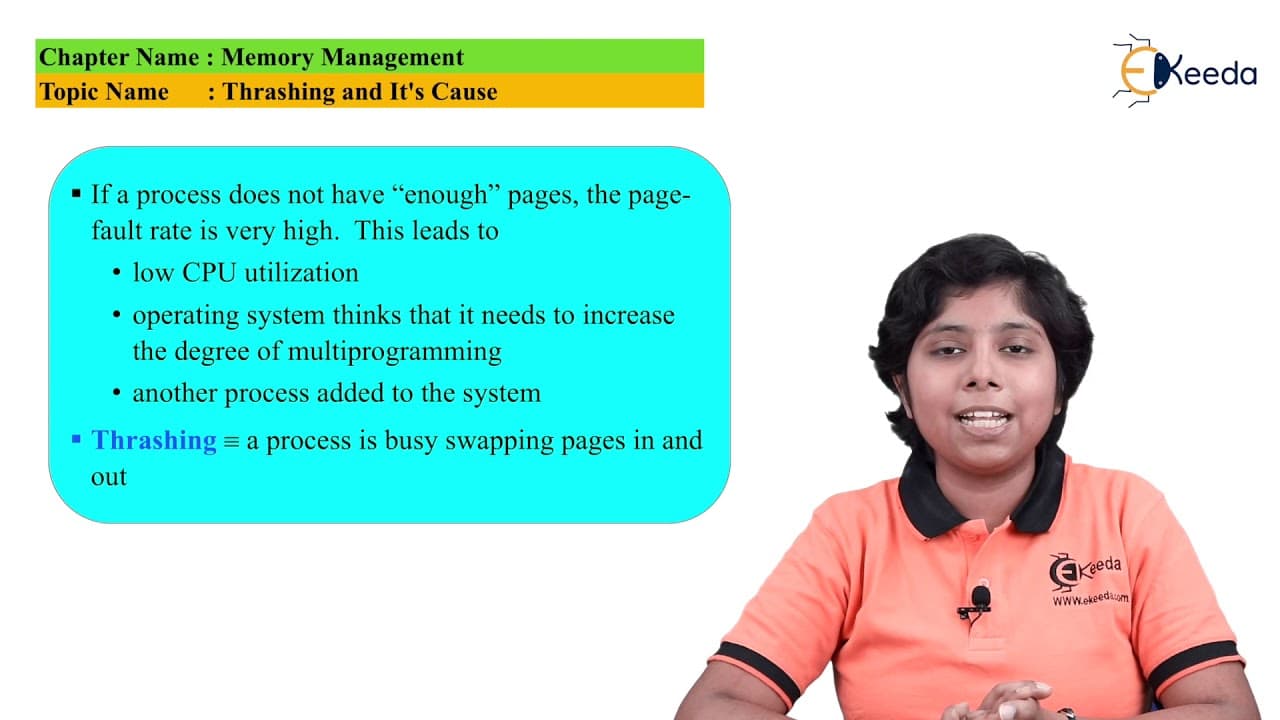
TL;DR
Thrashing occurs in operating systems when inadequate frame allocation leads to excessive paging activity, hindering process execution. It often results from a high degree of multiprogramming. Solutions include using local page replacement algorithms and working set strategies to minimize page faults and improve performance.
Transcript
click the Bell icon to get latest videos from akira hello friends today we will discuss about an issue related to the allocation of frames and which is known as thrashing what is thrashing and we will know the cause behind thrashing and how thrashing depends on the degree of multi-programming and how it is resolved with the local replacement algori... Read More
Key Insights
- ✋ Thrashing in operating systems results from high paging activity hindering process execution.
- 🥺 Inadequate frame allocation leads to frequent page swaps and system slowdowns.
- 😫 Local replacement algorithms and working set strategies help resolve thrashing issues.
- ❓ Thrashing can be caused by an increase in the degree of multiprogramming.
- ❓ Thrashing impacts system throughput and CPU utilization.
- ❓ The degree of multiprogramming affects system performance and thrashing occurrence.
- 📟 Using a local page replacement algorithm can prevent thrashing to some extent.
Install to Summarize YouTube Videos and Get Transcripts
Explore YouTube Video Summarizer or Get YouTube Transcript Extractor
Questions & Answers
Q: What is thrashing in operating systems?
Thrashing refers to high paging activity hindering process execution due to inadequate frame allocation, leading to excessive page swaps and system slowdowns.
Q: How can thrashing be resolved?
Thrashing can be resolved by implementing local replacement algorithms and working set strategies, ensuring adequate frame allocation to prevent frequent page swaps and improve system performance.
Q: What causes thrashing in operating systems?
Thrashing is caused by high paging activities without executing processes, often triggered by inadequate frame allocation and an increase in the degree of multiprogramming.
Q: How do local replacement algorithms help prevent thrashing?
Local replacement algorithms restrict process fetches from other processes, preventing thrashing by optimizing memory access time and minimizing page swap delays.
Summary & Key Takeaways
-
Thrashing in operating systems refers to high paging activity hindering process execution.
-
It occurs when inadequate frame allocation leads to frequent page swaps.
-
Resolution methods include local replacement and working set strategies.
Read in Other Languages (beta)
Share This Summary 📚
Summarize YouTube Videos and Get Video Transcripts with 1-Click
Try YouTube Summary with ChatGPT & Claude or YouTube Transcript Generator
Explore More Summaries from Ekeeda 📚






Summarize YouTube Videos and Get Video Transcripts with 1-Click
Try YouTube Summary with ChatGPT & Claude or YouTube Transcript Generator