What Is Covariance and How Does It Classify Relationships?
TL;DR
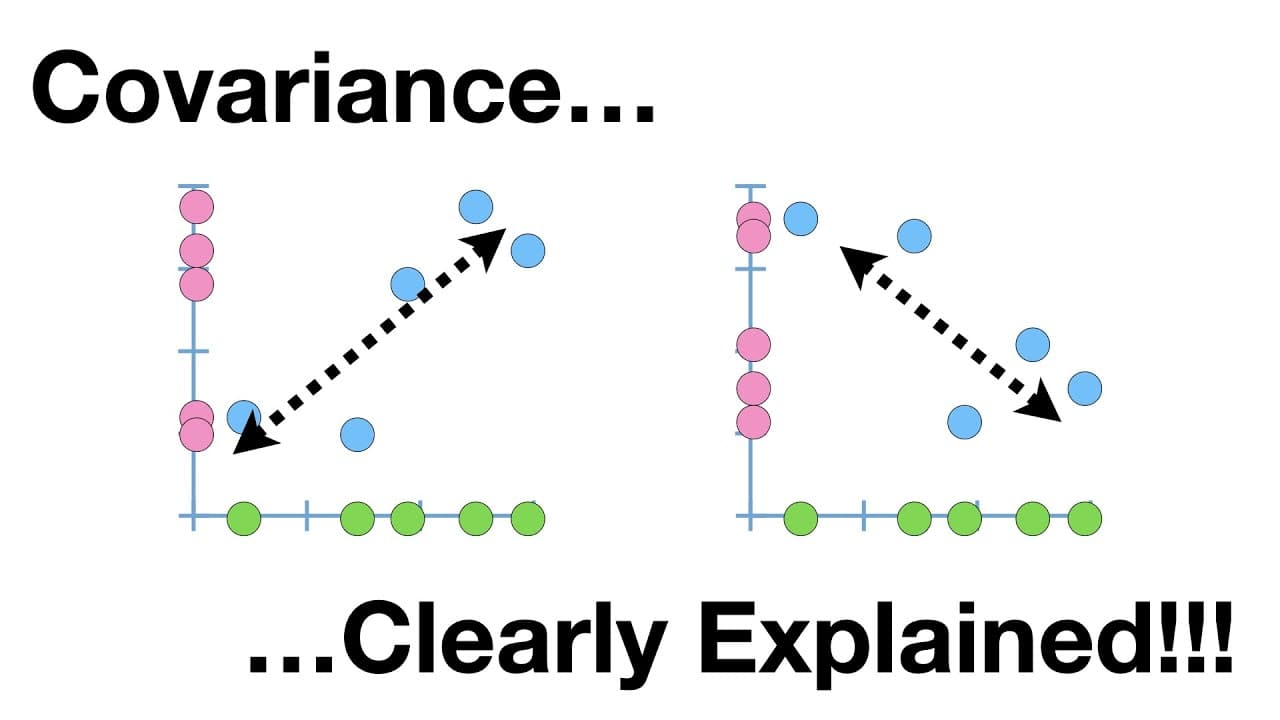
Covariance is a statistical measure that classifies the relationship between two variables as positive, negative, or nonexistent. A positive covariance indicates that when one variable increases, the other tends to increase as well, while a negative covariance suggests the opposite. A value of zero indicates no relationship, making covariance a useful but sometimes difficult-to-interpret tool in statistical analysis.
Transcript
my cat can't do stats in the window so I'll do stats walk low all day long stack quest hello I'm Josh stormer and welcome to stack quest today we're going to talk about covariance and this is part 1 in a two-part series on covariance and correlation note this stack quest assumes that you are already familiar with the concept of variance if not chec... Read More
Key Insights
- ⚾ Covariance helps classify relationships between variables based on the trend of their measurements.
- 💄 The scale of the data can affect the covariance value, making it challenging to compare between different datasets.
- 🥌 Covariance is a stepping stone to calculating correlation, which is a more reliable measure of the strength and direction of a relationship.
Install to Summarize YouTube Videos and Get Transcripts
Explore YouTube Video Summarizer or Get YouTube Transcript Extractor
Questions & Answers
Q: How does covariance help classify relationships between variables?
Covariance allows us to understand whether the relationship between two variables is positive, negative, or non-existent. This helps in analyzing patterns and trends in data.
Q: Why is covariance difficult to interpret?
Covariance is sensitive to the scale of the data, making it challenging to compare values between different data sets. It does not provide information about how close the data points are to the trend line.
Q: What is the difference between positive and negative covariance?
Positive covariance means that as one variable increases, the other variable also tends to increase. Negative covariance indicates that as one variable increases, the other variable tends to decrease.
Q: How is covariance calculated?
Covariance is calculated by taking the difference between each measurement and the mean value, multiplying these differences together, and then summing them up. This value is then divided by the number of measurements minus one.
Key Insights:
- Covariance helps classify relationships between variables based on the trend of their measurements.
- The scale of the data can affect the covariance value, making it challenging to compare between different datasets.
- Covariance is a stepping stone to calculating correlation, which is a more reliable measure of the strength and direction of a relationship.
- Covariance is useful in various statistical analyses, such as principal component analysis (PCA) and other computational settings.
Summary & Key Takeaways
-
Covariance is a way to analyze the relationship between two variables by comparing their measurements in pairs.
-
Positive covariance indicates that when one variable increases, the other variable also tends to increase.
-
Negative covariance indicates that when one variable increases, the other variable tends to decrease.
-
A covariance value of zero suggests that there is no relationship between the variables.
Read in Other Languages (beta)
Share This Summary 📚
Summarize YouTube Videos and Get Video Transcripts with 1-Click
Try YouTube Summary with ChatGPT & Claude or YouTube Transcript Generator
Explore More Summaries from StatQuest with Josh Starmer 📚


Summarize YouTube Videos and Get Video Transcripts with 1-Click
Try YouTube Summary with ChatGPT & Claude or YouTube Transcript Generator