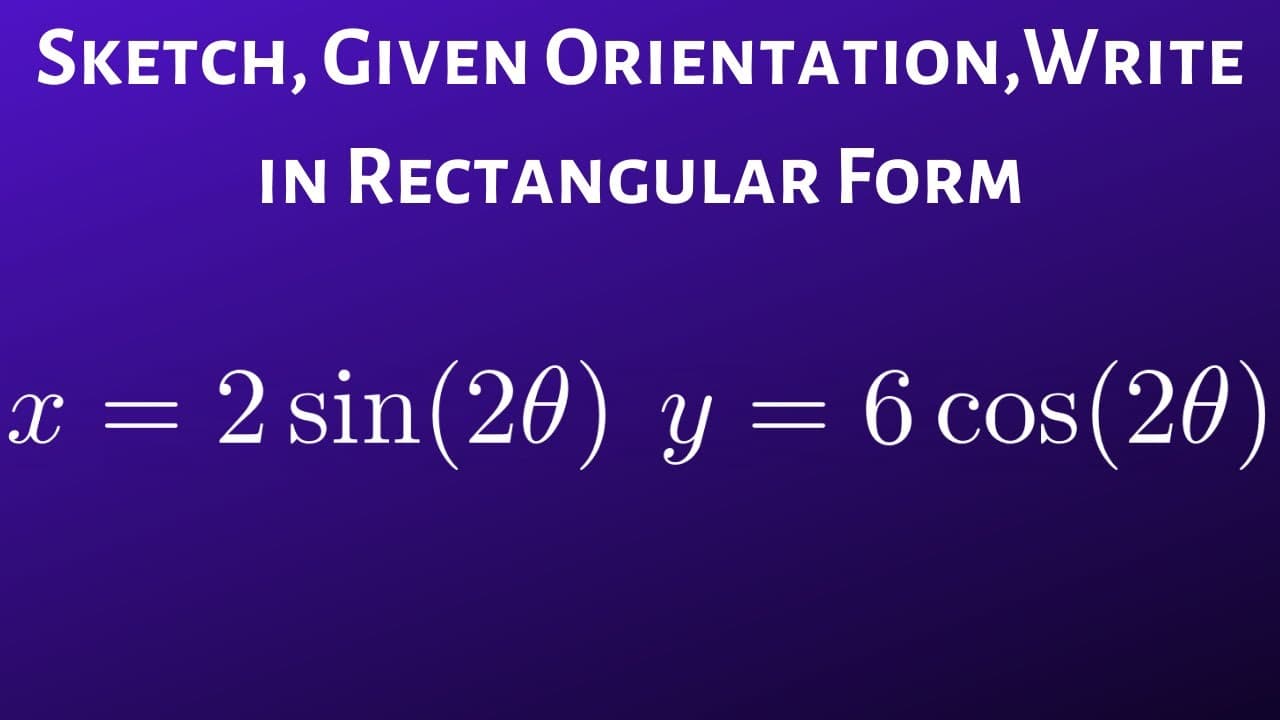
Graph the Parametric Equations(Ellipse), Give Orientation, and Give the Rectangular Form
TL;DR
Solving trig functions, using identities, and graphing ellipses with orientations explained.
Transcript
this problem we have to write these parametric equations in rectangular form and give a sketch and indicate the orientation let's go ahead and work through it solution so whenever you have trig functions like this the strategy is to solve for the trig functions and then use an identity so to solve the first equation for sine of two theta we'll just... Read More
Key Insights
- ❓ Converting parametric equations involves solving trig functions and applying trigonometric identities to simplify the equation.
- 🫚 Graphing an ellipse requires identifying the major and minor axes based on the square roots of the numbers in the equation.
- 😥 Determining the orientation of the ellipse graph is crucial to understand the direction in which the points move.
- 😒 The use of intermediate values of theta, such as π/4, helps in establishing the correct orientation of the ellipse graph.
Install to Summarize YouTube Videos and Get Transcripts
Explore YouTube Video Summarizer or Get YouTube Transcript Extractor
Questions & Answers
Q: How do you convert parametric equations into rectangular form?
By solving trig functions like sine and cosine, and using trigonometric identities, such as the sine-squared plus cosine-squared identity, the conversion can be achieved. This results in a rectangular equation representing the graph.
Q: What are the steps to graph an ellipse?
To graph an ellipse, determine the major axis by finding the larger square root value. Plot the major axis vertically or horizontally based on the bigger number location. Then plot the minor axis using the smaller square root value.
Q: How do you find the orientation of the graph of an ellipse?
To determine the orientation, create a table of values by plugging in selected angles like 0, π/2, and π. By observing the direction in which the points move, the orientation of the ellipse can be determined, whether clockwise or counterclockwise.
Q: Why is it important to select intermediate angles in determining the orientation of the graph?
Choosing intermediate angles, such as π/4, helps in identifying the continuous movement of points to establish the correct orientation of the ellipse. Without these values, the orientation might appear ambiguous or incorrect.
Summary & Key Takeaways
-
Converting parametric equations into rectangular form involves solving trig functions and applying identities.
-
Graphing an ellipse involves finding the major and minor axes based on the square roots of the numbers.
-
Determining the orientation of the graph is achieved by selecting intermediate values for theta.
Read in Other Languages (beta)
Share This Summary 📚
Summarize YouTube Videos and Get Video Transcripts with 1-Click
Try YouTube Summary with ChatGPT & Claude or YouTube Transcript Generator
Explore More Summaries from The Math Sorcerer 📚

Summarize YouTube Videos and Get Video Transcripts with 1-Click
Try YouTube Summary with ChatGPT & Claude or YouTube Transcript Generator