Number of solutions to linear equations | Linear equations | Algebra I | Khan Academy
TL;DR
Learn how to determine whether an equation has one solution, infinite solutions, or no solutions.
Transcript
Determine the number of solutions for each of these equations, and they give us three equations right over here. And before I deal with these equations in particular, let's just remind ourselves about when we might have one or infinite or no solutions. You're going to have one solution if you can, by solving the equation, come up with something lik... Read More
Key Insights
- ☺️ Equations with a specific value for x have one solution.
- ❓ Equations that simplify to something nonsensical have no solutions.
- ❓ Equations that result in a statement that is always true have infinite solutions.
- #️⃣ One can determine the number of solutions by analyzing the properties of the equation.
- 🍉 It is possible to manipulate equations to eliminate terms and solve for x.
- 🙃 Dividing both sides of an equation by a non-zero number is an acceptable operation.
- #️⃣ It is essential to consider the simplification of equations to determine the number of solutions.
Install to Summarize YouTube Videos and Get Transcripts
Explore YouTube Video Summarizer or Get YouTube Transcript Extractor
Questions & Answers
Q: How can you determine if an equation has one solution?
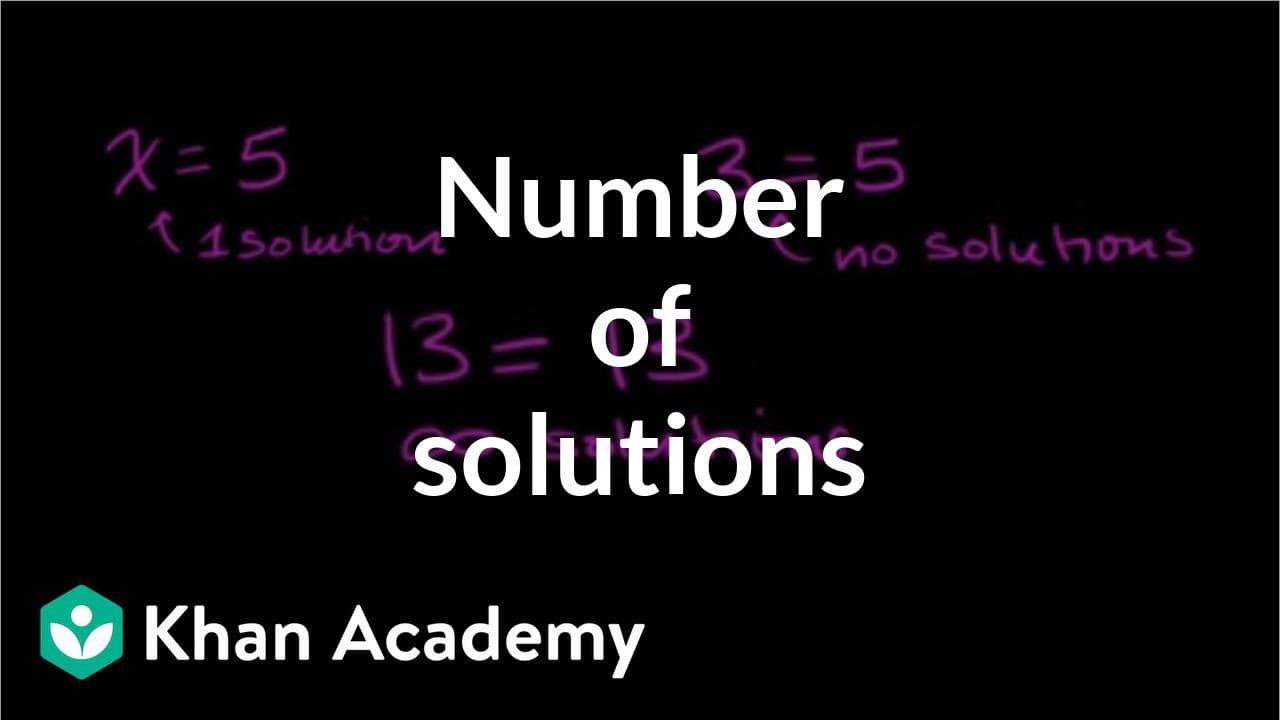
An equation has one solution if you can solve it and find a specific value for x, such as x = 5 or x = -pi.
Q: What happens if an equation simplifies to something nonsensical, such as 3 = 5?
If an equation simplifies to something absurd like 3 = 5, it means there are no solutions. No value of x can make 3 equal to 5.
Q: In what situation does an equation have infinite solutions?
An equation has infinite solutions if it results in a statement that is always true, such as x = x. Any value of x will make this statement true.
Q: Can you provide examples of the three scenarios?
Sure! An equation like -7x = -7x has infinite solutions, while an equation like -7x + 3 = -7x has no solutions. An equation like -7x + 3 = 2x - 1 has one solution, which is x = 1/9.
Summary & Key Takeaways
-
Equations with a specific value for x have one solution, while equations that simplify to something absurd have no solutions.
-
Equations that result in a statement that is always true, regardless of the value of x, have infinite solutions.
-
By analyzing three different equations, we can see examples of each scenario - one solution, no solutions, and infinite solutions.
Read in Other Languages (beta)
Share This Summary 📚
Summarize YouTube Videos and Get Video Transcripts with 1-Click
Try YouTube Summary with ChatGPT & Claude or YouTube Transcript Generator
Explore More Summaries from Khan Academy 📚



Summarize YouTube Videos and Get Video Transcripts with 1-Click
Try YouTube Summary with ChatGPT & Claude or YouTube Transcript Generator