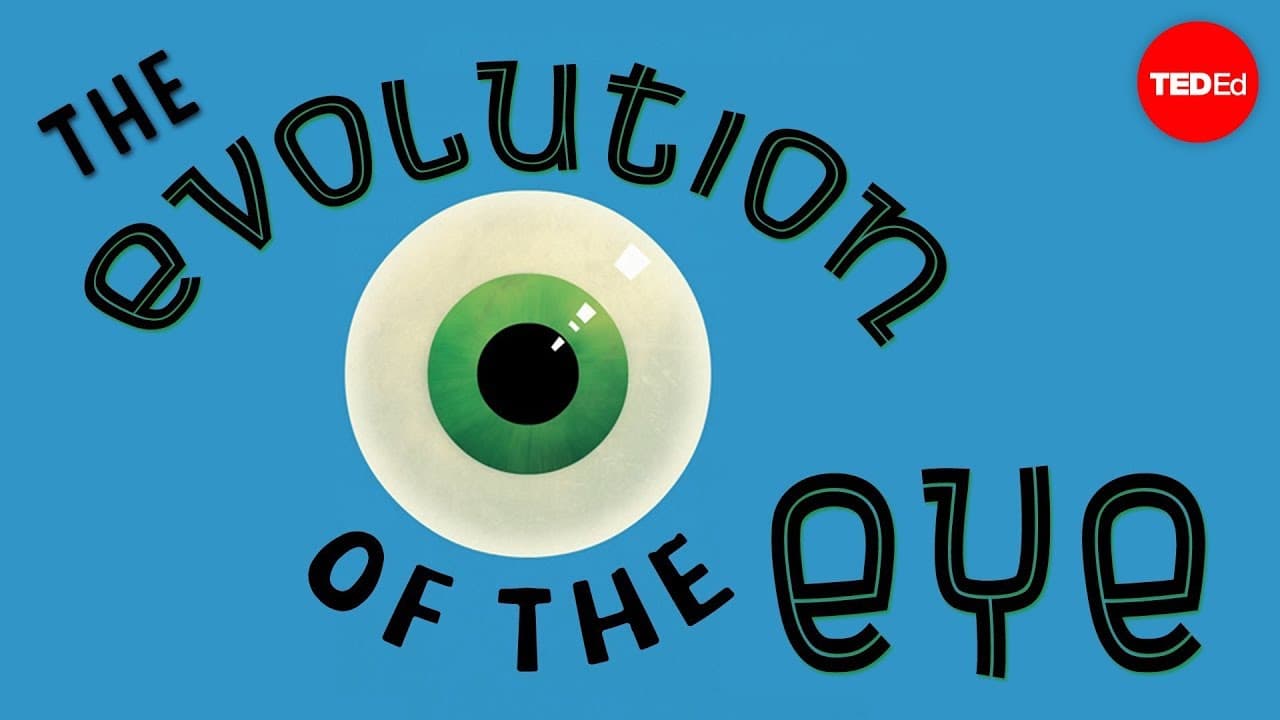
The evolution of the human eye - Joshua Harvey
TL;DR
The human eye's evolution from simple light spots to complex structures showcases remarkable adaptability and functionality.
Transcript
The human eye is an amazing mechanism, able to detect anywhere from a few photons to direct sunlight, or switch focus from the screen in front of you to the distant horizon in a third of a second. In fact, the structures required for such incredible flexibility were once considered so complex that Charles Darwin himself acknowledged that the ide... Read More
Key Insights
- 😃 The human eye's evolution showcases remarkable adaptability and functionality.
- 🙂 Evolutionary steps from light spots to complex structures improved light sensing and focusing.
- 😃 Additional eye structures like the iris and lens allowed for adaptability and enhanced vision.
- 😃 Brain adaptations accompanied the evolution of the human eye for better processing of visual information.
- 📺 Other animals display diverse eye adaptations for specialized functions like night vision and dual vision.
- 😃 The human eye's evolution involves a step-by-step process with traces of its evolutionary history.
- 😃 Ongoing research is exploring biomechanical implants based on eye structures to aid the vision-impaired.
Install to Summarize YouTube Videos and Get Transcripts
Explore YouTube Video Summarizer or Get YouTube Transcript Extractor
Questions & Answers
Q: How did the human eye's evolution start?
The human eye's evolution began with a simple light spot in single-celled organisms, gradually developing into more complex structures in organisms like flatworms to enhance light sensing and direction detection.
Q: What role did the pinhole effect play in the evolution of the human eye?
The pinhole effect significantly improved resolution and focusing in the human eye, leading to the development of a lens that allowed for adaptability to near and far vision, marking a key step in its evolution.
Q: What additional structures evolved alongside the human eye?
Throughout the human eye's evolution, additional structures like the iris, sclera, and tear glands developed to support and maintain its functionality, along with brain adaptations to process visual information more efficiently.
Q: How do the eyes of other animals showcase diverse adaptations?
Various animals, like cephalopods, cats, and the four-eyed fish, have evolved unique eye adaptations for specific functions such as night vision, dual vision in different environments, and minimizing blind spots.
Summary & Key Takeaways
-
The human eye's evolution began with a simple light spot in single-celled organisms, progressing to more complex structures in organisms like flatworms for better light sensing and direction detection.
-
Over time, the pinhole effect improved resolution and focusing, leading to the development of a lens that allowed for adaptability to near and far vision.
-
The evolution of the eye also involved the development of additional structures like the iris, sclera, and tear glands, along with brain adaptations to process visual information more effectively.
Read in Other Languages (beta)
Share This Summary 📚
Summarize YouTube Videos and Get Video Transcripts with 1-Click
Try YouTube Summary with ChatGPT & Claude or YouTube Transcript Generator
Explore More Summaries from TED-Ed 📚




Summarize YouTube Videos and Get Video Transcripts with 1-Click
Try YouTube Summary with ChatGPT & Claude or YouTube Transcript Generator