Foxholes (Military Tactic)
TL;DR
From World War I to present day, infantry tactics have evolved to counter more mobile warfare, leading to the adoption of the foxhole concept for temporary shelter and defense.
Transcript
foxholes military tactic world war ii to present day world war one had quickly degenerated into a conflict of mostly static land warfare based around extensive networks of defensive trenches these were elaborate fortifications that were semi-permanent and took a great deal of time and effort to construct as well as a fair degree of engineering expe... Read More
Key Insights
- 🥺 Trench warfare in World War I led to the need for better infantry cover.
- 🚗 Tanks and aircraft introduced more mobile warfare in World War II.
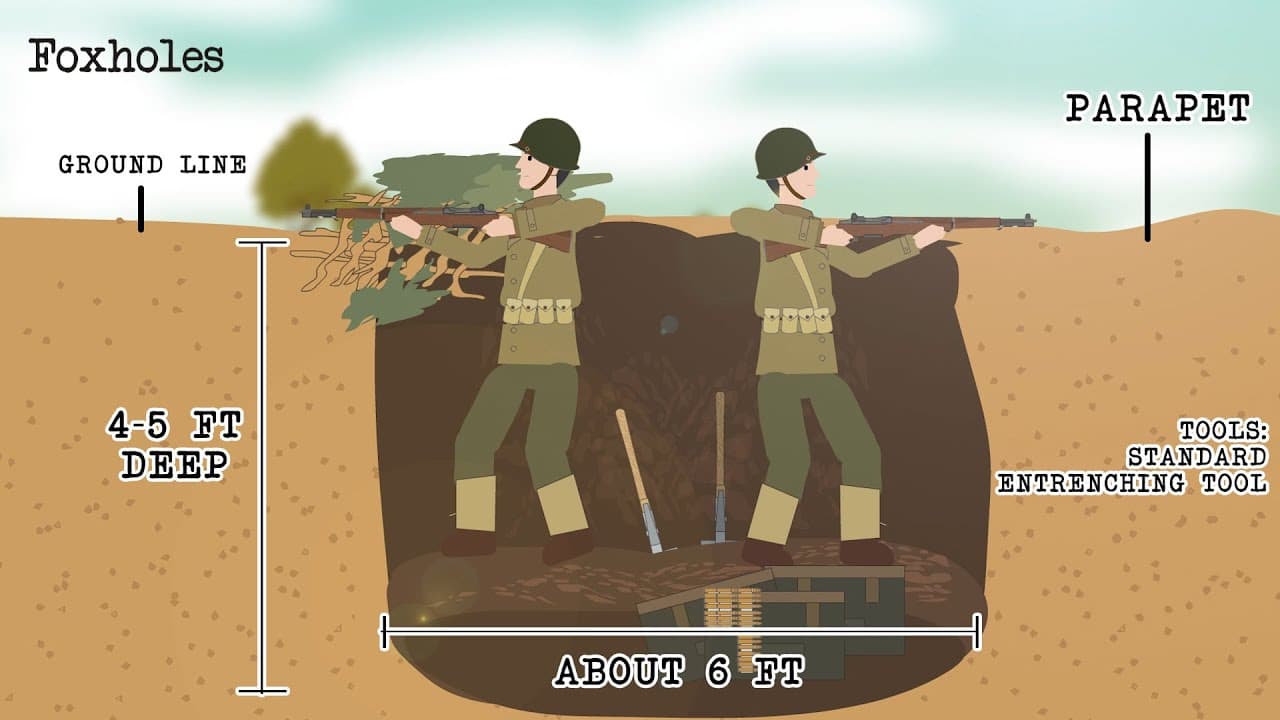
- 👊 The foxhole concept provided temporary shelter and defense against artillery and tank attacks.
- 🦛 The Germans used turret foxholes, while the Japanese developed octopus pots for different purposes.
- 🧘 Foxholes are still used in modern armies for defensive positions.
- 🦾 Mechanical diggers and explosive charges are now commonly used for constructing foxholes.
- ⌛ The shape and camouflage of foxholes have evolved over time.
Install to Summarize YouTube Videos and Get Transcripts
Explore YouTube Video Summarizer or Get YouTube Transcript Extractor
Questions & Answers
Q: How did World War I influence the need for infantry cover?
World War I showcased the devastating effects of artillery and machine guns, leading to the need for infantry to have meaningful cover from these weapons.
Q: What was the downside of the shell scrape approach?
The shell scrape approach offered minimal protection against firearms and tanks, resulting in soldiers getting crushed by tanks if they overran their positions.
Q: How was the foxhole different from the shell scrape?
The foxhole was a deeper pit designed to hold one or two men, providing better protection against artillery fire and allowing occupants to crouch under tank attacks.
Q: What were some variations of the foxhole concept?
The Germans used turrets on top of their foxholes for added permanence, and the Japanese developed octopus pots, which were shallow and better concealed one-man foxholes used for ambushes.
Summary & Key Takeaways
-
World War I introduced static trench warfare; World War II saw the emergence of more mobile warfare with tanks and aircraft.
-
The shell scrape approach proved ineffective, leading to the adoption of the foxhole concept for better protection against small arms fire and tank attacks.
-
Other variations of foxholes, such as the German turret foxholes and the Japanese octopus pots, were developed for different purposes.
Read in Other Languages (beta)
Share This Summary 📚
Summarize YouTube Videos and Get Video Transcripts with 1-Click
Try YouTube Summary with ChatGPT & Claude or YouTube Transcript Generator
Explore More Summaries from Simple History 📚



Summarize YouTube Videos and Get Video Transcripts with 1-Click
Try YouTube Summary with ChatGPT & Claude or YouTube Transcript Generator