Constructing a linear function word problem
TL;DR
The content explains how to model the number of gallons of water in a draining bathtub as a function of time using slope-intercept form.
Transcript
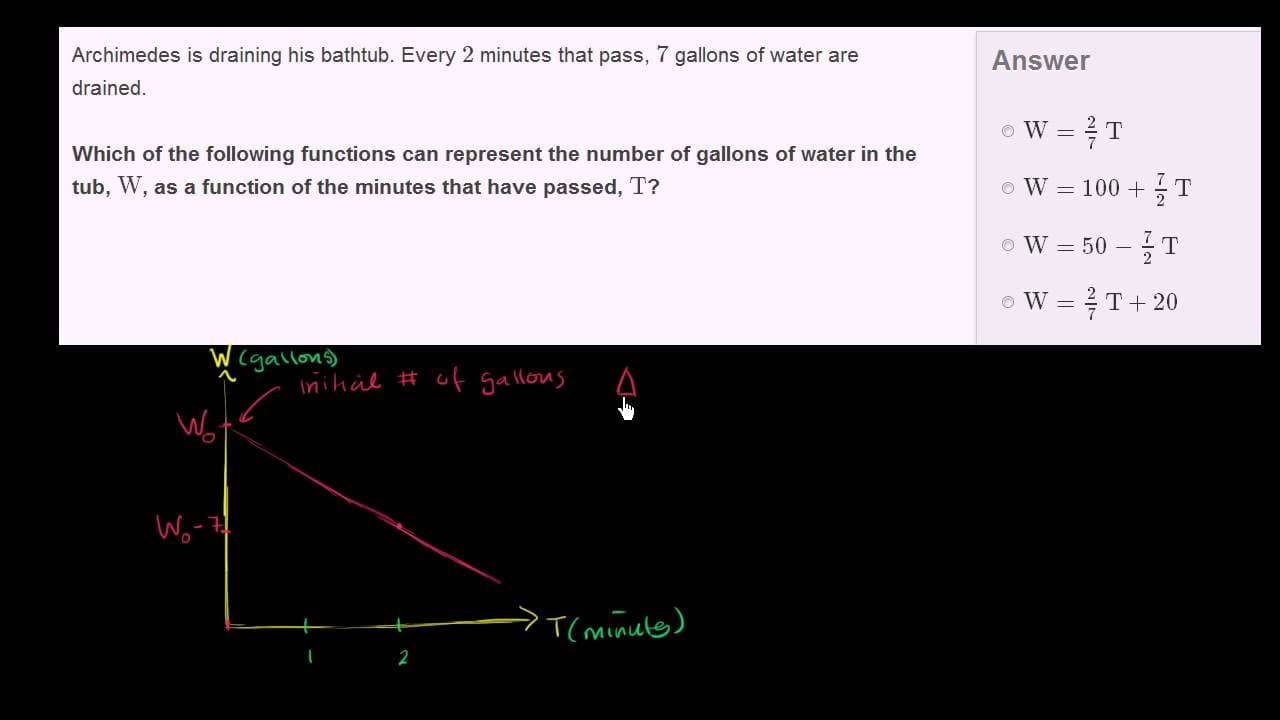
Archimedes is draining his bathtub. Every 2 minutes that pass, 7 gallons of water are drained. Which of the following functions can represent the number of gallons of water in the tub, W, as a function of the minutes that have passed, T? So let's think about this visually. So let's plot the number of gallons of water we have. Let's put that in the ... Read More
Key Insights
- 💦 Modeling the number of gallons of water in a draining bathtub can be done using a linear equation.
- 🫡 The slope of the line represents the rate of change of gallons with respect to time.
- 🤽 The y-intercept of the equation represents the initial volume of water in the tub.
- 🦖 The equation W = -7/2T + W0 satisfies the conditions given in the content.
- 🆘 Understanding the concept of slopes and intercepts helps to determine the correct equation.
- ⌛ Other equation choices do not match the pattern of decreasing number of gallons with time.
- 📈 The content emphasizes the graph and the visual representation of the function.
Install to Summarize YouTube Videos and Get Transcripts
Explore YouTube Video Summarizer or Get YouTube Transcript Extractor
Questions & Answers
Q: How does the number of gallons change with respect to time in a draining bathtub?
The number of gallons decreases linearly with respect to time at a rate of 7 gallons every 2 minutes. This is represented by the negative slope of the line.
Q: What does the initial volume of water in the tub represent?
The initial volume of water, denoted as W0, represents the number of gallons in the tub at time T = 0. It is the y-intercept of the function.
Q: Which equation correctly models the number of gallons of water in the tub as a function of time?
The equation W = -7/2T + W0 correctly models the number of gallons as it satisfies the requirement of starting with an initial number of gallons and decreasing as time passes.
Q: What is the significance of the slope in the equation?
The slope of -7/2 represents the rate of change of the number of gallons with respect to time. It indicates that for every 2 minutes time increases, the number of gallons decreases by 7.
Summary & Key Takeaways
-
Archimedes is draining his bathtub, with 7 gallons of water drained every 2 minutes.
-
The content visually represents the number of gallons of water in the tub as a function of time.
-
The equation used to model the function is W = -7/2T + W0, where W is the number of gallons and T is the time in minutes.
Read in Other Languages (beta)
Share This Summary 📚
Summarize YouTube Videos and Get Video Transcripts with 1-Click
Try YouTube Summary with ChatGPT & Claude or YouTube Transcript Generator
Explore More Summaries from Khan Academy 📚



Summarize YouTube Videos and Get Video Transcripts with 1-Click
Try YouTube Summary with ChatGPT & Claude or YouTube Transcript Generator