Physics, Kinematics, Free Fall (5 of 12) Solving for Displacement (Distance Fallen)
TL;DR
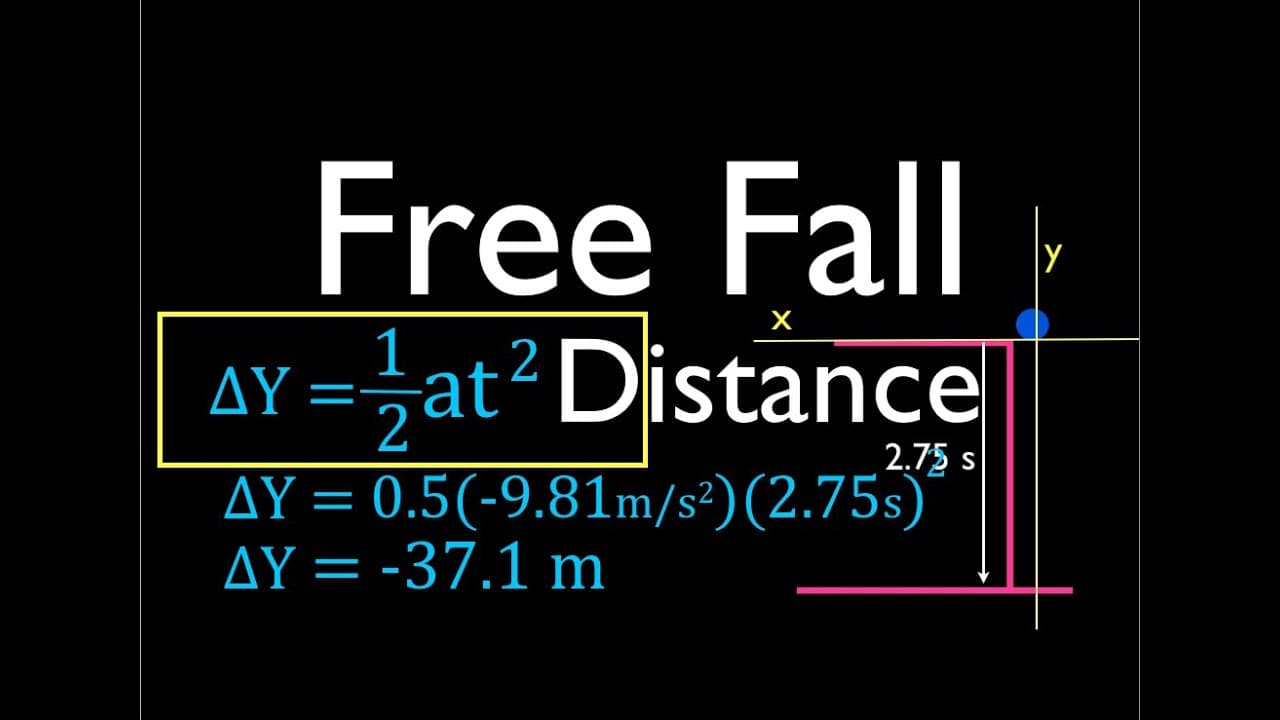
Calculate the height of an object dropped from a cliff using kinematic equations in freefall.
Transcript
okay in today's video I'm gonna go over a problem using one-dimensional kinematics for freefall and in this video we're going to calculate the height to which an object falls if we know the time it takes for the object to fall and here's the problem that we have Billy's standing at the edge of a lake as if a cliff that overlooks a lake it picks up ... Read More
Key Insights
- 📉 Freefall involves the downward motion of an object under gravity's influence, leading to a constant acceleration of 9.81 m/s^2.
- 👻 Understanding the initial velocity, time, and acceleration allows for the application of kinematic equations to solve freefall problems.
- 🤘 Properly distinguishing between positive and negative signs helps accurately represent motion direction in freefall scenarios.
- ⚾ Selecting the correct kinematic equation based on the known variables is crucial for efficient problem-solving.
- 🧘 The change in position, representing the height in freefall problems, can be determined using the equation 1/2 a T^2.
- 🧘 Simplifying the kinematic equation by considering an initial velocity of 0 simplifies the calculation for the change in position in freefall.
- 🧘 The height of a cliff or object can be calculated by applying the principles of freefall kinematics and solving for the change in position.
Install to Summarize YouTube Videos and Get Transcripts
Explore YouTube Video Summarizer or Get YouTube Transcript Extractor
Questions & Answers
Q: How is freefall defined in physics?
Freefall refers to the motion of an object under the sole influence of gravity, with no other forces acting on it. This results in an acceleration equal to the acceleration due to gravity, typically denoted as 9.81 m/s^2 on Earth.
Q: What are the key variables in solving freefall kinematics problems?
The key variables are time, initial velocity, acceleration, and change in position (height in this case). By understanding and manipulating these variables using kinematic equations, one can determine the desired quantities.
Q: Why is it essential to distinguish between positive and negative signs in freefall problems?
Distinguishing between positive and negative signs is crucial to accurately represent the direction of motion in freefall. Objects falling downwards are often assigned negative values to indicate the downward direction of acceleration and displacement.
Q: How does the choice of the kinematic equation impact solving freefall problems?
Choosing the appropriate kinematic equation based on the known variables is essential for solving freefall problems efficiently. By selecting the equation that aligns with the given information, one can simplify the problem and derive the solution effectively.
Summary & Key Takeaways
-
Using kinematic equations for freefall, calculate the height of an object dropped from a cliff in mathematical steps.
-
Understand the variables involved such as time, acceleration, and initial velocity in solving such problems.
-
Utilize the appropriate kinematic equation to find the change in position and determine the height of the cliff.
Read in Other Languages (beta)
Share This Summary 📚
Summarize YouTube Videos and Get Video Transcripts with 1-Click
Try YouTube Summary with ChatGPT & Claude or YouTube Transcript Generator
Explore More Summaries from Step by Step Science 📚



Summarize YouTube Videos and Get Video Transcripts with 1-Click
Try YouTube Summary with ChatGPT & Claude or YouTube Transcript Generator