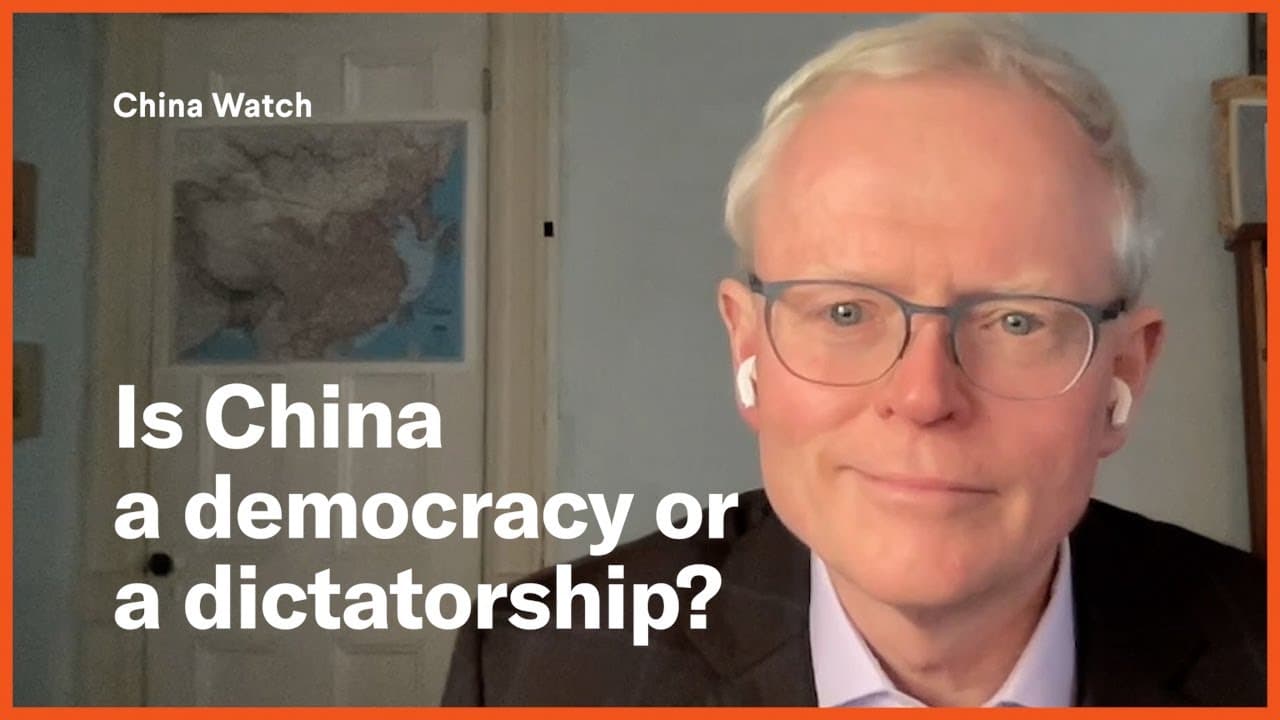
Is China a democracy or a dictatorship?
TL;DR
China is a one-party state with limited democratic features.
Transcript
Define your terms. Well, it's not a democracy in that people cannot vote for their leaders. It's not a dictatorship. Maybe that conjures up images of Hitler or Mussolini. It's not really that either. You have a strong leader at the top of a Communist Party or a one party state. And this leader, Xi Jinping, he doesn't have absolute power, but he has... Read More
Key Insights
- China is not a democracy in the traditional sense as citizens cannot vote for their leaders, but it is also not a dictatorship like those of historical tyrants.
- The Chinese Communist Party (CCP) claims to be a democracy, drawing from the May 4th Movement, but it lacks the electoral features typical of democracies.
- Freedom of speech is constitutionally guaranteed, but the actual scope for expression has narrowed significantly in recent years.
- Historically, China experienced a period of liberalization post-1970s, allowing economic reforms and some degree of expression, but this has been curtailed since the 2008 Beijing Olympics.
- The CCP maintains control through a large membership base, yet the majority of China's population, including many party members, have little influence over leadership decisions.
- Constructive criticism is tolerated by the CCP, especially when it addresses concrete issues like unpaid wages, but broader political dissent is not welcomed.
- Chinese citizens may not desire Western-style democracy but seek a system where the government listens to their concerns and ensures stability and prosperity.
- The CCP's legitimacy is partly based on its ability to deliver economic growth and stability, raising questions about the future if these goals are not met.
Install to Summarize YouTube Videos and Get Transcripts
Explore YouTube Video Summarizer or Get YouTube Transcript Extractor
Questions & Answers
Q: Is China a democracy or a dictatorship?
China is neither a democracy nor a dictatorship in the traditional sense. While citizens cannot vote for their leaders, which is a hallmark of democracy, the country is also not a dictatorship in the mold of historical tyrants. Instead, it is best described as a one-party state led by the Communist Party with a strong leader at the top.
Q: Why does China say it’s a democracy?
China claims to be a democracy by drawing on historical movements like the May 4th Movement, which advocated for democracy and science. The Communist Party seeks to associate itself with these enlightened ideals, despite lacking the electoral features typical of democracies. This claim is part of the party's effort to maintain legitimacy and align itself with progressive historical narratives.
Q: Is dissent allowed in China?
Dissent in China is limited. While the constitution guarantees freedom of speech, the actual scope for expressing dissent has been significantly curtailed, especially since the 2008 Beijing Olympics. The government tolerates some constructive criticism, particularly when it addresses specific issues, but broader political dissent is not welcomed and can be met with severe consequences.
Q: Why is freedom of expression limited in China?
Freedom of expression in China is limited due to the government's desire to maintain control and stability. Historically, there was more room for debate and discussion, but since around 2008, the Communist Party has tightened its grip on political discourse. This is part of a broader strategy to prevent challenges to its authority and ensure that dissent does not threaten the party's rule.
Q: Does the Chinese public have a say in how the country is run?
The Chinese public has limited influence over the country's governance. While there are about 90 million Communist Party members, this represents a small fraction of the 1.4 billion population. Even party members have little say in leadership decisions, as there are no mechanisms like primaries or elections to choose leaders. The party controls all facets of life, limiting public input.
Q: Can people voice concerns to the Chinese government?
Yes, people can voice concerns to the Chinese government, particularly if they involve concrete issues like unpaid wages. The Communist Party is somewhat tolerant of constructive criticism that addresses specific problems. However, broader political dissent or challenges to the party's authority are not tolerated and can lead to severe repercussions.
Q: If not democracy, then what do the Chinese people want?
Many Chinese people may not desire Western-style democracy but seek a political system where the government listens to their concerns and ensures stability and prosperity. They want a participatory system where their voices are heard, and their lives improve, rather than a system focused solely on electoral voting. The CCP's ability to deliver economic growth has been a key factor in maintaining its legitimacy.
Q: What is the future challenge for China's political system?
The future challenge for China's political system is maintaining legitimacy if it cannot continue to deliver economic growth and stability. The Communist Party's rule has been justified by its ability to improve living standards and ensure prosperity. If economic growth falters or stability is threatened, the party may face increased pressure and potential challenges to its authority from the public.
Summary & Key Takeaways
-
China's political system is characterized by a one-party state led by the Communist Party, which claims democratic legitimacy but lacks traditional electoral features. Citizens have limited freedom to express opinions as the scope for debate has narrowed in recent years.
-
Historically, China has seen periods of liberalization, especially post-1970s, which allowed economic reforms and some expression. However, since the 2008 Olympics, the CCP has cracked down on dissent and tightened control over political discourse.
-
While the CCP tolerates some constructive criticism, broader dissent is not allowed. Many Chinese citizens seek a system where their voices are heard and stability is ensured, rather than a Western-style democracy with electoral voting.
Read in Other Languages (beta)
Share This Summary 📚
Summarize YouTube Videos and Get Video Transcripts with 1-Click
Try YouTube Summary with ChatGPT & Claude or YouTube Transcript Generator
Explore More Summaries from Council on Foreign Relations 📚

Summarize YouTube Videos and Get Video Transcripts with 1-Click
Try YouTube Summary with ChatGPT & Claude or YouTube Transcript Generator