Strong acid–strong base titrations | Acids and bases | AP Chemistry | Khan Academy
TL;DR
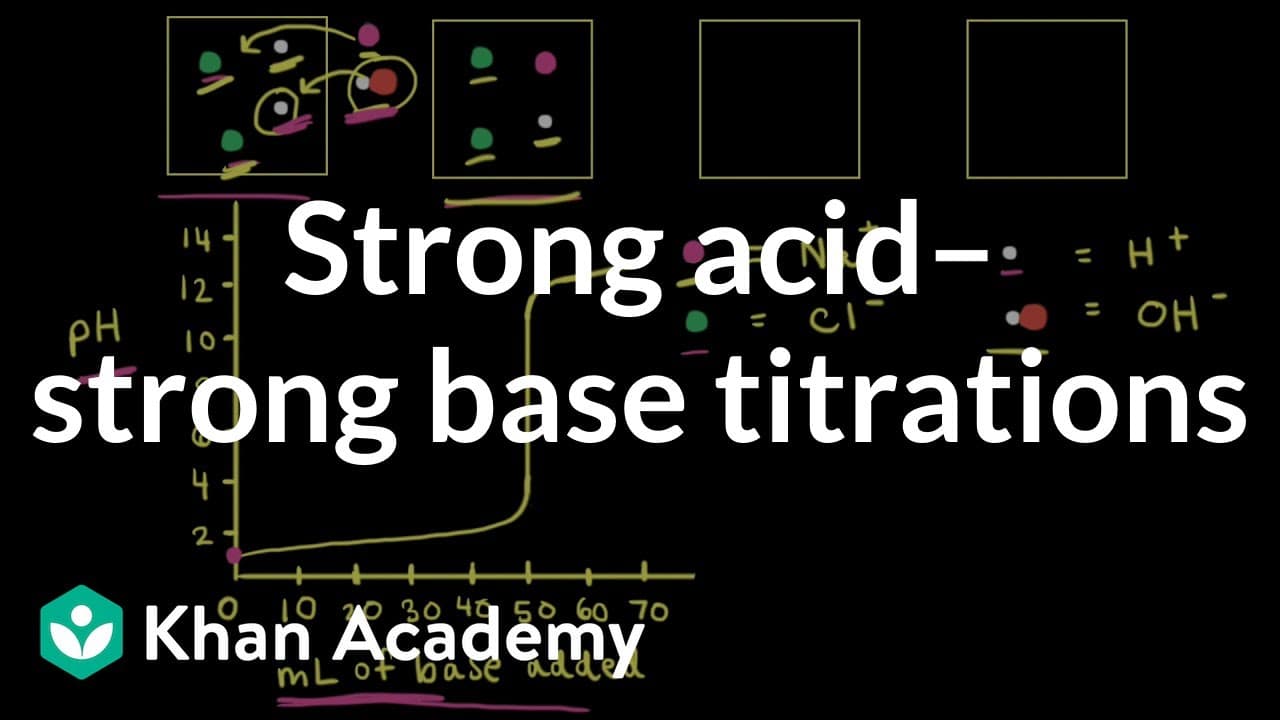
This content explains the process of titration for strong acid-strong base reactions and how to analyze titration curves to determine the concentration of the acid or base.
Transcript
- [Instructor] Hydrochloric acid is an example of a strong acid and sodium hydroxide is an example of a strong base. Let's say we are titrating an unknown concentration of hydrochloric acid with a known concentration of sodium hydroxide. Let's say it's .20 molar. Because we know the concentration of sodium hydroxide, we call that the titrant. And b... Read More
Key Insights
- 💪 Hydrochloric acid and sodium hydroxide are examples of strong acid and strong base, respectively, in a strong acid-strong base titration.
- 💪 The complete ionic equation for the reaction shows the dissociation of the strong acid and strong base, while the net ionic equation represents the reaction without spectator ions.
- 😥 Titration curves plot the pH against the volume of titrant added, and the equivalence point has a pH of 7.
- 🔺 The steepness of the titration curve around the equivalence point indicates that small amounts of base cause significant changes in pH.
Install to Summarize YouTube Videos and Get Transcripts
Explore YouTube Video Summarizer or Get YouTube Transcript Extractor
Questions & Answers
Q: What is the titrant and analyte in a strong acid-strong base titration?
In a strong acid-strong base titration, the known concentration of the strong base is called the titrant, while the unknown concentration of the strong acid is referred to as the analyte.
Q: How is the net ionic equation for a strong acid-strong base reaction written?
The net ionic equation for a strong acid-strong base reaction is derived by crossing out the spectator ions from the complete ionic equation. It represents only the ions that participate in the reaction, which in this case is hydroxide anions and H+ cations forming water.
Q: What is the significance of the equivalence point in a titration curve?
The equivalence point on a titration curve indicates the point at which the acid and base have been completely neutralized. In a strong acid-strong base titration, the equivalence point has a pH of 7.
Q: How can the initial concentration of the acid or base be determined from a titration curve?
The initial concentration of the acid or base can be calculated by determining the volume of titrant required to reach the equivalence point and using the equation MV = MV to solve for the unknown concentration.
Summary & Key Takeaways
-
In a strong acid-strong base titration, the strong acid and strong base react to form an aqueous solution of a salt and water.
-
The complete ionic equation for this reaction shows the dissociation of the strong acid and strong base, and the net ionic equation represents the reaction without spectator ions.
-
Titration curves plot the pH of the solution against the volume of titrant added, and the equivalence point is reached when the pH is around 7.
Read in Other Languages (beta)
Share This Summary 📚
Summarize YouTube Videos and Get Video Transcripts with 1-Click
Try YouTube Summary with ChatGPT & Claude or YouTube Transcript Generator
Explore More Summaries from Khan Academy 📚



Summarize YouTube Videos and Get Video Transcripts with 1-Click
Try YouTube Summary with ChatGPT & Claude or YouTube Transcript Generator