Linear transformation examples: Scaling and reflections | Linear Algebra | Khan Academy
TL;DR
Learn how to create custom linear transformations to manipulate vectors in desired ways.
Transcript
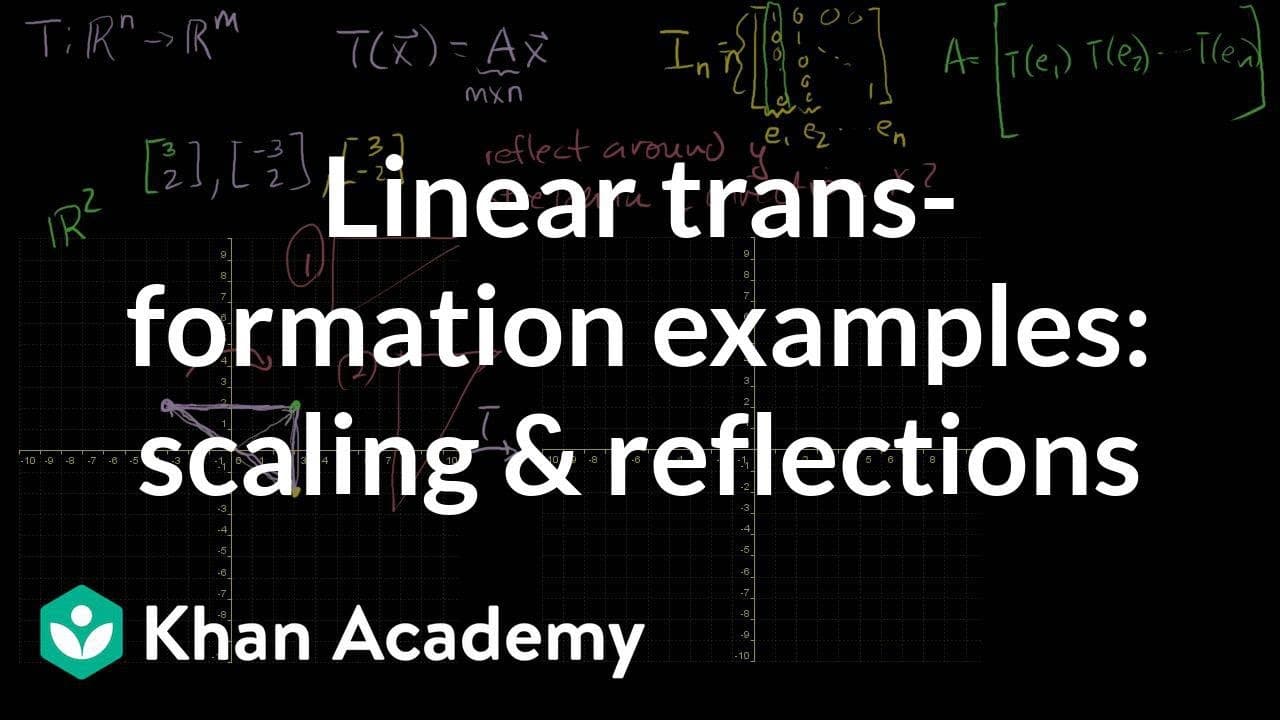
We've talked a lot about linear transformations. What I want to do in this video, and actually the next few videos, is to show you how to essentially design linear transformations to do things to vectors that you want them to do. So we already know that if I have some linear transformation, T, and it's a mapping from Rn to Rm, then we can represent... Read More
Key Insights
- ❓ Linear transformations can be represented by matrices operating on vectors.
- 🤘 Reflecting around an axis can be achieved by changing the sign of the corresponding coordinate.
- 🧑🏭 Stretching in a specific direction can be achieved by multiplying the corresponding coordinate by a factor.
- 🎨 Custom linear transformations can be designed by combining multiple transformations and representing them as matrices.
- 🫤 Diagonal matrices with non-zero terms along the diagonal represent transformations that scale or flip along a specific axis.
Install to Summarize YouTube Videos and Get Transcripts
Explore YouTube Video Summarizer or Get YouTube Transcript Extractor
Questions & Answers
Q: How can linear transformations be represented by matrices?
Linear transformations can be represented by matrices by applying the transformation to each column of the identity matrix, where each column is a basis vector.
Q: How can reflecting around the y-axis be achieved?
To reflect around the y-axis, simply change the sign of the x-coordinate of the vector.
Q: How can stretching in the y-direction be achieved?
Stretching in the y-direction can be achieved by multiplying the y-coordinate by a factor, such as 2.
Q: How can custom linear transformations be designed?
Custom linear transformations can be designed by combining operations like reflecting and stretching, and representing them as matrices.
Summary & Key Takeaways
-
Linear transformations can be represented by matrices, with each column of the matrix representing the transformation applied to a basis vector.
-
Reflecting around the y-axis can be achieved by changing the sign of the x-coordinate.
-
Stretching in the y-direction can be achieved by multiplying the y-coordinate by a factor.
-
These operations can be combined to create custom transformations.
Read in Other Languages (beta)
Share This Summary 📚
Summarize YouTube Videos and Get Video Transcripts with 1-Click
Try YouTube Summary with ChatGPT & Claude or YouTube Transcript Generator
Explore More Summaries from Khan Academy 📚



Summarize YouTube Videos and Get Video Transcripts with 1-Click
Try YouTube Summary with ChatGPT & Claude or YouTube Transcript Generator