What Is the Relationship Between Mass, Weight, Energy, Work, and Power?
TL;DR
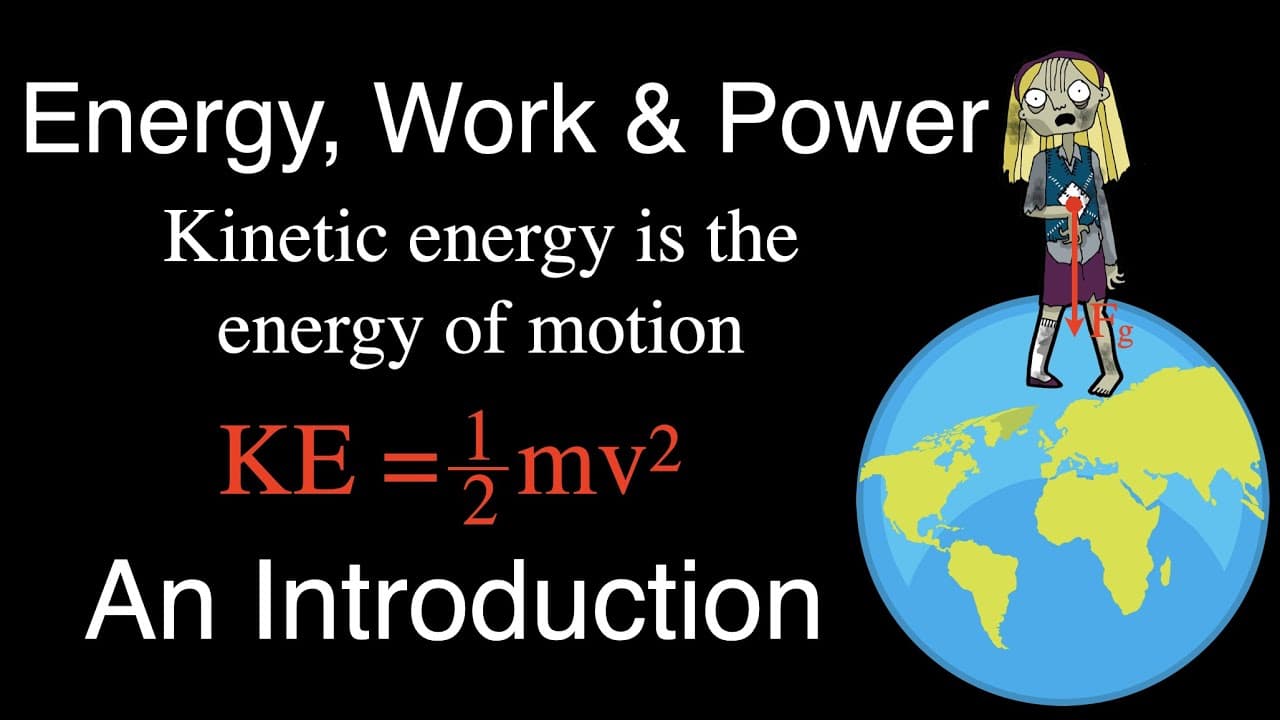
Mass is the amount of matter an object contains, calculated in kilograms, while weight is the gravitational force on that mass, measured in newtons. Energy includes gravitational potential and kinetic energy, work is done when a force moves an object, and power is the rate at which work is performed, measured in watts.
Transcript
as you can see from today's video i am going to go through an overview of five very important topics that would be mass weight energy work and power before we get started please don't forget to subscribe to my channel step by step science get all my excellent physics chemistry and math videos when i look at my youtube videos i see that so many peop... Read More
Key Insights
- 💱 Mass is the amount of matter in an object, resisting changes in motion.
- 💆 Weight is the force of gravity on an object with mass, varying with gravitational pull.
- 🧘 Energy includes gravitational potential energy from position and kinetic energy from motion.
- 💦 Work is done when a force moves an object through a distance.
- 💦 Power measures the rate of work done, reflecting how fast work is accomplished.
- 🏋️ Equations for calculating mass, weight, energy, work, and power provide a structured understanding.
- 🏋️ Units of measurement for mass, weight, energy, work, and power are crucial in calculations.
Install to Summarize YouTube Videos and Get Transcripts
Explore YouTube Video Summarizer or Get YouTube Transcript Extractor
Questions & Answers
Q: What is the difference between mass and weight?
Mass is a measure of an object's resistance to motion, while weight is the force of gravity acting on an object with mass. Mass remains constant, while weight varies based on gravity.
Q: How is gravitational potential energy calculated?
Gravitational potential energy (PE) is calculated as PE = mgh, where m is mass in kilograms, g is acceleration due to gravity (9.81 m/s^2), and h is the height change.
Q: What is the significance of kinetic energy?
Kinetic energy (KE) represents the energy of motion, calculated as KE = 0.5mv^2, where m is mass in kilograms and v is velocity in meters per second squared.
Q: How does power relate to work and time?
Power is the rate at which work is done, calculated as P = W/t, where P is power in watts, W is work in joules, and t is time in seconds.
Summary & Key Takeaways
-
Mass is a measure of an object's resistance to change in motion, representing the amount of matter an object contains.
-
Weight is the force of gravity acting on an object with mass, calculated using the equation Fg = mg.
-
Energy encompasses gravitational potential energy stored by an object's position, kinetic energy of motion, work done by force through distance, and power as the rate of work done.
Read in Other Languages (beta)
Share This Summary 📚
Summarize YouTube Videos and Get Video Transcripts with 1-Click
Try YouTube Summary with ChatGPT & Claude or YouTube Transcript Generator
Explore More Summaries from Step by Step Science 📚
Summarize YouTube Videos and Get Video Transcripts with 1-Click
Try YouTube Summary with ChatGPT & Claude or YouTube Transcript Generator