Fiscal policy to address output gaps | AP Macroeconomics | Khan Academy
TL;DR
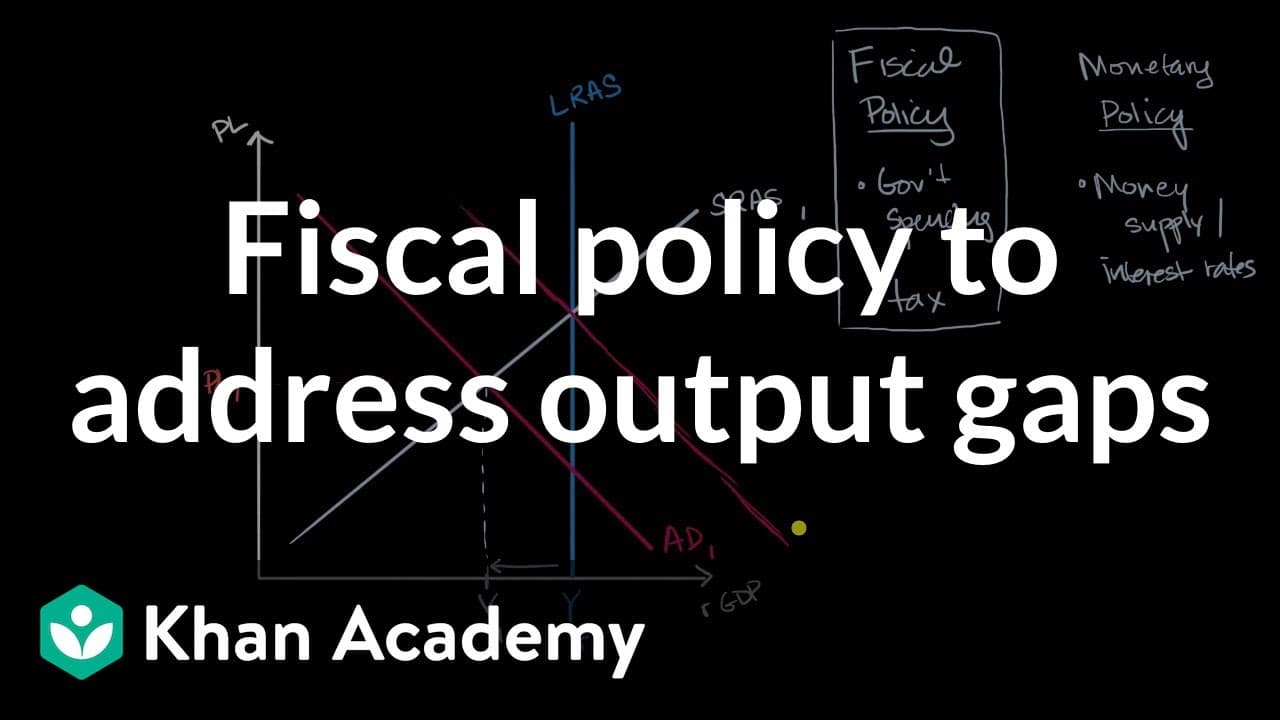
Fiscal policy involves changing government spending and taxation to stimulate economic growth or reduce a recessionary output gap. Different multipliers apply to government spending and taxation, making them not equivalent in their impact on the economy.
Transcript
- [Instructor] What we see here is an economy with an output gap. As you can see, the short run equilibrium output is below our full employment output. This is sometimes referred to as a recessionary output gap. And in other videos, we talk about how there could be a self-adjustment mechanism in the long run, that because we are below full employme... Read More
Key Insights
- 💱 Fiscal policy involves changing government spending and taxation to influence the economy.
- ❓ Increasing government spending can stimulate economic growth and increase output.
- ❓ Decreasing taxes can also stimulate the economy and increase output.
- ✋ Government spending has a higher multiplier effect than decreasing taxes due to the marginal propensity to consume.
- 💄 Different multipliers apply to government spending and taxation, making them not equivalent in their impact on the economy.
- 😒 Fiscal policy is one tool that the government can use to address a recessionary output gap.
- 😒 The government can use fiscal policy to shift the aggregate demand curve to the right and achieve full employment output.
Install to Summarize YouTube Videos and Get Transcripts
Explore YouTube Video Summarizer or Get YouTube Transcript Extractor
Questions & Answers
Q: What is fiscal policy?
Fiscal policy refers to the government's use of changes in government spending and taxation to influence the economy. It is used to stimulate economic growth or reduce a recessionary output gap.
Q: How does increasing government spending affect the economy?
When the government increases spending, it injects money into the economy, leading to increased demand for goods and services. This increased demand then stimulates economic growth and increases output.
Q: How does decreasing taxes affect the economy?
Decreasing taxes leaves more money in the hands of consumers and businesses, which can increase spending and stimulate economic activity. This can lead to an increase in output and economic growth.
Q: Are increasing government spending and decreasing taxes equivalent in their impact on the economy?
No, they are not equivalent. The impact on the economy depends on the multiplier effect. Government spending has a positive multiplier effect, while decreasing taxes has a smaller multiplier effect due to the marginal propensity to consume.
Summary & Key Takeaways
-
Fiscal policy involves government spending and taxation.
-
Increasing government spending can stimulate the economy and increase output.
-
Decreasing taxes can also stimulate the economy and increase output.
Read in Other Languages (beta)
Share This Summary 📚
Summarize YouTube Videos and Get Video Transcripts with 1-Click
Try YouTube Summary with ChatGPT & Claude or YouTube Transcript Generator
Explore More Summaries from Khan Academy 📚



Summarize YouTube Videos and Get Video Transcripts with 1-Click
Try YouTube Summary with ChatGPT & Claude or YouTube Transcript Generator