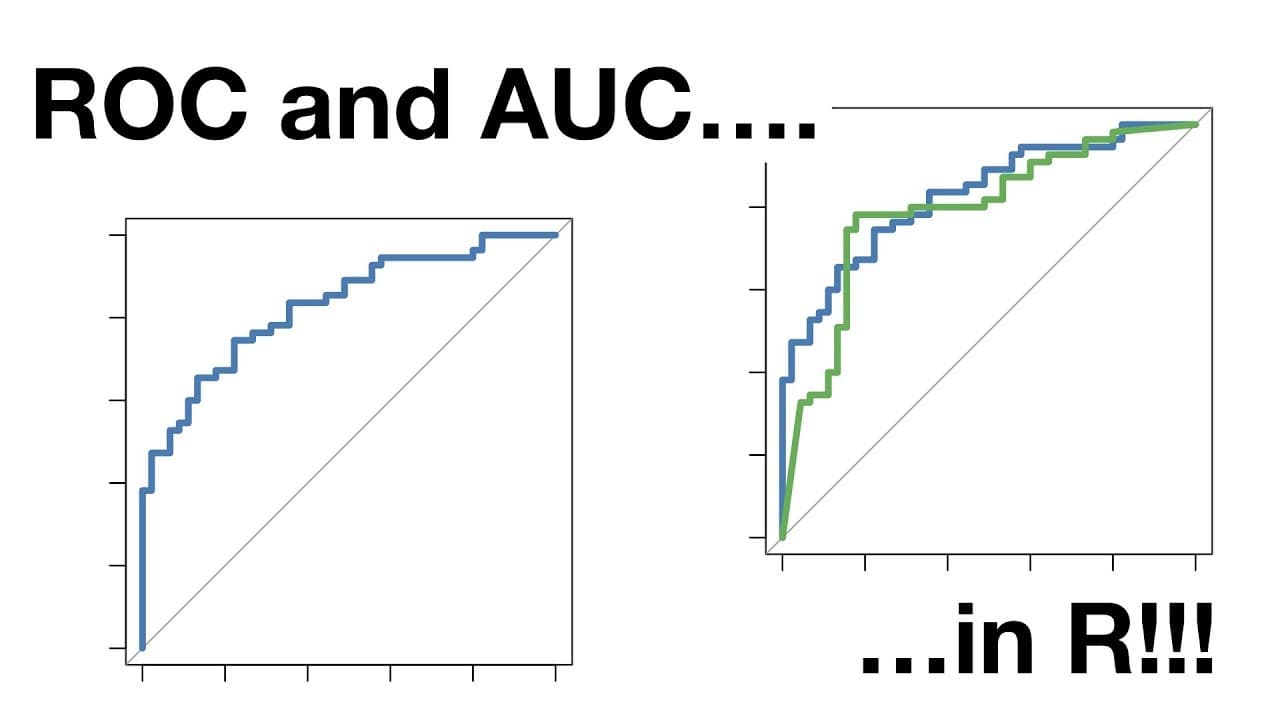
How to Draw ROC Curves and Calculate AUC in R
TL;DR
To draw ROC curves and calculate AUC in R, use the PROC library and fit a logistic regression model to your data. Begin by loading the required libraries, generating your dataset, and then utilize the ROC function for visualization and the AUC metrics. Customizing and comparing multiple ROC curves offers insights into model performance.
Transcript
let's make a graph let's make it look cool thank goodness Stack quest is here just step quest rules stack quest hello I'm Josh Starla and welcome to stack quest today we're gonna talk about drawing ROC graphs and calculating the AUC in R if you're interested in doing this at home there's a link to the example code in the description below in this s... Read More
Key Insights
- ☠️ ROC graphs depict classifier performance through true positive rate vs false positive rate trade-offs.
- 🛸 AUC quantifies the performance of a model, with higher AUC values indicating better discrimination ability.
- 📈 Sensitivity and specificity metrics are critical for evaluating classifier accuracy in ROC analysis.
- 📚 Customizing ROC graphs using PR ROC library helps in visualizing model performance effectively.
- 📈 Threshold selection in ROC graphs influences the balance between true positives and false positives.
- 👻 Comparing ROC curves allows for model comparison and selecting the best performing classifier.
- 🦻 Understanding the ROC curve structure aids in interpreting model performance and evaluating classifiers effectively.
Install to Summarize YouTube Videos and Get Transcripts
Explore YouTube Video Summarizer or Get YouTube Transcript Extractor
Questions & Answers
Q: What is the purpose of drawing ROC graphs in R?
ROC graphs visually depict the trade-off between true positive rate (sensitivity) and false positive rate (1-specificity) for different threshold values, evaluating the performance of binary classifiers.
Q: How can one compute the AUC (Area Under the Curve) in R for ROC graphs?
The AUC in ROC graphs quantifies the classifier's performance, where a higher AUC value (closer to 1) indicates better model discrimination ability, calculated directly from the ROC curve.
Q: Why is it essential to understand sensitivity and specificity when analyzing ROC curves?
Sensitivity measures the true positive rate, correctly identifying positive cases, while specificity measures the true negative rate, correctly identifying negative cases, crucial for assessing model accuracy.
Q: How can one compare multiple ROC curves in R to evaluate classifier performance?
By overlaying ROC curves for different models, like logistic regression and random forests, one can visually compare their AUC values and predictive capabilities to choose the best performing model.
Summary & Key Takeaways
-
Stack Quest explains drawing ROC graphs and calculating AUC in R through step-by-step coding examples.
-
Use PR ROC library to draw ROC graphs, extract thresholds, and compute AUC values.
-
Comparing ROC curves, customizing graphs, understanding sensitivity and specificity in data analysis.
Read in Other Languages (beta)
Share This Summary 📚
Summarize YouTube Videos and Get Video Transcripts with 1-Click
Try YouTube Summary with ChatGPT & Claude or YouTube Transcript Generator
Explore More Summaries from StatQuest with Josh Starmer 📚




Summarize YouTube Videos and Get Video Transcripts with 1-Click
Try YouTube Summary with ChatGPT & Claude or YouTube Transcript Generator