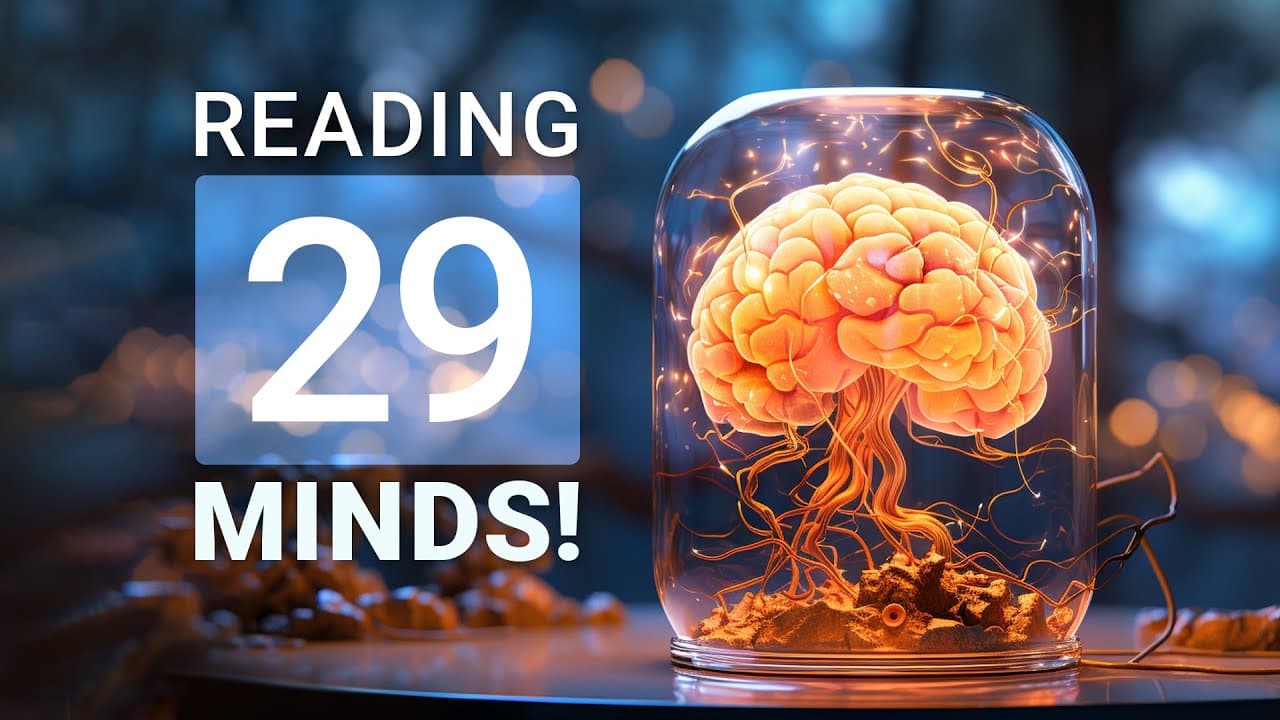
AI Reads Minds of 29 Patients!
TL;DR
Scientists decode brain signals to play music directly from the brain, showcasing potential for communication.
Transcript
Today you are in for a treat, because we are going to perform brain to audio, yes listen to music straight from your brain, kind of, and more. Yes, I hear you asking, Doctor, how is this even possible? Well, this new paper showcases an EEG-based technique to perform this science-fiction like experiment. Normally, EEG, electroencephalograp... Read More
Key Insights
- 🧠 EEG-based technique decodes brain signals for brain-to-audio music playback.
- 🧠 Intracranial EEG enables precise brain signal monitoring for accurate decoding.
- 🔄 Increasing electrode count enhances reconstruction quality but may introduce noise.
- 🧠 Brain-to-text and brain-to-audio technologies offer communication solutions for speech-impaired individuals.
- 😯 Research indicates the potential to reconstruct speech musicality for enhanced communication.
- 🧠 Brain-computer interfaces show promise in enabling efficient communication for paralyzed individuals.
- 🖐️ Decoding techniques play a significant role in the accuracy and quality of brain signal reconstruction.
Install to Summarize YouTube Videos and Get Transcripts
Explore YouTube Video Summarizer or Get YouTube Transcript Extractor
Questions & Answers
Q: How does the EEG-based technique work to play music from the brain?
The technique involves placing electrodes on the brain's surface, recording neural activity, and decoding it using a neural network to create auditory spectrograms of music.
Q: What were the results of the brain spectrogram decoding experiment?
Scientists successfully decoded the neural information from the brain signals to reproduce Pink Floyd's song, proving the accuracy of brain-to-audio reconstruction.
Q: What insights did the paper provide about brain signals and electrode placements?
The paper indicated that increasing the number of electrodes on the brain improves reconstruction quality but also increases noise, highlighting the importance of decoding techniques.
Q: How can brain-to-audio technology benefit those unable to communicate through speech?
This technology enables not only writing but also the reconstruction of speech musicality, potentially helping individuals like Stephen Hawking communicate in a more expressive manner.
Summary & Key Takeaways
-
Scientists used an EEG-based technique to play music directly from the brain's surface.
-
By decoding neural activity, they successfully recreated Pink Floyd's song in brain spectrograms.
-
Research highlights potential for communication assistance through brain-to-audio technology.
Read in Other Languages (beta)
Share This Summary 📚
Summarize YouTube Videos and Get Video Transcripts with 1-Click
Try YouTube Summary with ChatGPT & Claude or YouTube Transcript Generator
Explore More Summaries from Two Minute Papers 📚





Summarize YouTube Videos and Get Video Transcripts with 1-Click
Try YouTube Summary with ChatGPT & Claude or YouTube Transcript Generator