How To Evaluate Limits of Radical Functions | Calculus
TL;DR
Learn how to evaluate a limit with radicals by multiplying the numerator and denominator by the conjugate.
Transcript
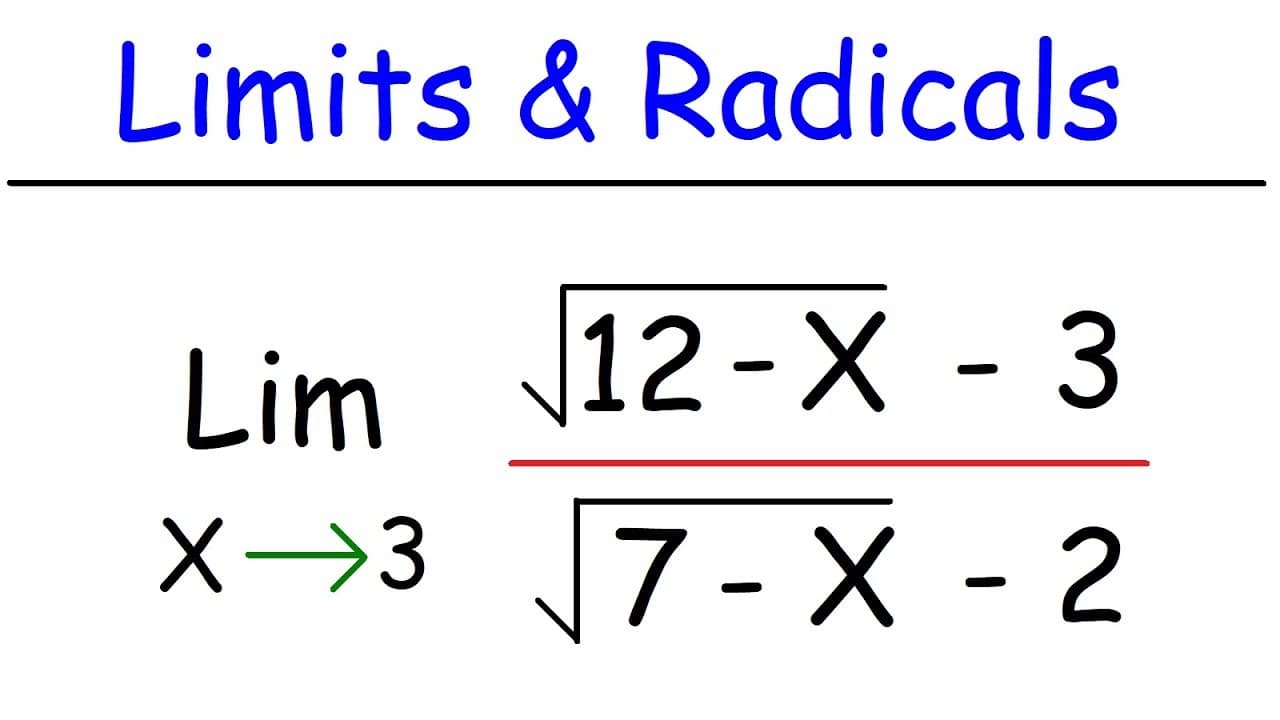
consider the problem on the board what is the limit as x approaches 3 given the function that we have the square root of 12 minus x minus 3 over the square root of 7 minus x minus 2. how can we evaluate that limit feel free to pause the video if you want to try this problem yourself well we could start with direct substitution to see if that's goin... Read More
Key Insights
- 📁 Direct substitution may not always give a definite answer for limits with radicals.
- 😑 Multiplying the numerator and denominator by the conjugate helps to simplify the expression and eliminate the radical.
- 😑 Simplifying the expression is crucial to evaluate the limit accurately.
Install to Summarize YouTube Videos and Get Transcripts
Explore YouTube Video Summarizer or Get YouTube Transcript Extractor
Questions & Answers
Q: How can we evaluate the limit (√12 - x - 3)/(√7 - x - 2) as x approaches 3?
We first try direct substitution, which gives an indeterminate form of 0/0. To evaluate the limit, we multiply the numerator and denominator by the conjugate of the radical expression, simplify, and then use direct substitution to find the final answer of 2/3.
Q: Why do we multiply the numerator and denominator by the conjugate?
By multiplying the numerator and denominator by the conjugate, we eliminate the radical in the denominator and simplify the expression. This allows us to evaluate the limit and find the answer.
Q: What happens to the terms with the square root in the simplified expression?
The terms with the square root in the simplified expression cancel each other out, resulting in a simpler expression for evaluation.
Q: Is it necessary to simplify the expression before evaluating the limit?
Yes, simplifying the expression is necessary to eliminate the indeterminate form and make the limit evaluation possible. It also helps to find the final answer accurately.
Summary & Key Takeaways
-
The problem is to find the limit as x approaches 3 of (√12 - x - 3)/(√7 - x - 2).
-
Direct substitution gives an indeterminate form of 0/0.
-
To evaluate the limit, multiply the numerator and denominator by the conjugate of the radical expression.
-
Simplify the expression and use direct substitution to find the final answer of 2/3.
Read in Other Languages (beta)
Share This Summary 📚
Summarize YouTube Videos and Get Video Transcripts with 1-Click
Try YouTube Summary with ChatGPT & Claude or YouTube Transcript Generator
Explore More Summaries from The Organic Chemistry Tutor 📚



Summarize YouTube Videos and Get Video Transcripts with 1-Click
Try YouTube Summary with ChatGPT & Claude or YouTube Transcript Generator