TEAS 7 Chemistry: Introduction to Atoms
TL;DR
Learn about atoms, their structure, and subatomic particles to ace the TEAS exam.
Transcript
in this video we're going to talk about the basics of atoms and the structure of atoms this video is specifically for people who are preparing for the teas exam so many of the tease prep materials that I found are confusing and impossible to understand so I wanted to try and teach this stuff in a way that is Crystal Clear I've put together a short ... Read More
Key Insights
- 🫀 Atoms are the fundamental units of matter, consisting of protons, neutrons, and electrons.
- 🈂️ Subatomic particles like protons carry a positive charge, neutrons are neutral, and electrons have a negative charge.
- 🖐️ Valence electrons in the outermost energy level of an atom play a vital role in chemical bonding.
- 😂 Understanding the structure of atoms and subatomic particles is essential for success in exams like the TEAS.
- 💨 Electrons are arranged in energy levels or shells around the nucleus in a simplified way for easy comprehension.
- 😶🌫️ Concepts like orbitals and electron clouds, though complex, are not typically tested in TEAS exams.
- 🫀 Practice questions help reinforce knowledge of atomic structure and subatomic particles.
Install to Summarize YouTube Videos and Get Transcripts
Explore YouTube Video Summarizer or Get YouTube Transcript Extractor
Questions & Answers
Q: What are atoms, and what are they composed of?
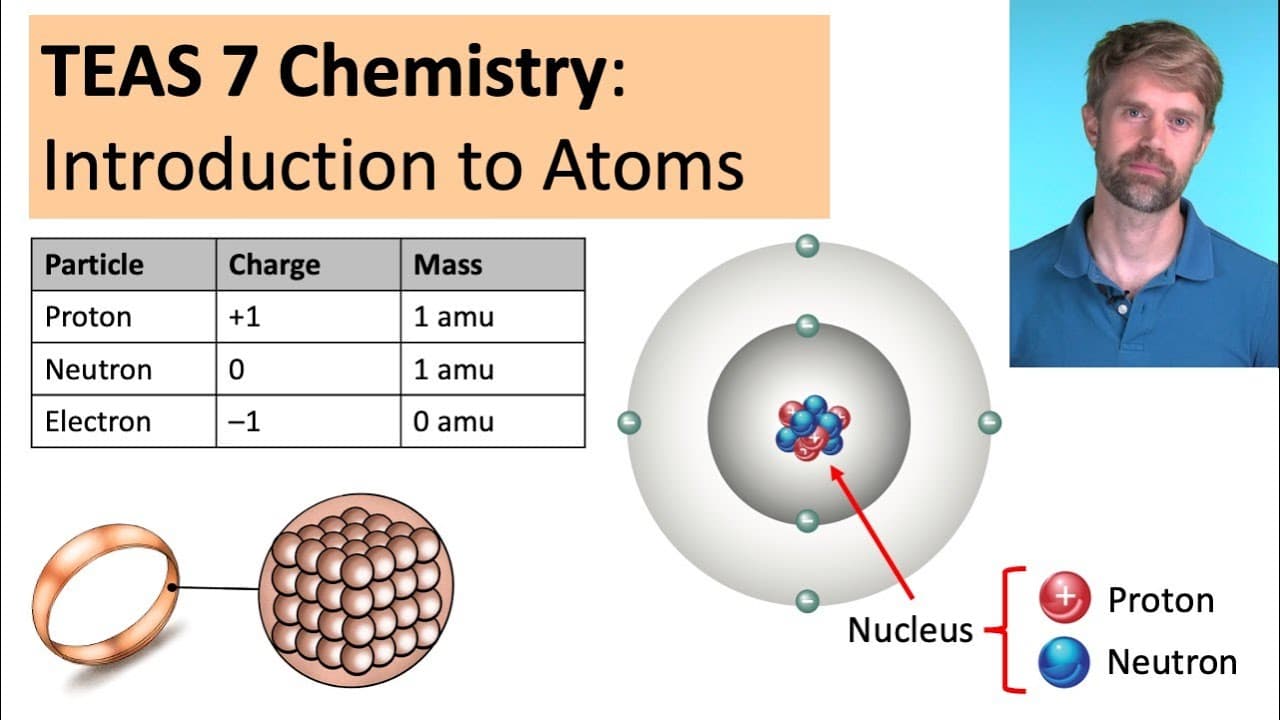
Atoms are the building blocks of matter, made up of protons and neutrons in the nucleus, with electrons orbiting around the nucleus in energy levels.
Q: How are subatomic particles like protons, neutrons, and electrons characterized?
Protons have a positive charge and a mass of 1 AMU, neutrons are neutral with a mass of 1 AMU, while electrons have a negative charge and almost no mass.
Q: Why are valence electrons crucial for chemical bonding?
Valence electrons reside in the outermost energy level of an atom and determine how atoms interact and bond with one another to form compounds.
Q: How do electrons move in an atom, and why is understanding their organization important?
Electrons move randomly in 3D shapes called orbitals, but for simplicity, they are often depicted orbiting around the nucleus in energy levels, crucial for understanding chemical reactions.
Summary & Key Takeaways
-
Atoms are tiny particles that make up everything, consisting of protons, neutrons in the nucleus, and electrons in energy levels.
-
Subatomic particles like protons have a positive charge and a mass of 1 AMU, neutrons are neutral, while electrons have a negative charge and almost no mass.
-
Electrons are organized in energy levels, with the outermost level, known as the valence level, containing valence electrons essential for chemical bonding.
Read in Other Languages (beta)
Share This Summary 📚
Summarize YouTube Videos and Get Video Transcripts with 1-Click
Try YouTube Summary with ChatGPT & Claude or YouTube Transcript Generator
Explore More Summaries from Tyler DeWitt 📚
Summarize YouTube Videos and Get Video Transcripts with 1-Click
Try YouTube Summary with ChatGPT & Claude or YouTube Transcript Generator