How to Evaluate the Sum of a Telescoping Series
TL;DR
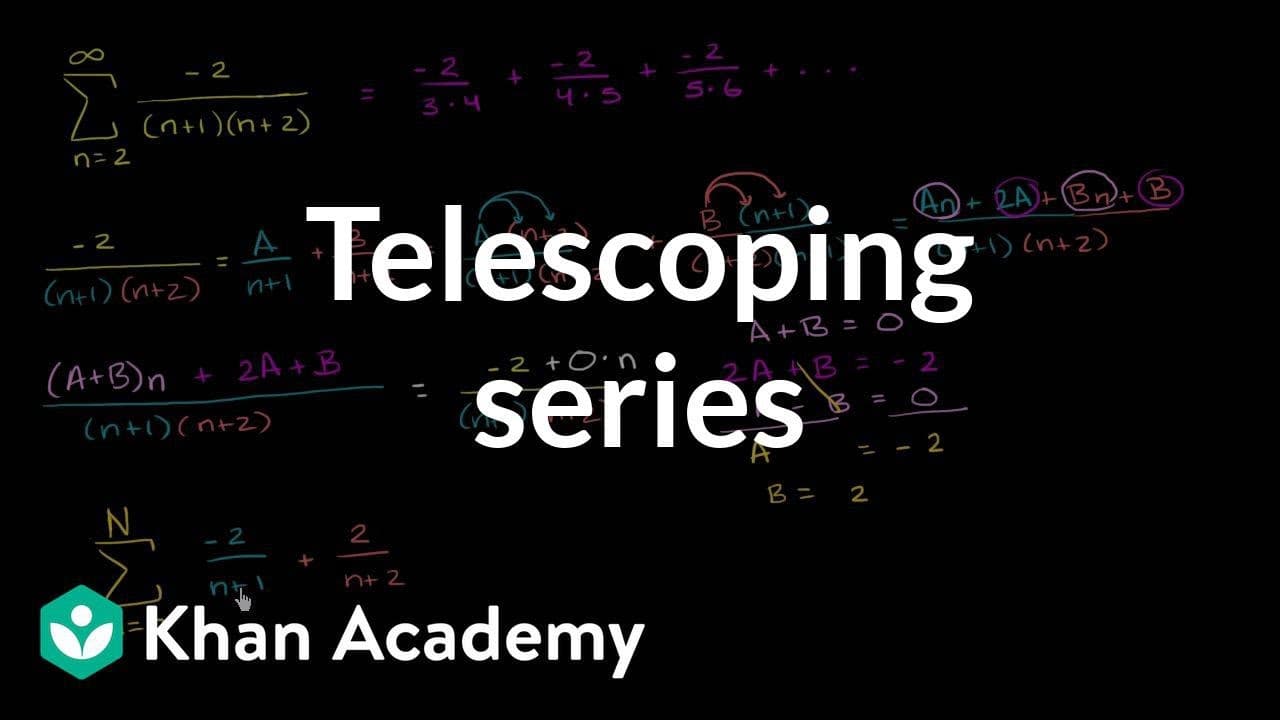
To evaluate the sum of a telescoping series, use partial fraction decomposition to simplify the expression into a sum of two fractions. After canceling terms, take the limit as the number of terms approaches infinity. The final result for this series is -2/3.
Transcript
So what we're going to attempt to do is evaluate this sum right over here, evaluate what this series is, negative 2 over n plus 1 times n plus 2, starting at n equals 2, all the way to infinity. And if we wanted to see what this looks like, it starts at n equals 2. So when n equals 2, this is negative 2 over 2 plus 1, which is 3, times 2 plus 2, wh... Read More
Key Insights
- 🍉 Evaluating a telescoping series involves rewriting it using partial fraction expansion to simplify the terms.
- 🍉 Canceling terms in a telescoping series helps reduce it to a finite sum for easier evaluation.
- 👻 Taking the limit as the number of terms approaches infinity allows finding the value of the sum.
Install to Summarize YouTube Videos and Get Transcripts
Explore YouTube Video Summarizer or Get YouTube Transcript Extractor
Questions & Answers
Q: What is a telescoping series?
A telescoping series is a series in which most terms cancel each other, leaving only a finite number of terms to be summed.
Q: How can partial fraction expansion help in evaluating a series?
Partial fraction expansion allows rewriting a rational function as a sum of simpler fractions, making it easier to evaluate the sum of a series.
Q: What is the significance of canceling terms in a telescoping series?
Canceling terms reduces a telescoping series to a finite sum, simplifying its evaluation by eliminating an infinite number of terms.
Q: How is the sum of a telescoping series calculated?
The sum of a telescoping series can be found by taking the limit as the number of terms approaches infinity, simplifying the expression to a finite value.
Summary & Key Takeaways
-
The video introduces a telescoping series and the need to evaluate its sum.
-
The partial fraction expansion technique is applied to rewrite the series as a sum of two fractions.
-
The series is simplified by canceling out terms, resulting in a finite sum of terms.
-
Taking the limit as the number of terms approaches infinity, the sum is found to be -2/3.
Read in Other Languages (beta)
Share This Summary 📚
Summarize YouTube Videos and Get Video Transcripts with 1-Click
Try YouTube Summary with ChatGPT & Claude or YouTube Transcript Generator
Explore More Summaries from Khan Academy 📚



Summarize YouTube Videos and Get Video Transcripts with 1-Click
Try YouTube Summary with ChatGPT & Claude or YouTube Transcript Generator