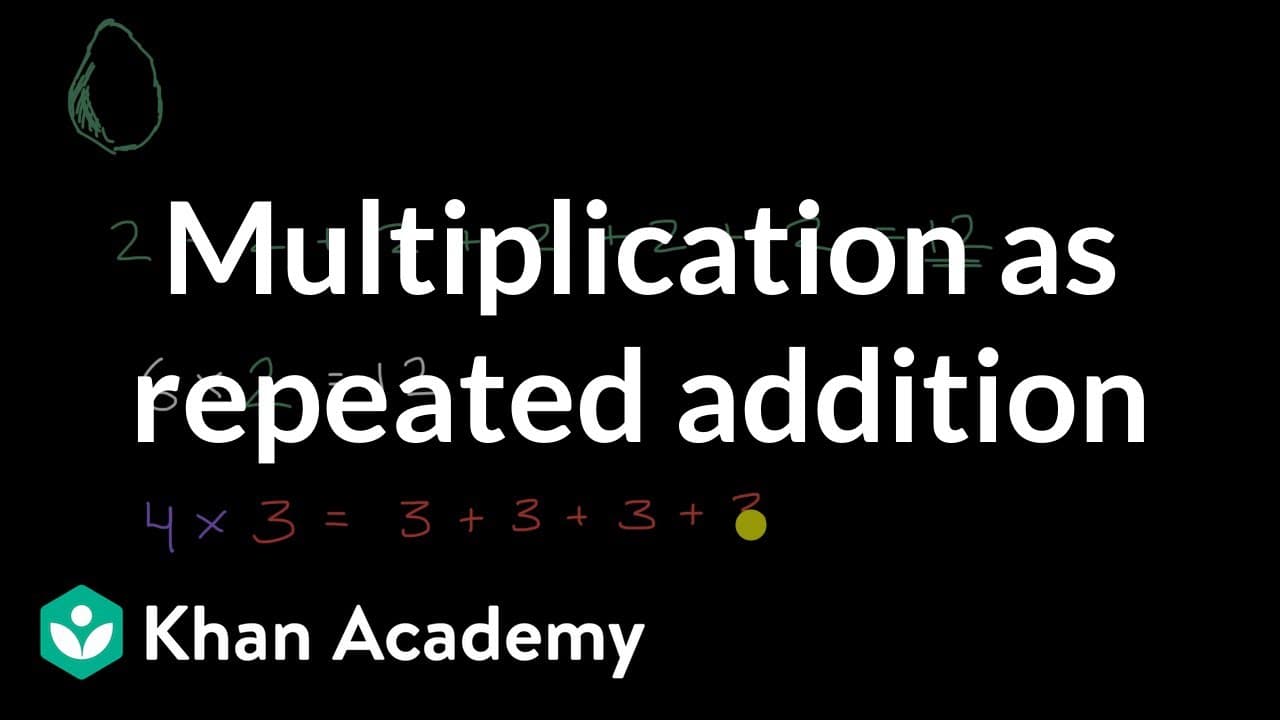
Multiplication as repeated addition
TL;DR
Multiplication can be thought of as repeated addition, simplifying the process and providing a neater way to express calculations.
Transcript
- [Instructor] So as some of you already know, I really enjoy eating a good avocado, which, despite its appearance that it looks like a vegetable, but it's actually a fruit. And let's say that I eat two avocados per day, and I eat two avocados per day for six days. Now, there's a couple of ways that I could think about how many avocados did I eat? ... Read More
Key Insights
- 🍌 Avocados are fruits, not vegetables, despite their appearance.
- 😑 Repeated addition is a way to express multiplication by adding the same number multiple times.
- 🤬 The symbol "X" is often used to represent multiplication.
- 🔄 Skip counting, such as counting in multiples, helps in visualizing repeated addition and multiplication.
- 🔁 Multiplication as repeated addition provides a neater and more efficient method for calculating and understanding mathematical operations.
- 🧑🏭 The commutative property of multiplication states that the order of the factors does not affect the result.
- 🐕🦺 Repeated addition can be used to solve multiplication problems and vice versa.
Install to Summarize YouTube Videos and Get Transcripts
Explore YouTube Video Summarizer or Get YouTube Transcript Extractor
Questions & Answers
Q: How can multiplication be represented as repeated addition?
Multiplication can be seen as adding the same number multiple times. For example, if you have 6 groups of 2, you can represent it as 2 + 2 + 2 + 2 + 2 + 2, which equals 12.
Q: Can you provide an example of repeated addition for 4 times 3?
Certainly! To represent 4 times 3 as repeated addition, you would add three to itself four times: 3 + 3 + 3 + 3. This gives you a total of 12.
Q: Is there a difference between 3 times 4 and 4 times 3 when represented as repeated addition?
Interestingly, both 3 times 4 and 4 times 3 result in the same value when represented as repeated addition. In both cases, you get 12 by adding the respective numbers repeatedly.
Q: How does viewing multiplication as repeated addition make calculations neater?
Representing multiplication as repeated addition simplifies calculations by condensing multiple additions into a single expression. It provides a clearer and more concise way to understand and solve mathematical problems.
Summary & Key Takeaways
-
The instructor explains that avocados, despite their appearance as a vegetable, are actually fruits and shares his enjoyment of eating them.
-
He demonstrates two ways to calculate the total number of avocados eaten over six days, either through repeated addition or multiplication.
-
The instructor emphasizes that multiplication can be viewed as repeated addition, making calculations more concise and easier to understand.
Read in Other Languages (beta)
Share This Summary 📚
Summarize YouTube Videos and Get Video Transcripts with 1-Click
Try YouTube Summary with ChatGPT & Claude or YouTube Transcript Generator
Explore More Summaries from Khan Academy 📚



Summarize YouTube Videos and Get Video Transcripts with 1-Click
Try YouTube Summary with ChatGPT & Claude or YouTube Transcript Generator