2015 AP Calculus AB 6c | AP Calculus AB solved exams | AP Calculus AB | Khan Academy
TL;DR
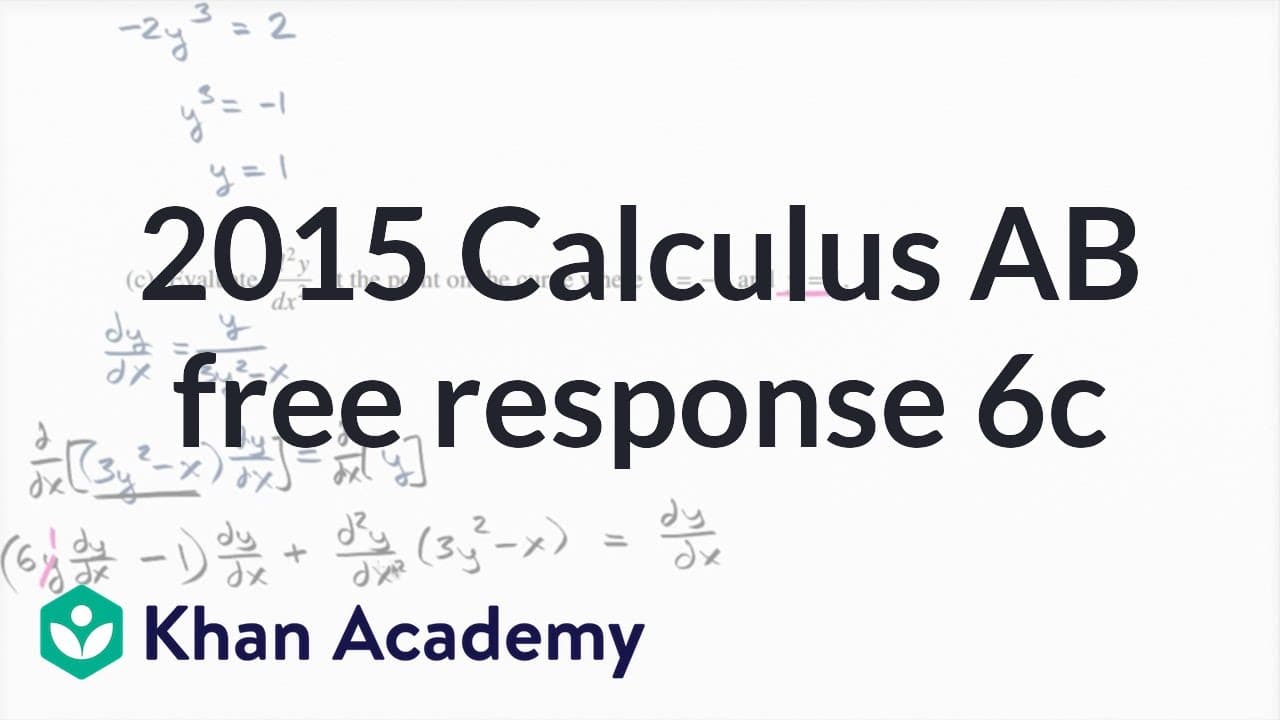
This video explains how to calculate the second derivative of a function using implicit differentiation.
Transcript
- [Voiceover] Part C, evaluate the second derivative of y with respect to x squared at the point on the curve where x equals negative one and y is equal to one. Alright, so let's just go to the beginning where they tell us that dy dx is equal to y over three y squared minus x. So let me write that down. So dy dy dx is equal to y over three y square... Read More
Key Insights
- ❣️ Implicit differentiation is used to find the derivative of an equation with respect to x, where x and y are related.
- 🙃 Multiplying both sides of the derivative equation by the denominator simplifies the process of finding the second derivative.
- 📏 Applying the product rule and chain rule enables us to find the derivative of each term when using implicit differentiation.
Install to Summarize YouTube Videos and Get Transcripts
Explore YouTube Video Summarizer or Get YouTube Transcript Extractor
Questions & Answers
Q: What is the purpose of multiplying both sides of the derivative equation by the denominator?
By multiplying both sides by the denominator, we simplify the task of finding the second derivative and avoid using the quotient rule, which can be complex and time-consuming.
Q: Can you explain the steps involved in applying implicit differentiation in this case?
Implicit differentiation involves taking the derivative of both sides of the equation with respect to x. We use the chain rule and product rule to find the derivative of each term and multiply them accordingly.
Q: How can we find the second derivative when given specific values for x and y?
After applying implicit differentiation and simplifying the equation, we substitute the given values into the equation. By solving for the second derivative, we can find its value at the given point.
Q: What does it mean for the second derivative of y with respect to x to be equal to 1/16?
The second derivative of y with respect to x represents the rate of change of the slope at a specific point on the curve. In this case, at the point (-1, 1), the slope's rate of change is 1/16.
Summary & Key Takeaways
-
The video demonstrates the process of finding the second derivative of a function using implicit differentiation.
-
It explains how to simplify the task by multiplying both sides of the derivative equation by the denominator.
-
After applying implicit differentiation and solving the equation, the video shows how to substitute the given values to find the second derivative.
Read in Other Languages (beta)
Share This Summary 📚
Summarize YouTube Videos and Get Video Transcripts with 1-Click
Try YouTube Summary with ChatGPT & Claude or YouTube Transcript Generator
Explore More Summaries from Khan Academy 📚



Summarize YouTube Videos and Get Video Transcripts with 1-Click
Try YouTube Summary with ChatGPT & Claude or YouTube Transcript Generator