What Is Internal Energy in Ideal Gases?
TL;DR
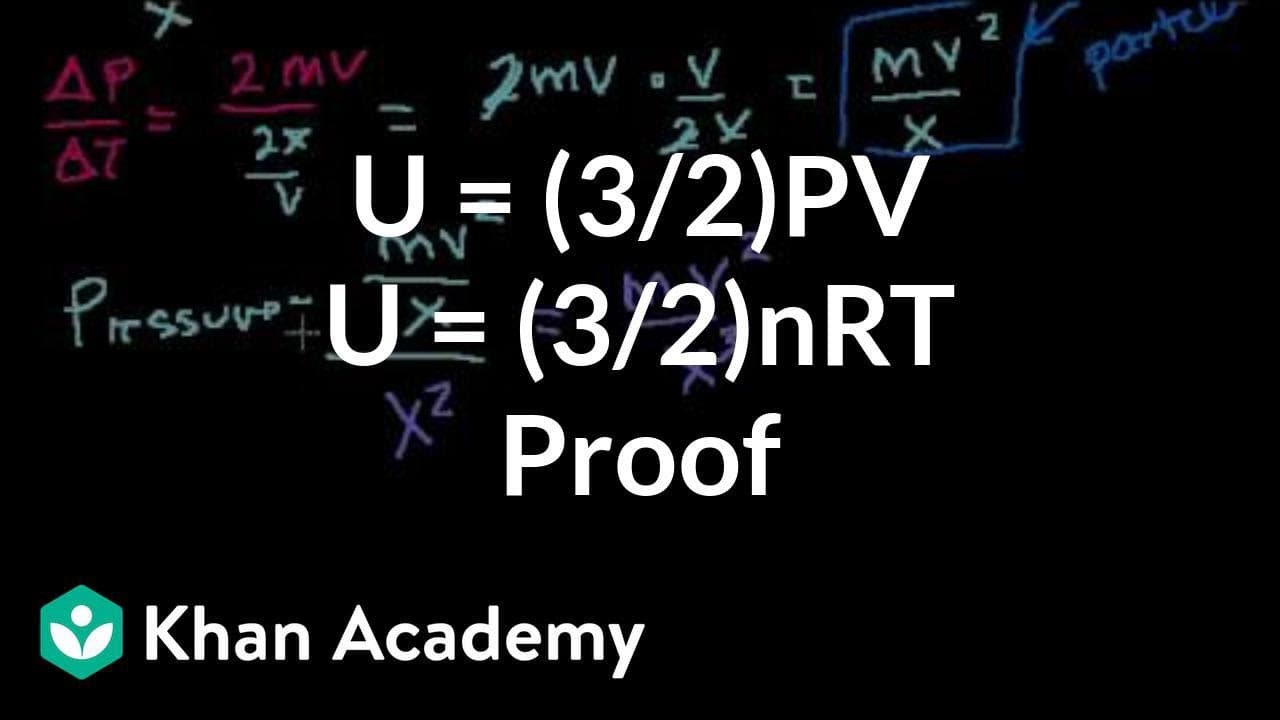
Internal energy in an ideal gas is defined as the total kinetic energy of its particles, represented by the equation U = (3/2)PV, where P is pressure and V is volume. This relationship shows that the internal energy is directly proportional to the temperature and number of particles, meaning if temperature remains constant, the internal energy does not change.
Transcript
I've already told you multiple times that big, uppercase U is the internal energy of a system. And it's really everything thrown in there. It's the kinetic energy of the molecules. It has the potential energy if the molecules are vibrating. It has the chemical energy of the bonds. It has the potential energy of electrons that want to get some place... Read More
Key Insights
- ❓ Internal energy includes the kinetic, potential, and chemical energy of a system.
- 🫢 In an ideal gas, where particles are monoatomic, the internal energy is solely determined by the kinetic energy of the particles.
- 💥 The pressure exerted by one particle on a wall can be calculated using its momentum change during a collision.
- 🍹 The total pressure on a wall is the sum of these contributions from all particles.
- 🫢 The internal energy of an ideal gas can be expressed as 3/2 times the product of the number of particles, the ideal gas constant, and the temperature.
- 🫢 If temperature remains constant, the internal energy of an ideal gas does not change.
Install to Summarize YouTube Videos and Get Transcripts
Explore YouTube Video Summarizer or Get YouTube Transcript Extractor
Questions & Answers
Q: What factors determine the internal energy of a system?
The internal energy of a system is determined by the total energy within it, including kinetic, potential, and chemical energy. For an ideal gas, internal energy is solely determined by the kinetic energy of its particles.
Q: How is the pressure on a wall calculated in an ideal gas system?
The pressure exerted by one particle on a wall can be calculated by considering its change in momentum during a collision. By summing up the contributions from all particles, the total pressure on the wall can be determined.
Q: What are the implications of the simplifying assumptions made in this analysis?
The analysis assumes that all particles in the system have the same velocity and mass, and that 1/3 of the particles are moving in each spatial dimension. These assumptions simplify the math but do not reflect the complexity of real gas systems.
Q: How does the internal energy of an ideal gas change with temperature?
If the temperature of an ideal gas changes while other variables remain constant, the internal energy will also change. The change in internal energy can be calculated using the equation 3/2 times the change in temperature, or 3/2 times the change in the product of pressure and volume.
Summary & Key Takeaways
-
Internal energy is the total energy in a system, including kinetic energy, potential energy, and chemical energy.
-
In the case of an ideal gas, where particles are monoatomic and only have kinetic energy, internal energy is solely determined by the kinetic energy of the particles.
-
The pressure exerted by one particle on a wall can be calculated using its momentum change during a collision, and the total pressure on the wall is the sum of these contributions from all particles.
-
By manipulation of equations, the internal energy of an ideal gas can be expressed as 3/2 times the product of the number of particles, the ideal gas constant, and the temperature.
Read in Other Languages (beta)
Share This Summary 📚
Summarize YouTube Videos and Get Video Transcripts with 1-Click
Try YouTube Summary with ChatGPT & Claude or YouTube Transcript Generator
Explore More Summaries from Khan Academy 📚



Summarize YouTube Videos and Get Video Transcripts with 1-Click
Try YouTube Summary with ChatGPT & Claude or YouTube Transcript Generator