How to Find the Difference Quotient of a Function
TL;DR
To find the difference quotient of a function, replace x with x plus h in the function, then simplify the resulting expression using distribution and cancellation. The difference quotient represents the average rate of change of the function over an interval and can be computed for various types of functions, including linear and quadratic.
Transcript
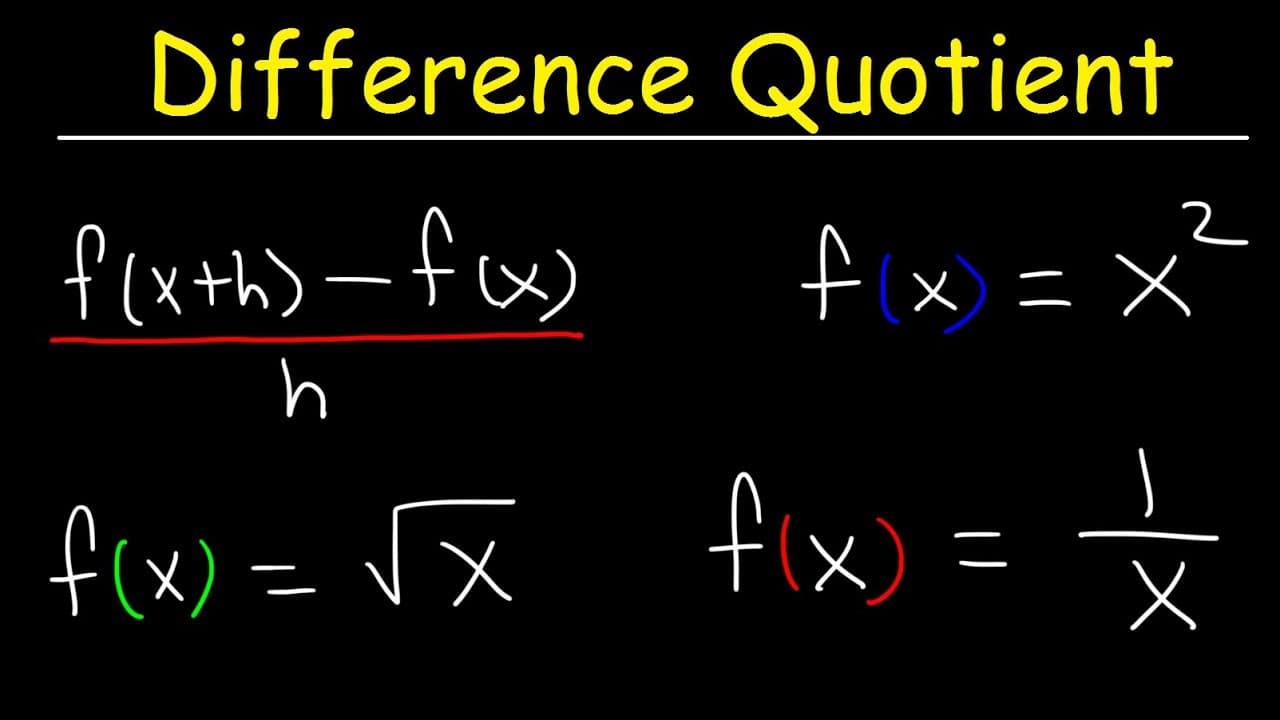
in this lesson we're going to focus on finding the difference quotient of a function so let's say we have a function f of x and it's equal to 7x what is the difference quotient of that function now the difference quotient is represented by this formula it's f of x plus h minus f of x over h now we already have f of x is 7x what do you think f of x ... Read More
Key Insights
- ☠️ The difference quotient involves finding the rate of change of a function over an infinitesimally small interval.
- 😑 Distributing and foiling are crucial steps in simplifying the expression and canceling terms.
- 🧑🏭 Factoring out the greatest common factor allows us to simplify the expression and cancel common terms efficiently.
- 😑 Multiplying the numerator and denominator by the conjugate helps eliminate radicals and simplify the expression.
- 😑 Canceling terms is essential in order to reduce the expression to its simplest form.
- 😥 The difference quotient provides insight into the instantaneous rate of change of a function at a specific point.
- 🅰️ The process can be applied to various types of functions, including linear, quadratic, and radical functions.
Install to Summarize YouTube Videos and Get Transcripts
Explore YouTube Video Summarizer or Get YouTube Transcript Extractor
Questions & Answers
Q: What is the formula for the difference quotient of a function?
The formula for the difference quotient of a function is (f(x + h) - f(x)) / h, where f(x) represents the given function.
Q: How do you find f(x + h) in the difference quotient?
To find f(x + h), substitute every occurrence of x in the function expression with (x + h), preserving the algebraic operations and simplifying where possible.
Q: What is the purpose of distributing in the difference quotient simplification?
Distributing allows us to expand expressions and combine like terms, making it easier to cancel terms and simplify the overall expression.
Q: Why do we multiply by the conjugate in the case of radicals?
Multiplying by the conjugate of the radical helps eliminate the radical by canceling out the square root terms. This allows us to simplify the expression further.
Summary & Key Takeaways
-
The difference quotient of a function is determined by replacing x with x plus h in the function expression and simplifying the resulting expression.
-
Distributing and canceling terms allows us to simplify the expression and find the final difference quotient.
-
The process involves foiling, factoring out the greatest common factor, canceling common terms, and multiplying by the conjugate when dealing with radicals.
Read in Other Languages (beta)
Share This Summary 📚
Summarize YouTube Videos and Get Video Transcripts with 1-Click
Try YouTube Summary with ChatGPT & Claude or YouTube Transcript Generator
Explore More Summaries from The Organic Chemistry Tutor 📚



Summarize YouTube Videos and Get Video Transcripts with 1-Click
Try YouTube Summary with ChatGPT & Claude or YouTube Transcript Generator