Stress & Strain - Elastic Modulus & Shear Modulus Practice Problems - Physics
TL;DR
The content explains how to calculate the change in length, stress, strain, and maximum load for different materials using elastic and shear modulus concepts.
Transcript
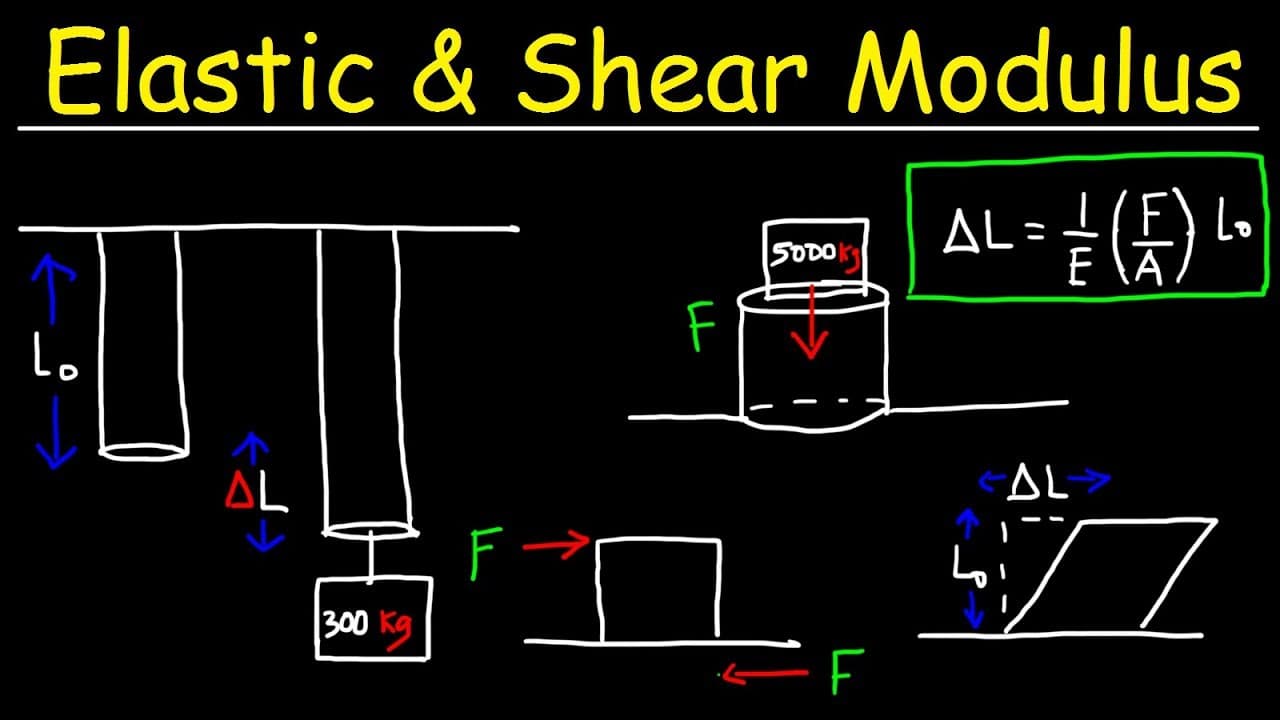
let's consider this problem a 300 kilogram block hangs on a 2 meter long aluminum cylindrical rod with a diameter of 0.5 centimeters we're given the elastic modulus of aluminum what is the change in length of the rod so let's say this is the rod before we added the 300 kilogram block to it now once we add the block the rod is going to increase in l... Read More
Key Insights
- 💱 Elastic modulus, also known as Young's modulus, is used to calculate the change in length of a material under the application of a force.
- 🈸 Shear modulus is used to calculate the movement of a material under the application of a shear force.
- 🍵 The ultimate tensile strength and ultimate compressive stress indicate the maximum stress a material can handle before breaking.
- 😵 The stress applied to a material is equal to the force exerted on it divided by its cross-sectional area.
- 💱 The strain of a material is the fractional change in length or deformation of the material.
- ❓ Tensile stress and strain refer to the stretching of a material, while compressive stress and strain refer to the shortening or compression of a material.
- ❓ The elastic modulus and shear modulus are unique to each material and depend on its composition and structure.
Install to Summarize YouTube Videos and Get Transcripts
Explore YouTube Video Summarizer or Get YouTube Transcript Extractor
Questions & Answers
Q: How can we calculate the change in length of a rod hanging a 300 kg block?
The change in length can be calculated using the formula delta l = 1/e * F / A * l initial, where e is the elastic modulus, F is the force, A is the area, and l initial is the initial length of the rod.
Q: How is the tensile strain of the rod calculated?
The tensile strain is calculated as delta l / l initial, where delta l is the change in length and l initial is the initial length of the rod.
Q: What is the compressive stress applied to a concrete column with a 5,000 kg block on top?
The compressive stress can be calculated by dividing the weight of the block (mass x gravity) by the area of the column (pi x r^2), where r is the radius of the column.
Q: How do we determine the maximum force that a concrete column can support without breaking?
The maximum force can be calculated by multiplying the compressive strength of the concrete by the area of the column.
Summary & Key Takeaways
-
The content discusses how to calculate the change in length of a rod, the compressive stress applied to a column, and the movement of a cube under the application of force.
-
It provides formulas for calculating these values based on the elastic and shear modulus of the materials.
-
The examples given involve aluminum, concrete, and an aluminum cube.
Read in Other Languages (beta)
Share This Summary 📚
Summarize YouTube Videos and Get Video Transcripts with 1-Click
Try YouTube Summary with ChatGPT & Claude or YouTube Transcript Generator
Explore More Summaries from The Organic Chemistry Tutor 📚



Summarize YouTube Videos and Get Video Transcripts with 1-Click
Try YouTube Summary with ChatGPT & Claude or YouTube Transcript Generator