2015 AP Physics 1 free response 3a
TL;DR
A block is compressed by a spring and then released, converting potential energy to kinetic energy, before coming to a stop due to friction.
Transcript
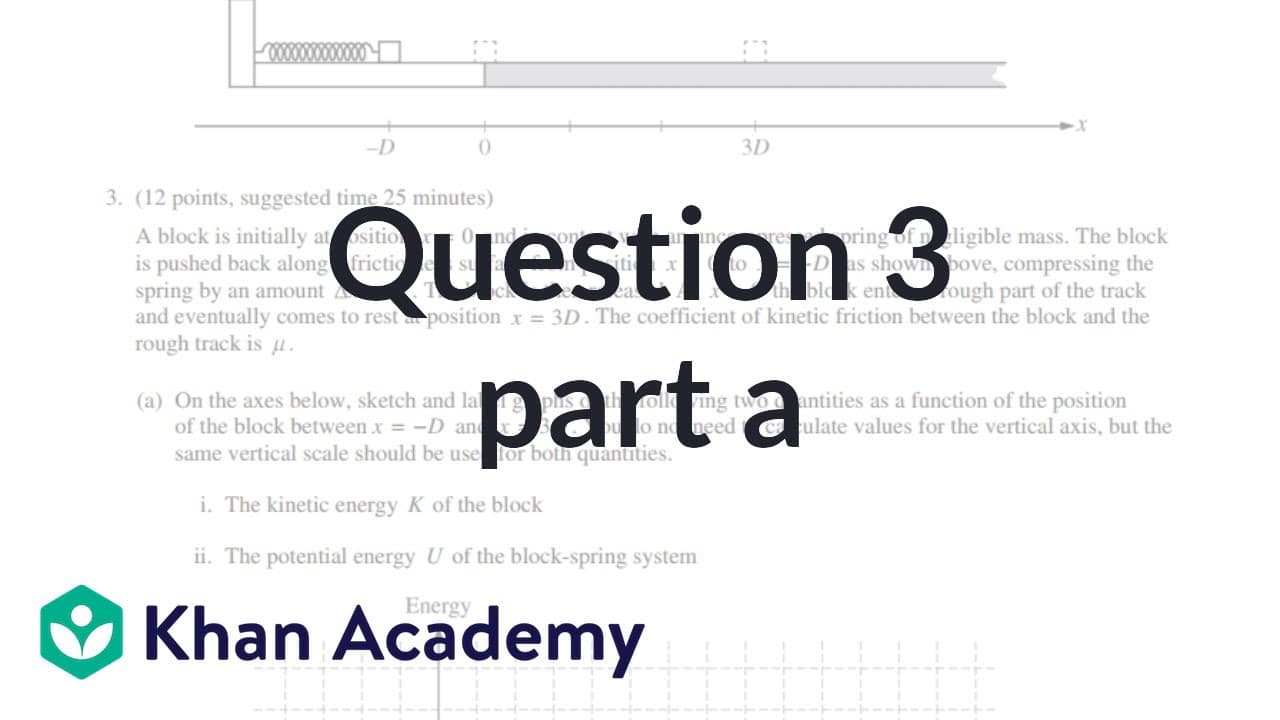
- [Voiceover] A block is initially at position x = zero, and in contact with an uncompressed spring of negligible mass. The block is pushed back along a frictionless surface from position x = zero to x = -D, as shown above, compressing the spring by an amount delta x = D. So, the block starts here, and it's just in contact with the spring, so it's ... Read More
Key Insights
- 🌸 When a spring is compressed, potential energy is stored in the spring-block system.
- 🌸 The potential energy of a compressed spring is given by 1/2 times the spring constant times the square of the compression.
- 🚫 The kinetic energy of the block is initially zero but increases as the potential energy is converted to kinetic energy.
- ✋ Friction causes the block to decelerate and eventually come to a stop.
- ☠️ The force of friction does negative work, reducing the kinetic energy at a constant rate.
- 🧘 The relationship between energy and position in a block-spring system is represented by curves. The potential energy curve is nonlinear, while the kinetic energy curve decreases linearly.
- 🥵 Energy is conserved in the system, with potential energy being converted to kinetic energy and eventually dissipated as heat due to friction.
Install to Summarize YouTube Videos and Get Transcripts
Explore YouTube Video Summarizer or Get YouTube Transcript Extractor
Questions & Answers
Q: How is potential energy related to the compression of a spring?
The potential energy of a compressed spring is given by 1/2 times the spring constant times the square of the compression. This potential energy is what is stored in the spring-block system.
Q: What happens to the potential energy when the block is released?
When the block is released, the potential energy is converted to kinetic energy as the spring accelerates the block. The sum of potential and kinetic energy remains constant until all potential energy is converted to kinetic energy.
Q: What causes the block to come to rest at x=3D?
The block comes to rest at x=3D due to constant friction. The friction acts against the motion of the block, constantly reducing its kinetic energy until it comes to a stop.
Q: What type of curve represents the kinetic energy in relation to position?
The kinetic energy decreases linearly with position due to constant friction. The force of friction remains the same, so it does the same amount of negative work over a given distance.
Summary & Key Takeaways
-
A block is initially at position x=0 and is pushed back to position x=-D, compressing the spring by an amount delta x=D.
-
The potential energy of the compressed spring is given by 1/2 times the spring constant times the square of the compression.
-
The block is released and its potential energy is converted to kinetic energy as it accelerates.
-
The block eventually comes to rest at position x=3D due to constant friction.
Read in Other Languages (beta)
Share This Summary 📚
Summarize YouTube Videos and Get Video Transcripts with 1-Click
Try YouTube Summary with ChatGPT & Claude or YouTube Transcript Generator
Explore More Summaries from Khan Academy 📚



Summarize YouTube Videos and Get Video Transcripts with 1-Click
Try YouTube Summary with ChatGPT & Claude or YouTube Transcript Generator