How to Create a Budget Using the 50/30/20 Rule
TL;DR
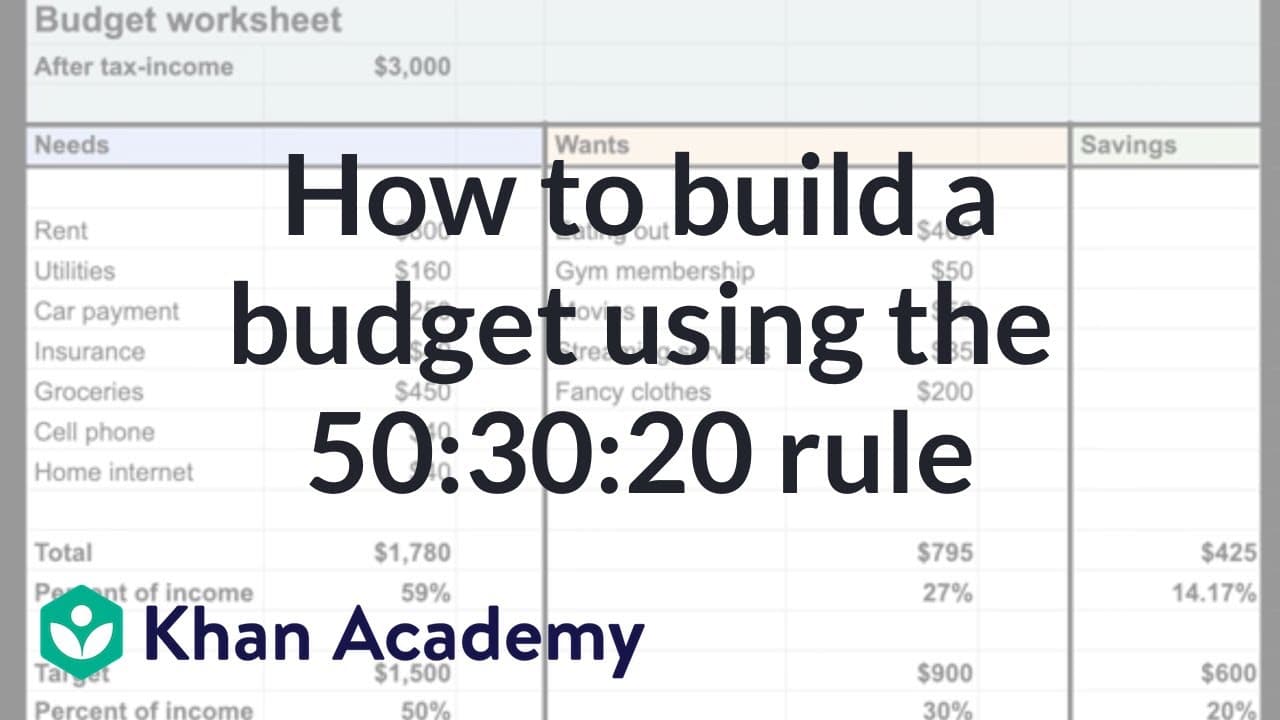
To build an effective budget, start by calculating your after-tax income and categorize expenses into needs, wants, and savings. The 50/30/20 rule advises allocating 50% for needs, 30% for wants, and saving 20%. Adjusting your spending in these categories can help align your budget with these guidelines.
Transcript
- [Instructor] In this video, I'm gonna show an example of what a budget could look like and how you might want to modify that budget depending on your goals, your wants, your needs, and what you wanna save for. So I'm going to do it on a spreadsheet, but you could do a budget on a piece of paper. There's going to be tools that you could find onlin... Read More
Key Insights
- 🚕 Calculating after-tax income is crucial for accurate budgeting.
- 🪡 The 50/30/20 rule provides a framework for allocating income towards needs, wants, and savings.
- 🪡 Adjusting expenses in the needs and wants categories can help reach the recommended budget percentages.
- 🪘 Saving more than 20% is commendable, as long as it aligns with sustainable living.
- ❓ Tracking expenses and being mindful of spending habits is vital for budget modification and financial planning.
- ❓ Finding cheaper alternatives for necessities can significantly impact the budget.
Install to Summarize YouTube Videos and Get Transcripts
Explore YouTube Video Summarizer or Get YouTube Transcript Extractor
Questions & Answers
Q: How can I calculate my after-tax income for budgeting purposes?
To calculate your after-tax income, you can refer to your pay stub or look at your bank account to determine the amount that is deposited each month after taxes and other withholdings.
Q: How can I differentiate between needs and wants in my budget?
Needs are essential expenses for survival, such as housing, utilities, transportation, insurance, and groceries. Wants are non-essential expenses like eating out, gym memberships, entertainment, and luxury items.
Q: What should I do if my budget exceeds the recommended percentage for needs?
If your budget exceeds the recommended 50% for needs, you can consider reducing expenses. This might involve finding a cheaper apartment, opting for a lower-cost cell phone plan, or economizing on utilities to bring down the overall spending.
Q: Is it necessary to save exactly 20% of my after-tax income?
The 20% savings rule is a general guideline, but it's not set in stone. It's important to save regularly, even if the percentage is slightly lower in some months. The focus should be on living within your means and making conscious financial decisions.
Summary & Key Takeaways
-
The video demonstrates how to create a budget on a spreadsheet, starting with after-tax income and separating expenses into needs, wants, and savings.
-
The 50/30/20 rule suggests spending 50% on needs, 30% on wants, and saving 20% of after-tax income. However, the example budget exceeds the recommended percentage for needs.
-
To meet the 50/30/20 rule, the budget can be modified by reducing expenses on needs, finding cheaper alternatives, and adjusting spending on wants.
Read in Other Languages (beta)
Share This Summary 📚
Summarize YouTube Videos and Get Video Transcripts with 1-Click
Try YouTube Summary with ChatGPT & Claude or YouTube Transcript Generator
Explore More Summaries from Khan Academy 📚






Summarize YouTube Videos and Get Video Transcripts with 1-Click
Try YouTube Summary with ChatGPT & Claude or YouTube Transcript Generator