Products
Features
YouTube Video Summarizer
Summarize YouTube videos
Web & PDF Highlighter
Highlight web pages & PDFs
Chat with PDF
Ask any PDF questions with AI
Ask AI Clone
Chat with your highlights & memories
Audio Transcriber
Transcribe audio files to text
Glasp Reader
Read and highlight articles
Kindle Highlight Export
Export your Kindle highlights
Idea Hatch
Hatch ideas from your highlights
Integrations
Obsidian Plugin
Notion Integration
Pocket Integration
Instapaper Integration
Medium Integration
Readwise Integration
Snipd Integration
Hypothesis Integration
Apps & Extensions
Chrome Extension
Safari Extension
Edge Add-ons
Firefox Add-ons
iOS App
Android App
Discover
Discover
Ideas
Discover new ideas and insights
Articles
Curated articles and insights
Books
Book recommendations by great minds
Posts
Essays and notes from readers
Quotes
Inspiring quotes collection
Videos
Curated videos and summaries
Explore Glasp
Glasp Newsletter
Weekly insights and updates
Glasp Talk
Interview series with great minds
Glasp Blog
Latest news and articles
Glasp Use Cases
Learn how others use Glasp
Build & Support
Glasp API
Access Glasp's API for developers
MCP Connector
Connect Glasp to Claude & ChatGPT
Community
Glasp Reddit Community
Students
Student discount and benefits
FAQs
Frequently Asked Questions
AboutPricing
DashboardLog inSign up

How to Model Snow Melting with Linear Equations
June 12, 2010
by
Khan Academy
YouTube video player
How to Model Snow Melting with Linear Equations

TL;DR

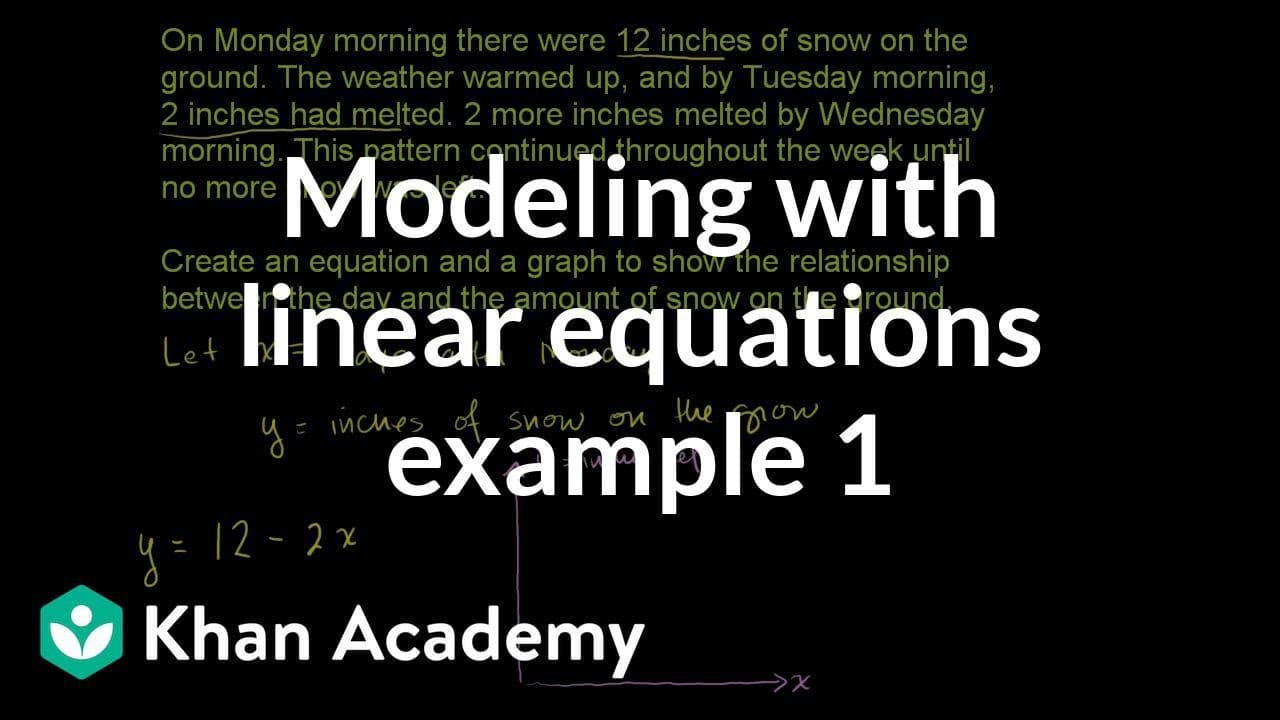
To model the melting snow, start with an initial amount of 12 inches and decrease it by 2 inches for each day. The linear equation is y = 12 - 2x, where x represents the days after Monday and y is the inches of snow remaining. Graphing this will show a straight line reflecting the decrease in snow over the week.

Transcript

On Monday morning, there were 12 inches of snow on the ground. The weather warmed up, and by Tuesday morning, 2 inches had melted. All right, so we'll have 10 left. 2 more inches melted by Wednesday morning. This pattern continued throughout the week until no more snow was left. So they're essentially saying that we had 12 inches of snow on the gro... Read More

Key Insights

  • 🫠 The melting of snow over time can be represented by a linear equation and graph.
  • 🫠 The initial amount of snow on the ground and the daily melt rate determine the equation parameters.
  • 📈 The graph visually depicts the decreasing trend of snow as the days progress.

Install to Summarize YouTube Videos and Get Transcripts

Explore YouTube Video Summarizer or Get YouTube Transcript Extractor

Questions & Answers

Q: What is the initial amount of snow on the ground and how much melt occurs each day?

The initial amount of snow on the ground is 12 inches on Monday. Each day, 2 inches of snow melts.

Q: How can the relationship between the day and the amount of snow on the ground be represented mathematically?

The relationship can be represented by the equation y = 12 - 2x, where x is the number of days after Monday and y is the amount of snow on the ground.

Q: What happens to the amount of snow on Wednesday?

On Wednesday, which is 2 days after Monday, there will be 8 inches of snow left on the ground.

Q: What does the graph of the snow melting pattern look like?

The graph shows a linear relationship, with the amount of snow decreasing by 2 inches each day. It forms a downward-sloping straight line.

Summary & Key Takeaways

  • The content discusses the process of snow melting over the course of a week, with 12 inches of snow on Monday and a daily melt of 2 inches.

  • An equation is created to represent the relationship between the number of days after Monday (x) and the amount of snow on the ground (y).

  • A graph is plotted to visualize the relationship, showing a linear decrease in the amount of snow as days progress.


Read in Other Languages (beta)

English

Share This Summary 📚

Summarize YouTube Videos and Get Video Transcripts with 1-Click

Download browser extensions on:

Try YouTube Summary with ChatGPT & Claude or YouTube Transcript Generator

Explore More Summaries from Khan Academy 📚

Classical Japan during the Heian Period | World History | Khan Academy thumbnail
Classical Japan during the Heian Period | World History | Khan Academy
Khan Academy
Breakthrough Junior Challenge Winner Reveal! Homeroom with Sal - Thursday, December 3 thumbnail
Breakthrough Junior Challenge Winner Reveal! Homeroom with Sal - Thursday, December 3
Khan Academy
Interview with Karina Murtagh thumbnail
Interview with Karina Murtagh
Khan Academy

Summarize YouTube Videos and Get Video Transcripts with 1-Click

Download browser extensions on:

Try YouTube Summary with ChatGPT & Claude or YouTube Transcript Generator

Apps & Extensions

  • Chrome Extension
  • Safari Extension
  • Edge Add-ons
  • Firefox Add-ons
  • iOS App
  • Android App

Key Features

  • YouTube Video Summarizer
  • Web & PDF Summarizer
  • Web & PDF Highlighter
  • Chat with PDF
  • Ask AI Clone
  • Audio Transcriber
  • Glasp Reader
  • Kindle Highlight Export
  • Idea Hatch

Integrations

  • Obsidian Plugin
  • Notion Integration
  • Pocket Integration
  • Instapaper Integration
  • Medium Integration
  • Readwise Integration
  • Snipd Integration
  • Hypothesis Integration

More Features

  • APIs
  • MCP Connector
  • Blog & Post
  • Embed Links
  • Image Highlight
  • Personality Test
  • Quote Shots

Company

  • About us
  • Blog
  • Community
  • FAQs
  • Job Board
  • Newsletter
  • Pricing
Terms

•

Privacy

•

Guidelines

© 2026 Glasp Inc. All rights reserved.

