Supernova (supernovae) | Stars, black holes and galaxies | Cosmology & Astronomy | Khan Academy
TL;DR
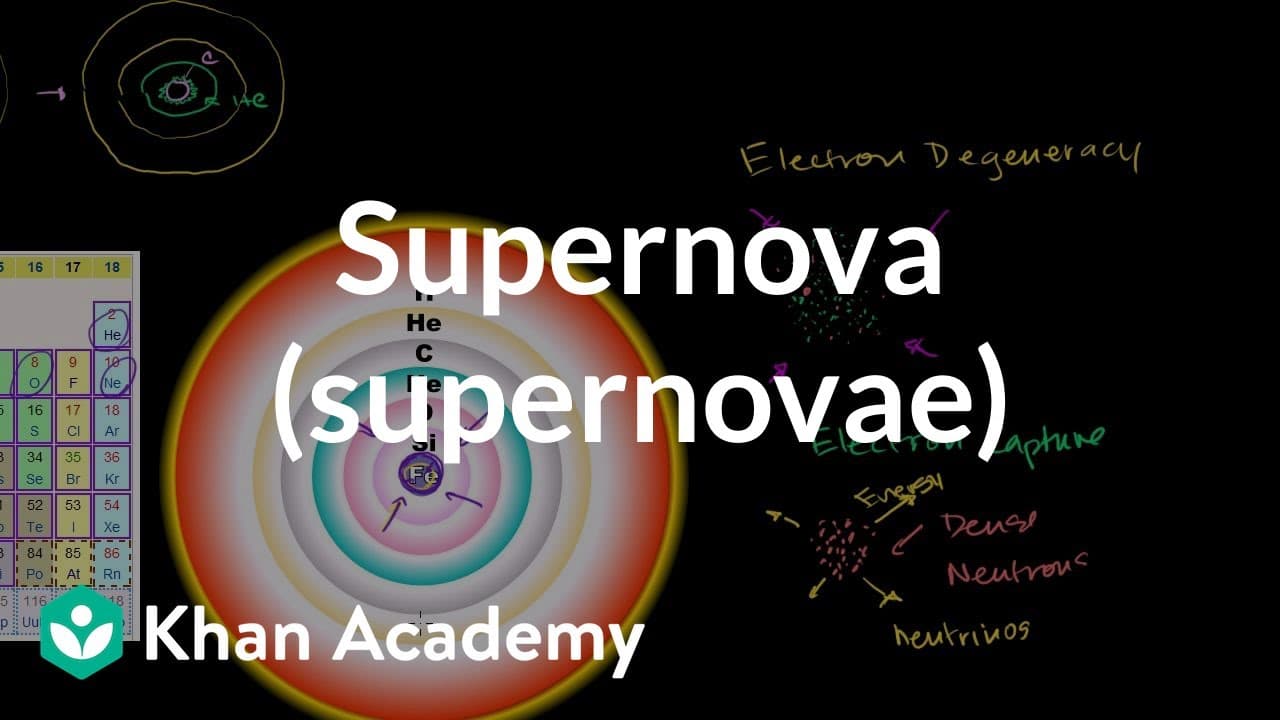
Massive stars go through a process where their iron cores become increasingly dense, leading to a collapse and explosion known as a supernova.
Transcript
Where we left off in the last video, we had a mature massive star, a star that had started forming a core of iron. It has enormous pressure, enormous inward pressure on this core. Because as we form heavier and heavier elements in the core, the core gets denser and denser and denser. And so we keep fusing more and more elements into iron. This iron... Read More
Key Insights
- 🙂 Massive stars go through a life cycle where the fusion of lighter elements leads to the formation of heavier elements in their cores.
- ❣️ The fusion process ends with the formation of an iron core, which becomes increasingly dense due to the constant fusion of heavier elements.
- 💯 Electron degeneracy pressure temporarily prevents the further collapse of the iron core, but eventually gives in.
- 🤩 The collapse of the iron core leads to electron capture, the release of neutrinos, and the explosion of the rest of the star in a supernova.
- ✴️ Supernovae release an enormous amount of energy and can create neutron stars or black holes, depending on the mass of the original star.
- ❣️ Heavier elements, including uranium, are formed during supernovae and are essential for the existence of life.
- ❓ The Crab Nebula, a remnant of a supernova explosion, provides evidence of the violent and energetic nature of these events.
Install to Summarize YouTube Videos and Get Transcripts
Explore YouTube Video Summarizer or Get YouTube Transcript Extractor
Questions & Answers
Q: What prevents the iron core of a massive star from collapsing altogether?
Electron degeneracy pressure, which arises from the repulsion between closely-packed electrons, prevents the iron core from collapsing further.
Q: What happens when the iron core of a massive star becomes too massive for electron degeneracy pressure to hold?
Electron capture occurs, where electrons get captured by protons in the nucleus, causing the core to collapse into a dense ball of neutrons.
Q: What triggers a supernova explosion?
The collapse of the iron core into a dense ball of neutrons releases an enormous amount of energy, causing the rest of the star to explode outward in a supernova.
Q: How much energy is released in a supernova?
A supernova can release as much energy as the sun will in its entire lifetime, temporarily outshining an entire galaxy and shooting out material at speeds up to 10% of the speed of light.
Summary & Key Takeaways
-
When a massive star forms an iron core, the core becomes denser as heavier elements are fused. Fusion of iron requires energy, so the core becomes more massive but doesn't fuse.
-
Electron degeneracy pressure, from the repulsion of closely-packed electrons, temporarily prevents the iron core from collapsing further.
-
As the iron core becomes even more massive, electron degeneracy pressure gives in, leading to electron capture and the collapse of the core into a dense ball of neutrons. This collapse releases an enormous amount of energy, causing a supernova.
Read in Other Languages (beta)
Share This Summary 📚
Summarize YouTube Videos and Get Video Transcripts with 1-Click
Try YouTube Summary with ChatGPT & Claude or YouTube Transcript Generator
Explore More Summaries from Khan Academy 📚



Summarize YouTube Videos and Get Video Transcripts with 1-Click
Try YouTube Summary with ChatGPT & Claude or YouTube Transcript Generator