What Is Planetary Governance and Why Is It Important?

TL;DR
Planetary governance is essential for addressing global challenges like climate change and political unrest, requiring new collaborative frameworks beyond traditional nation-state systems. Imagining solutions through narratives like science fiction can inspire innovative governance that emphasizes cooperation, as seen in the successful development of the European Union. To adapt effectively, humanity must cultivate imagination and foster sufficient consensus for meaningful action.
Transcript
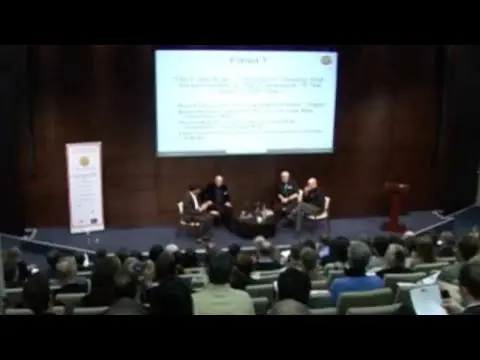
[Applause] Good evening and welcome to the Long Now Foundation. My name is Patrick Dow and I'm board president here at the Long Now Foundation. I'm very excited to introduce our speakers for this evening. Public policy expert Stephen Hines, president of the Rockefeller Brothers Fund, and science fiction author and longtime Long now member Kim Stanl... Read More
Key Insights
- 😀 Governance must evolve beyond nation-states to effectively address planetary challenges facing humanity.
- 🖐️ Imagination plays a vital role in fostering innovative solutions and inspiring collective action for a sustainable future.
- 🇪🇺 The European Union serves as an important model for cooperative governance and conflict resolution among nations.
- 🦮 Recognizing existential threats is essential for would-be policymakers to guide future governance structures.
- 🔬 Science fiction can provide valuable narratives that shape public and political imagination about future possibilities.
- 🆘 Implementing "sufficient consensus" can help overcome the paralysis often created by rigid voting requirements in governance.
- ✊ Collaboration between major powers, especially the U.S. and China, is critical to avoid global conflict and promote joint solutions.
Install to Summarize YouTube Videos and Get Transcripts
Explore YouTube Video Summarizer or Get YouTube Transcript Extractor
Questions & Answers
Q: How do Hines and Robinson define planetary governance?
Planetary governance is envisioned as a unified framework that transcends traditional nation-state boundaries, focusing on collective decision-making to address global challenges. Both speakers assert that this collective approach is essential for effective management of issues like climate change, inequality, and technological risks. They argue that collaboration across borders is necessary for sustainable development, urging a shift from the zero-sum logic of nation-states to one that recognizes our common biosphere.
Q: What role does imagination play in shaping governance, according to the speakers?
Imagination is deemed crucial for envisioning innovative solutions to complex global problems. Robinson argues that science fiction serves as a medium to stimulate ideas about future governance and societal structures. Hines adds that a strong imaginative framework can inspire the development of cooperative governance models that are adaptable to the emergent complexities of international relations, encouraging a proactive rather than reactive approach to future challenges.
Q: Can you explain the significance of the European Union as discussed by Hines?
Hines describes the European Union as a monumental political experiment born out of the devastation of two world wars. He notes that the EU represents a peace project facilitating cooperation among formerly adversarial nations by pooling sovereignty to address collective challenges. This model is highlighted as a potential template for future governance, particularly in overcoming the limitations of traditional nation-state dynamics and fostering an environment where collective decision-making can thrive.
Q: What are the existential threats mentioned by Hines?
Hines identifies three simultaneous existential threats: the climate crisis, the resurgence of a nuclear arms race, and the rapid advancement of uncontrolled technologies. He emphasizes the urgency of rethinking governance systems to mitigate these threats, advocating for a shift toward planetary thinking that recognizes interdependence among people and ecological systems globally.
Q: How does science fiction influence real-world governance ideas?
Robinson discusses how science fiction challenges conventional thinking, providing narratives that explore potential futures and governance models. By envisioning alternate realities, science fiction can inspire policymakers and the public to consider transformative approaches to governance that prioritize sustainability, equity, and broader participation in decision-making processes.
Q: What is the concept of "sufficient consensus" as brought up in the discussion?
"Sufficient consensus" refers to a revised approach to decision-making that values majority agreement over the often unattainable goal of unanimous consent. This concept posits that achieving a substantial but not complete majority can still lead to effective governance, allowing for flexibility in addressing pressing issues while avoiding stagnant political processes that require unanimous agreement.
Q: How do Hines and Robinson view the relationship between the U.S. and China?
Hines highlights the crucial nature of the U.S.-China relationship, arguing that it is one of the most consequential dynamics of the 21st century. Both speakers advocate for cooperation over confrontation, urging a collaborative spirit to manage shared global challenges while recognizing the complexities of each nation's domestic and international motivations.
Q: What do Hines and Robinson believe is necessary for future governance?
They stress the need for a transformative approach to governance that incorporates imaginative thinking, adaptive structures, and broad public engagement. Hines and Robinson call for systems that prioritize collective well-being, promote sustainability, and allow for dynamic responses to the ever-evolving landscape of global challenges, thus ensuring a more equitable future for all.
Summary & Key Takeaways
-
Stephen Hines and Kim Stanley Robinson explore the concept of planetary governance, emphasizing the need for a collective imagination to address global challenges. They discuss how historical developments, like the European Union, offer lessons for future governance frameworks.
-
Hines highlights the importance of evolving from traditional nation-state systems, advocating for collaborative governance that includes civil society and promotes planetary well-being, as demonstrated through diplomatic efforts like the Iran nuclear negotiations.
-
Robinson relates science fiction to real-world scenarios, suggesting that imaginative narratives can inspire innovative solutions for pressing global issues. Both speakers stress the urgency for humanity to rethink governance structures to ensure a sustainable future.
Read in Other Languages (beta)
Share This Summary 📚
Summarize YouTube Videos and Get Video Transcripts with 1-Click
Try YouTube Summary with ChatGPT & Claude or YouTube Transcript Generator
Explore More Summaries from The Long Now Foundation 📚





Summarize YouTube Videos and Get Video Transcripts with 1-Click
Try YouTube Summary with ChatGPT & Claude or YouTube Transcript Generator