Similar triangles (part 2) | Similarity | Geometry | Khan Academy
TL;DR
The video explains how to identify and solve problems related to similar triangles using angle relationships and ratios.
Transcript
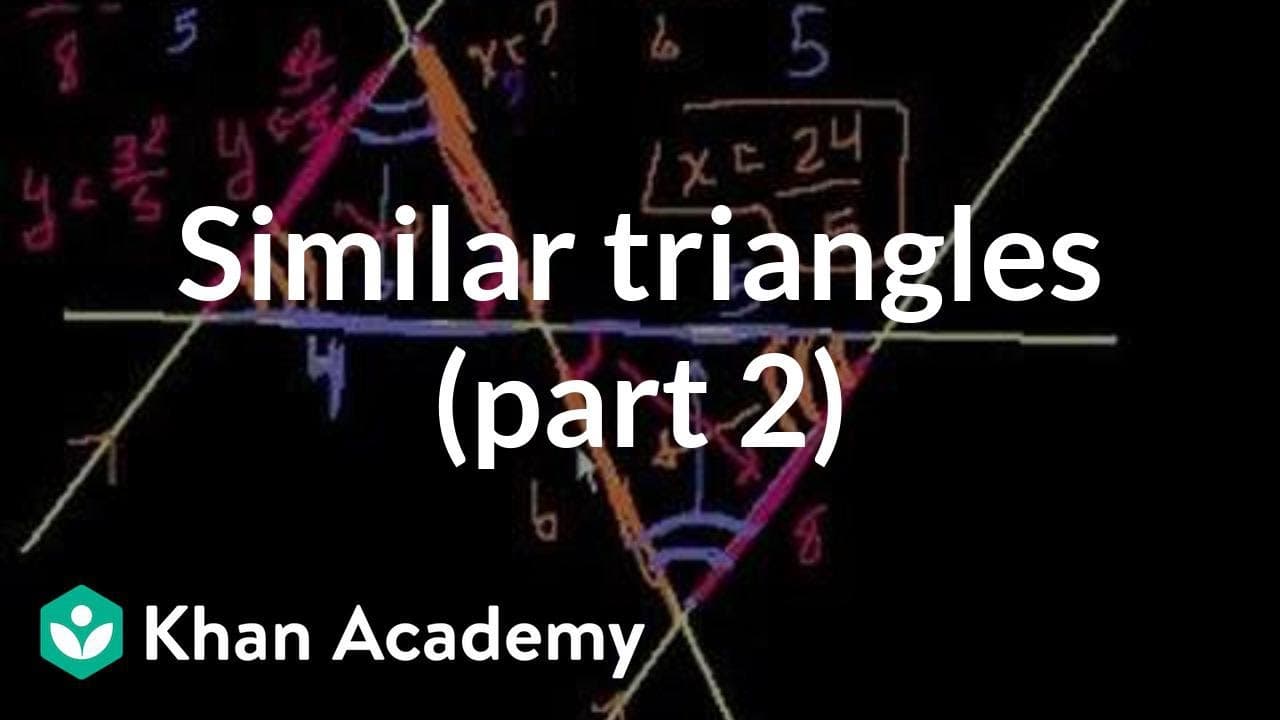
Welcome back. So where we had left off, we said, OK, we have this angle here, can we figure out if any of these angles are equal to it? Well we know that alternate interior angles on-- this is a transversal line right here, and these are parallel lines. So we know alternate interior. So this is an interior and it's alternate interior is here. So we... Read More
Key Insights
- 🔺 Alternate interior angles and corresponding angles are helpful in proving the similarity of triangles.
- 🔺 If two angles in two triangles are equal, the third angles must also be equal for the triangles to be similar.
- 🔺 Corresponding sides in similar triangles are opposite angles that are equal.
- 🙃 Ratios of corresponding sides can be used to solve for missing side lengths in similar triangles.
- 🔺 Attention to angle-to-side correspondence is necessary to correctly determine corresponding sides in similar triangles.
- 🔺 Similar triangles can have overlapping regions and still be considered similar if their angles are equal.
- 🫥 Parallel lines and transversal lines form alternate interior angles, which are useful in determining similarity.
Install to Summarize YouTube Videos and Get Transcripts
Explore YouTube Video Summarizer or Get YouTube Transcript Extractor
Questions & Answers
Q: What are alternate interior angles and how are they used in determining similar triangles?
Alternate interior angles are angles that are formed when a transversal line crosses two parallel lines. In similar triangles, these angles are equal, which can help identify equal angles in the triangles.
Q: Can similar triangles have only two equal angles or is it necessary for all three angles to be equal?
Similar triangles can have only two equal angles, and it is sufficient to prove that they are similar. If any two angles in two triangles are equal, the third angle must also be equal.
Q: How do we determine the corresponding sides in two similar triangles?
Corresponding sides in similar triangles are opposite angles that are equal. To find a corresponding side, identify the angle it is opposite to in one triangle and look for the same angle in the other triangle.
Q: How can we solve for missing side lengths in similar triangles?
By setting up ratios of corresponding sides, we can solve for missing side lengths. If we know the ratio between one pair of corresponding sides, we can use it to find the length of the missing side.
Summary & Key Takeaways
-
The video introduces the concept of similar triangles and explains how to determine if two triangles are similar based on angle relationships.
-
It demonstrates how to use the properties of alternate interior angles and corresponding angles to identify equal angles in similar triangles.
-
The video also shows how to use the ratios of corresponding sides to solve for missing side lengths in similar triangles.
Read in Other Languages (beta)
Share This Summary 📚
Summarize YouTube Videos and Get Video Transcripts with 1-Click
Try YouTube Summary with ChatGPT & Claude or YouTube Transcript Generator
Explore More Summaries from Khan Academy 📚



Summarize YouTube Videos and Get Video Transcripts with 1-Click
Try YouTube Summary with ChatGPT & Claude or YouTube Transcript Generator