Harvard students pick up particle physics at CERN collider
TL;DR
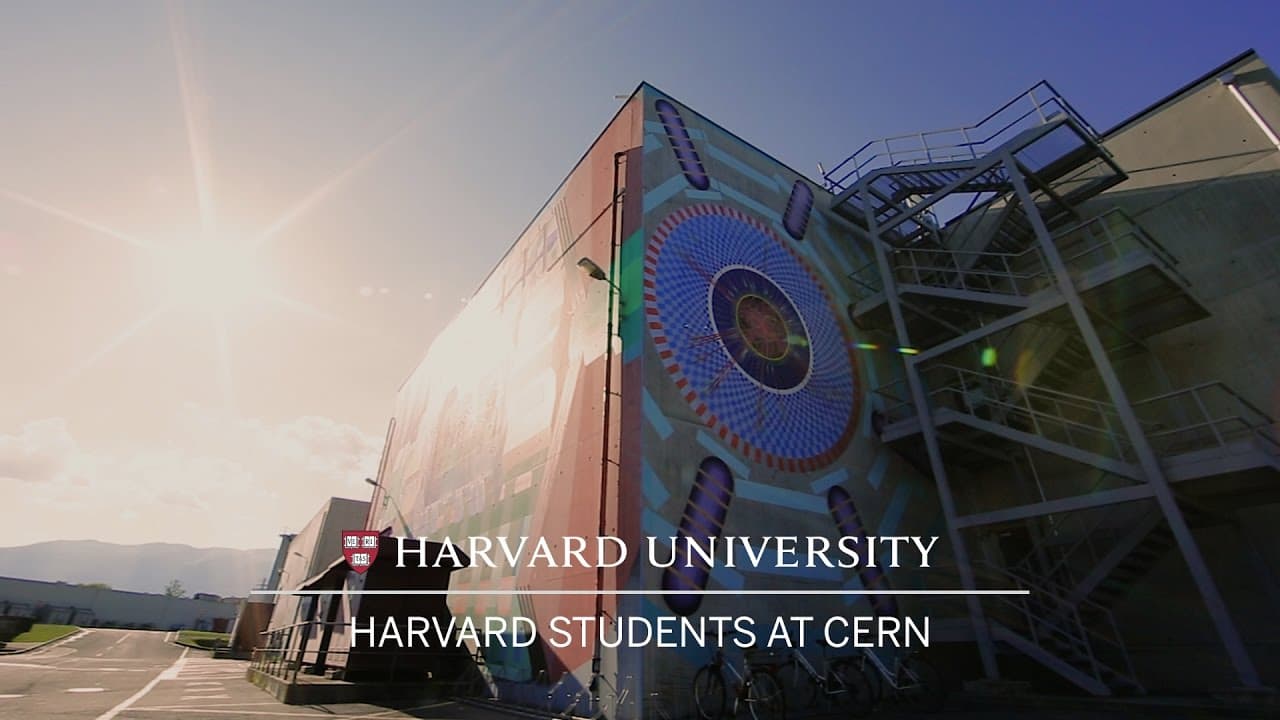
CERN in Switzerland houses the Atlas experiment, which collides protons at high energies to study the fundamental nature of matter and search for new physics ideas.
Transcript
we're in Geneva in Switzerland and this is the home of CERN which is a huge science laboratory just a couple miles outside the city home to the LHC the Large Hadron Collider which collides protons at higher energies than ever before to observe those collisions we have the Atlas experiment which Harvard has been contributing significantly to for a d... Read More
Key Insights
- 👶 CERN's Atlas experiment strives to uncover new physics ideas and understand the fundamental nature of matter.
- 💦 The collaborative environment at CERN encourages thousands of scientists to work together on complex experiments.
- ℹ️ The antiproton decelerator facility at CERN is the only source for antimatter particles like antiprotons.
- 🤨 The symmetrical nature of equations raises questions about why there is an abundance of matter compared to antimatter in the universe.
- 😌 The allure of physics lies in the process of answering fundamental questions and discovering beautiful solutions.
- 💥 Atlas functions as a continuous experiment, constantly collecting data from collisions and cosmic events.
- 🐎 Replacements and upgrades in the Atlas experiment aim to enhance sensitivity and data readout speed.
Install to Summarize YouTube Videos and Get Transcripts
Explore YouTube Video Summarizer or Get YouTube Transcript Extractor
Questions & Answers
Q: What is Atlas, and what is its purpose?
The Atlas experiment at CERN is a large-scale endeavor to understand the fundamental nature of matter by colliding protons at high energies. Its goal has evolved from finding the Higgs boson to exploring new physics ideas, such as supersymmetry and dark matter.
Q: How does Atlas run, and who is involved in its operation?
Atlas is always running, collecting data from collisions and cosmic events. Shifters constantly monitor the detectors and data collection to ensure everything is functioning correctly. It involves thousands of people working together to answer some of the most challenging questions in the universe.
Q: What is the role of CERN's antiproton decelerator facility?
The antiproton decelerator facility at CERN generates antiprotons by colliding protons and cooling the resulting particles. These antiprotons are essential for experiments at CERN and are not readily available from any other source in the world.
Q: Why is there more matter than antimatter in the universe?
Although equations treating matter and antimatter are symmetric, the universe predominantly consists of matter. Scientists at CERN aim to understand why this imbalance exists and how the universe evolved into its current state.
Summary & Key Takeaways
-
CERN is a large science laboratory in Geneva, Switzerland, known for its Large Hadron Collider (LHC) and the Atlas experiment.
-
Atlas is a massive science experiment designed to observe the results of proton collisions at extremely high energies.
-
CERN is like a compact college town for physicists, with buildings, dorms, cafeterias, and a collaborative atmosphere.
Read in Other Languages (beta)
Share This Summary 📚
Summarize YouTube Videos and Get Video Transcripts with 1-Click
Try YouTube Summary with ChatGPT & Claude or YouTube Transcript Generator
Explore More Summaries from Harvard University 📚




Summarize YouTube Videos and Get Video Transcripts with 1-Click
Try YouTube Summary with ChatGPT & Claude or YouTube Transcript Generator