Soil Characteristics Form the Irrigation Consideration - Water Resource Engineering 1
TL;DR
Soil types for irrigation categorized based on weathering agents, residue soil, and water content affect plant growth.
Transcript
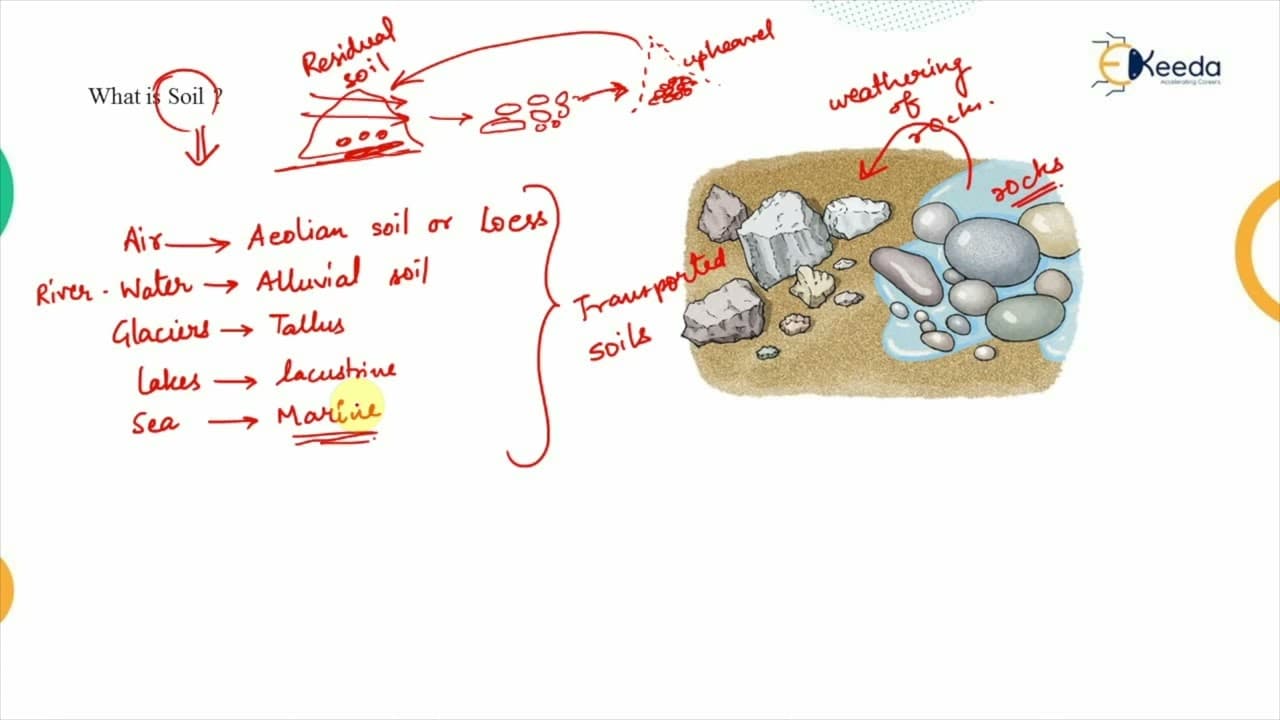
hello everyone in this video we are going to discuss the different soil characteristics from the irrigation point of view so let's start so when we want to study this soil characteristics the first question that comes to our mind that what is this soil so this soil is the material which is obtained upon the weathering of the rocks so if you look at... Read More
Key Insights
- 🌊 Soil formation occurs due to rock weathering by various agents like air, water, glaciers, lakes, or sea.
- 🤑 Alluvial and marine soils are nutrient-rich, ideal for irrigation and crop cultivation in India.
- 💦 Soil water comprises gravitational, capillary, and hydroscopic water affecting plant growth and irrigation efficiency.
- 🥘 Soil depth influences irrigation requirements, with shallow soils needing more frequent watering.
- 💦 Deep soils support larger irrigation water storage, require less frequent watering.
- 💦 Shallow soils result in higher total water requirements due to frequent irrigation needs.
- 🌱 Different soil types impact plant growth, irrigation needs, and overall crop yields.
Install to Summarize YouTube Videos and Get Transcripts
Explore YouTube Video Summarizer or Get YouTube Transcript Extractor
Questions & Answers
Q: How is soil classified based on weathering agents?
Soil is categorized depending on agents like air, water, glaciers, lakes, or sea that cause rock disintegration to form different types of soil.
Q: Why are alluvial and marine soils preferred for irrigation?
These soils are rich in nutrients, beneficial for plant growth, making them ideal for cultivating crops and maximizing agricultural yields.
Q: What are the three types of soil water and their roles in irrigation?
Gravitational water drains, capillary water is absorbed by plants, and hydroscopic water is unavailable for plant use, impacting irrigation requirements.
Q: How does soil depth affect irrigation needs?
Adequate soil depth is crucial for storing irrigation water and supporting root growth, with shallow soils requiring more frequent watering than deep soils.
Summary & Key Takeaways
-
Soil forms from rock weathering, classified based on agents like air, water, or glaciers.
-
Alluvial and marine soils rich in nutrients used for irrigation due to plant growth benefits.
-
Soil water consists of gravitational, capillary, and hydroscopic water affecting plant growth and irrigation needs.
Read in Other Languages (beta)
Share This Summary 📚
Summarize YouTube Videos and Get Video Transcripts with 1-Click
Try YouTube Summary with ChatGPT & Claude or YouTube Transcript Generator
Explore More Summaries from Ekeeda 📚






Summarize YouTube Videos and Get Video Transcripts with 1-Click
Try YouTube Summary with ChatGPT & Claude or YouTube Transcript Generator