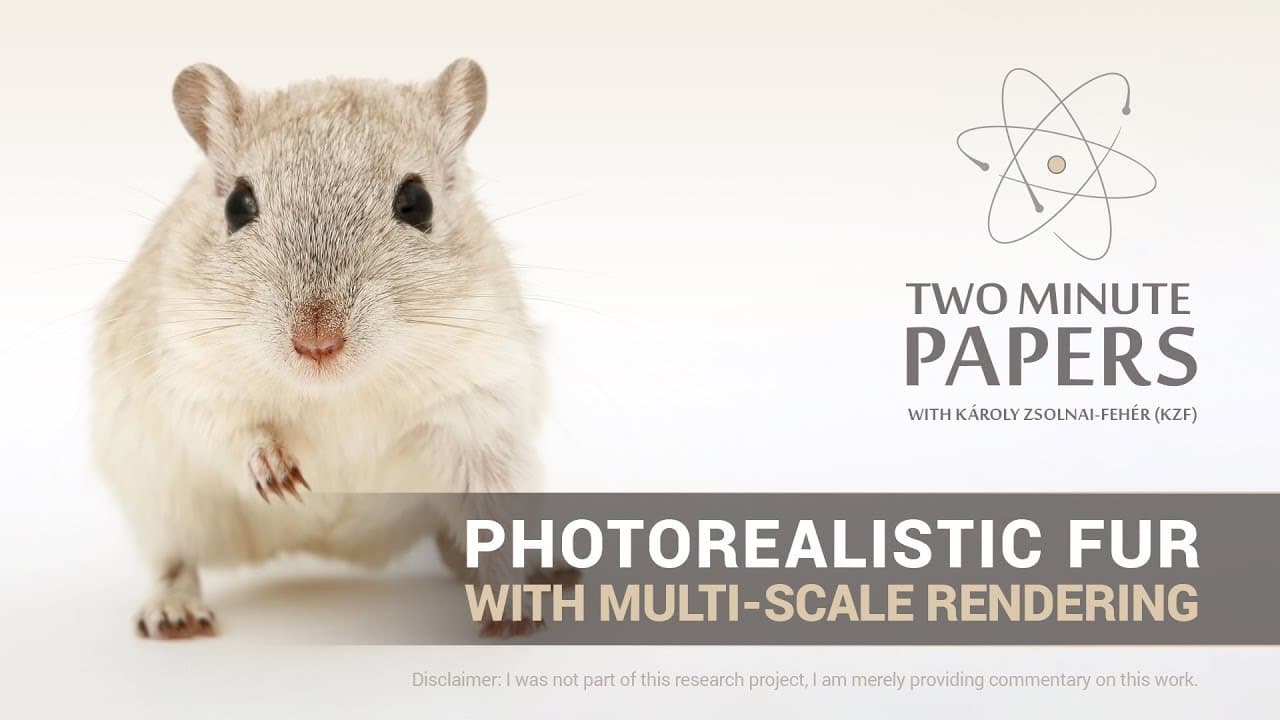
Photorealistic Fur With Multi-Scale Rendering | Two Minute Papers #183
TL;DR
New technique renders fur images efficiently, saving time and cost.
Transcript
Dear Fellow Scholars, this is Two Minute Papers with Károly Zsolnai-Fehér. Creating a photorealistic image with fur and hair is hard. It is typically done by using light simulation programs where we use the laws of physics to simulate the path of millions and millions of light rays as they bounce off of different objects in a scene. This typically ... Read More
Key Insights
- 🙂 Hair and fur rendering is challenging due to light simulation complexity.
- 💨 New technique optimizes samples per pixel for clearer and faster rendering.
- 🧑🌾 Multi-scale model separates near and far-field scattering for efficiency.
- ⌛ The technique saves time and cost in rendering photorealistic images.
- 🏑 Near-field model is more accurate but computationally expensive.
- 💨 Far-field scattering model is faster to compute at the expense of fidelity.
- 🧑🌾 Stitching together near and far-field models optimizes visual quality.
Install to Summarize YouTube Videos and Get Transcripts
Explore YouTube Video Summarizer or Get YouTube Transcript Extractor
Questions & Answers
Q: Why is creating photorealistic images with fur and hair difficult?
Creating such images is hard due to the complex simulation of light rays bouncing off objects and inner scattering media in fur fibers.
Q: How does the new technique improve image quality while reducing rendering time?
The new technique optimizes samples per pixel, allowing for clearer images at lower sample counts compared to previous methods, saving time and cost.
Q: What is the main innovation of this work in rendering hair and fur?
The main innovation is the introduction of a multi-scale model that computes near and far-field scattering separately, optimizing computation time and visual fidelity.
Q: Why is the near-field model more expensive to compute?
The near-field model is more faithful to reality but requires more computation as it accurately simulates light transmission between inner layers of fur fibers.
Summary & Key Takeaways
-
Creating photorealistic images with fur and hair is challenging due to light simulation.
-
New technique reduces noise in images by optimizing samples per pixel.
-
Multi-scale model renders near and far-field scattering separately for faster computation.
Read in Other Languages (beta)
Share This Summary 📚
Summarize YouTube Videos and Get Video Transcripts with 1-Click
Try YouTube Summary with ChatGPT & Claude or YouTube Transcript Generator
Explore More Summaries from Two Minute Papers 📚

Summarize YouTube Videos and Get Video Transcripts with 1-Click
Try YouTube Summary with ChatGPT & Claude or YouTube Transcript Generator