Kinematics and force example
TL;DR
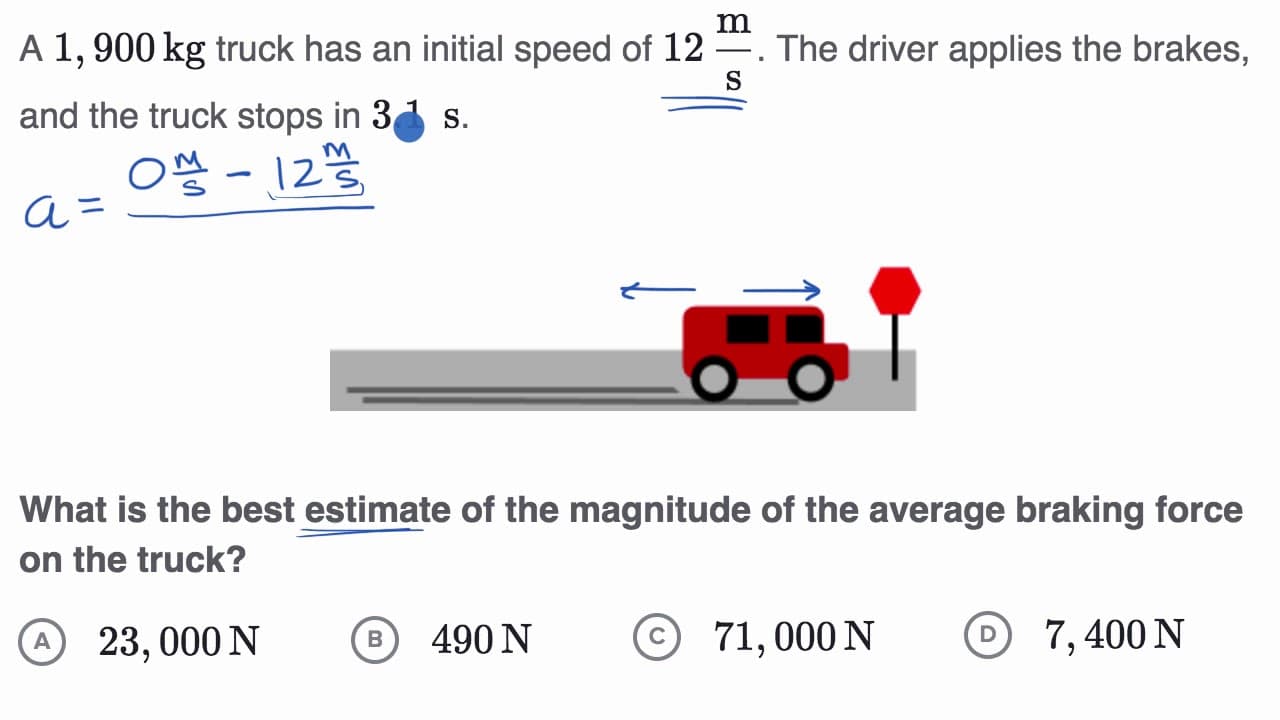
Estimate the magnitude of the average braking force on a 1,900-kilogram truck based on its initial speed and the time it takes to stop.
Transcript
- [Instructor] A 1,900 kilogram truck has an initial speed of 12 meters per second. The driver applies the brakes and the truck stops in 3.1 seconds. What is the best estimate of the magnitude of the average braking force on the truck? Pause this video, see if you can work this out. All right, probably the simplest way to approach this is to say, w... Read More
Key Insights
- 💱 The average acceleration during braking can be determined by dividing the change in velocity by the change in time.
- 👻 Newton's second law relates force, mass, and acceleration, allowing us to calculate the average braking force.
- 🤩 The negative sign indicates that the acceleration and force are in the opposite direction to the truck's initial motion.
- 😚 Estimating the magnitude of the force is sufficient to identify the closest option among the given choices.
- 🤩 The mass and initial velocity of the truck affect the magnitude of the braking force.
Install to Summarize YouTube Videos and Get Transcripts
Explore YouTube Video Summarizer or Get YouTube Transcript Extractor
Questions & Answers
Q: How can we estimate the average braking force on a truck?
To estimate the average braking force, we can calculate the average acceleration during braking and then use Newton's second law: force = mass × acceleration.
Q: What is the formula for calculating acceleration during braking?
The formula for acceleration during braking is given by the change in velocity divided by the change in time.
Q: Why is the acceleration during braking negative?
The acceleration during braking is negative because it opposes the direction of motion, causing the vehicle to slow down.
Q: Why did the instructor estimate the acceleration and force values?
The instructor estimated the values to provide an approximate answer within the given choices. The actual values might be slightly different, but the estimate helps identify the closest option.
Q: What is Newton's second law of motion?
Newton's second law states that the force acting on an object is equal to the mass of the object multiplied by its acceleration.
Q: How does the mass of the truck affect the braking force?
The greater the mass of the truck, the greater the braking force required to stop it within a given time. The force needed is directly proportional to the mass.
Q: How does the initial speed of the truck impact the braking force?
The higher the initial speed of the truck, the greater the deceleration and braking force needed to bring it to a stop within a given time period.
Q: Why is the magnitude of the braking force more important in this case?
The magnitude of the braking force is more important as the direction is already determined (opposite to the motion). By focusing on magnitude, we can compare the given choices accurately.
Summary & Key Takeaways
-
A 1,900-kilogram truck initially travels at 12 meters per second and comes to a stop in 3.1 seconds.
-
The average acceleration during braking is approximately -4 meters per second squared.
-
Using Newton's second law, the estimate for the magnitude of the average braking force is approximately 7,600 Newtons.
Read in Other Languages (beta)
Share This Summary 📚
Summarize YouTube Videos and Get Video Transcripts with 1-Click
Try YouTube Summary with ChatGPT & Claude or YouTube Transcript Generator
Explore More Summaries from Khan Academy 📚



Summarize YouTube Videos and Get Video Transcripts with 1-Click
Try YouTube Summary with ChatGPT & Claude or YouTube Transcript Generator