Stokes' theorem proof part 1 | Multivariable Calculus | Khan Academy
TL;DR
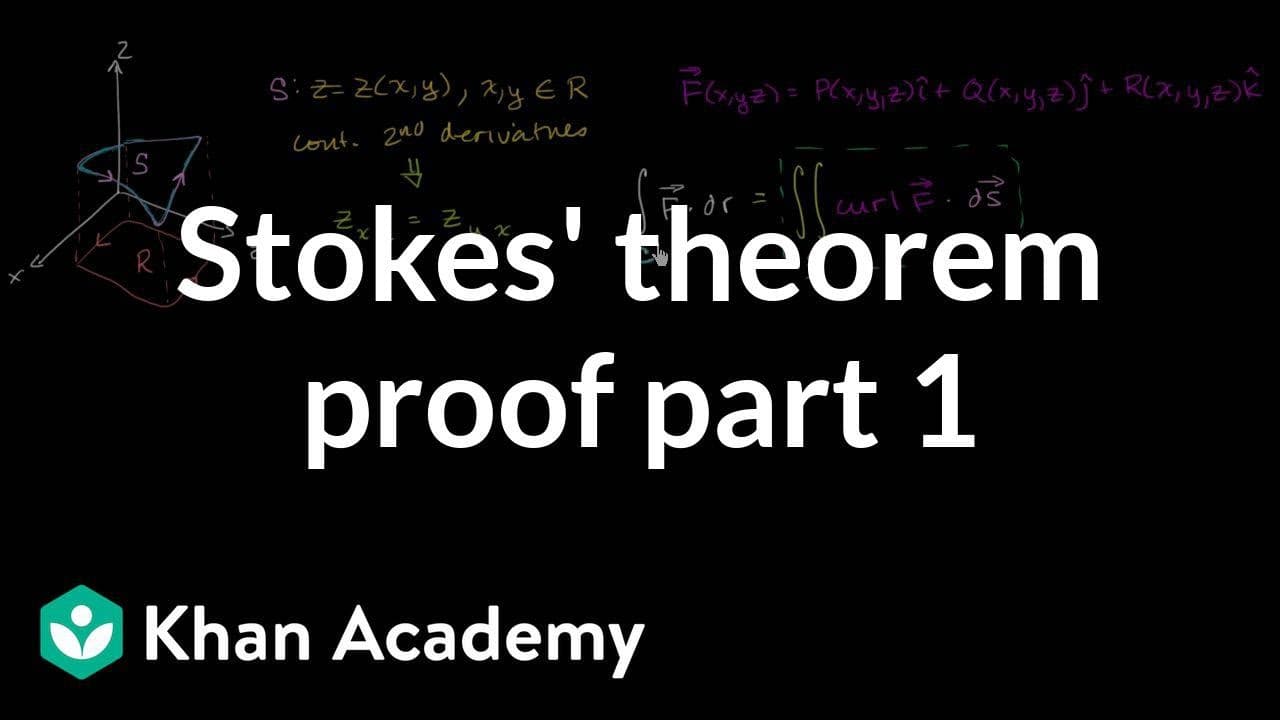
In this video, the instructor attempts to prove a special case version of Stokes' theorem for a surface that is a function of x and y.
Transcript
- [Instructor] In this video, I will attempt to prove, or actually this and the next several videos, attempt to prove a special case version of Stokes' theorem or essentially Stokes' theorem for a special case. And I'm doing this because the proof will be a little bit simpler, but at the same time it's pretty convincing. And the special case we're ... Read More
Key Insights
- ❣️ The special case of Stokes' theorem assumes a surface that is a function of x and y, simplifying the proof.
- 🥹 The function describing the surface must have continuous second-order derivatives for the proof to hold.
- 😚 Stokes' theorem relates a line integral around a closed path to a surface integral of the curl of a vector field over the bounded surface.
Install to Summarize YouTube Videos and Get Transcripts
Explore YouTube Video Summarizer or Get YouTube Transcript Extractor
Questions & Answers
Q: What is the special case version of Stokes' theorem discussed in the video?
The special case assumes that the surface is a function of x and y only, and not z. This simplifies the proof while still being convincing.
Q: Why is it important for the function describing the surface to have continuous second-order derivatives?
This assumption allows us to equate the mixed partial derivatives of z, which is necessary to prove Stokes' theorem in this specific case.
Q: How is Stokes' theorem typically stated?
Stokes' theorem states that the line integral of a vector field around a closed path is equal to the surface integral of the curl of the vector field over the surface bounded by the path.
Q: What is the goal of the next video?
In the next video, the instructor will focus on expressing the surface integral part of Stokes' theorem for the special case described, using the assumptions made.
Summary & Key Takeaways
-
The video aims to prove a special case version of Stokes' theorem for a surface that can be expressed as a function of x and y.
-
The proof assumes that the function describing the surface has continuous second-order derivatives.
-
Stokes' theorem states that the line integral of a vector field around a closed path is equal to the surface integral of the curl of the vector field over the surface bounded by the path.
Read in Other Languages (beta)
Share This Summary 📚
Summarize YouTube Videos and Get Video Transcripts with 1-Click
Try YouTube Summary with ChatGPT & Claude or YouTube Transcript Generator
Explore More Summaries from Khan Academy 📚



Summarize YouTube Videos and Get Video Transcripts with 1-Click
Try YouTube Summary with ChatGPT & Claude or YouTube Transcript Generator