How do task constraints shape the organization of degrees of freedom in movement?
TL;DR
Task constraints shape motor synergies and control in movement.
Transcript
hi everyone this is rob gray from asu in the perception action podcast again and this is the fifth article in my review series looking at some of my favorite articles from 2020. in this one the topic is going to be focusing on organization of degrees of freedom and movement and talking about motor synergies so let's what we're essentially talking a... Read More
Key Insights
- The degrees of freedom problem in movement involves selecting joint configurations for tasks like serving a volleyball, which can be addressed through motor synergies.
- Motor synergies involve coupling joint movements to work together, allowing one joint's movement to compensate for another, specific to the task being performed.
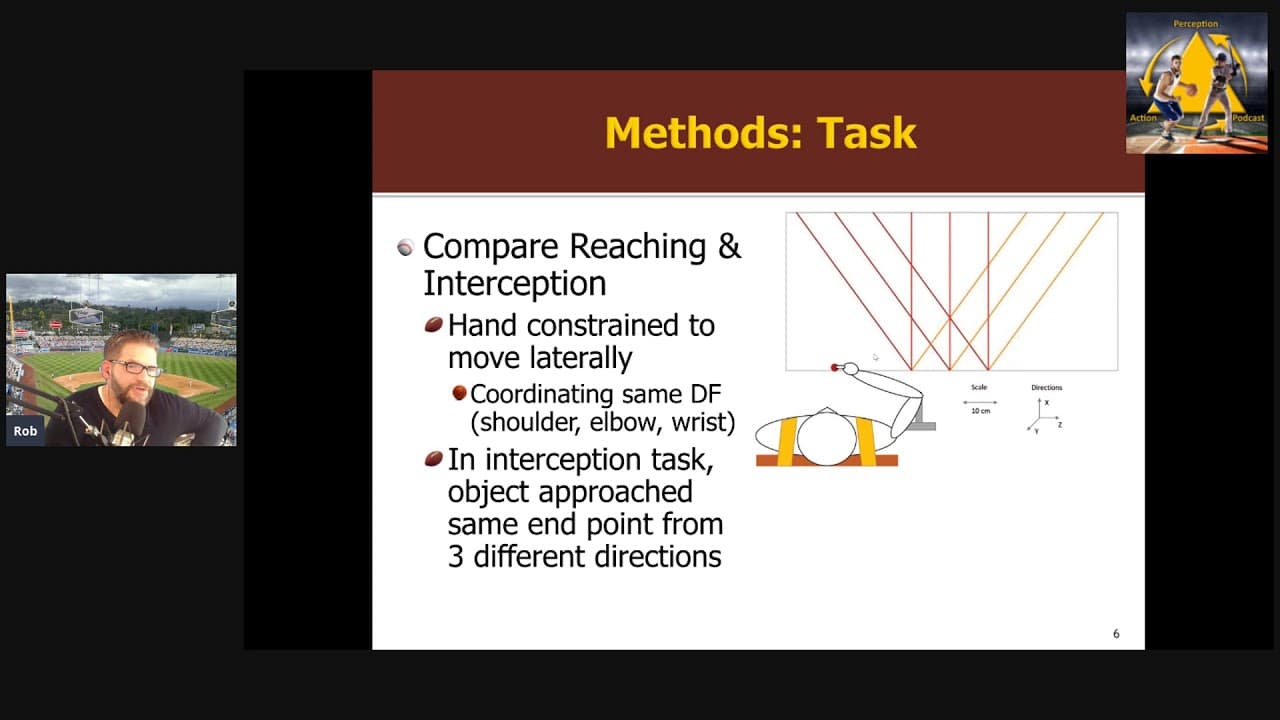
- The study by Toure et al. investigates how task constraints shape motor synergies by comparing reaching and interception tasks with controlled variables.
- Constraints can operate at two levels: forming the basic coordination pattern and specifying the control values within the synergy.
- The study uses uncontrolled manifold analysis to separate variability into task-relevant (good) and task-irrelevant (bad) components, showing evidence of synergies.
- Results show different movement profiles for reaching and interception tasks, indicating different control strategies and the influence of perspective online control.
- Task constraints like target movement affect the creation of different synergies, while others like approach angle affect control within the same synergy.
- The research highlights the importance of using simple tasks in laboratory settings to understand complex motor control processes and task constraints.
Install to Summarize YouTube Videos and Get Transcripts
Explore YouTube Video Summarizer or Get YouTube Transcript Extractor
Questions & Answers
Q: What is the degrees of freedom problem in movement?
The degrees of freedom problem in movement, as proposed by Bernstein, involves selecting from a vast array of possible joint configurations to perform a task. This problem is exemplified in activities like serving a volleyball, where athletes must choose the optimal combination of shoulder, elbow, and wrist angles to achieve the desired outcome.
Q: How do motor synergies help in solving the degrees of freedom problem?
Motor synergies help solve the degrees of freedom problem by coupling joint movements so they work together. This allows one joint's movement to compensate for another, creating a temporary organization specific to the task. Such synergies enable athletes to perform complex movements efficiently by reducing the number of independent variables they need to control.
Q: What are the two levels at which task constraints operate?
Task constraints operate at two levels. The first is coordination, where constraints shape the basic pattern of movement or synergy. The second is control, where constraints specify the exact values within the synergy to achieve the task goal. These levels influence both the formation of synergies and the precise control needed for task execution.
Q: How does the study by Toure et al. investigate task constraints?
The study by Toure et al. investigates task constraints by comparing reaching and interception tasks, using the same degrees of freedom in both. They employ uncontrolled manifold analysis to separate variability into task-relevant and task-irrelevant components, examining how constraints affect synergy formation and control across different tasks and conditions.
Q: What is uncontrolled manifold analysis?
Uncontrolled manifold analysis is a method used to separate movement variability into components that affect task performance (bad variability) and those that do not (good variability). This analysis helps identify motor synergies by showing how joint configurations co-vary to maintain task performance, providing insights into the coordination and control of movement.
Q: What did the study find about movement profiles in reaching and interception tasks?
The study found distinct movement profiles for reaching and interception tasks. Reaching tasks exhibited symmetrical velocity profiles with peak velocity occurring midway, while interception tasks showed asymmetrical profiles with earlier peak velocity and longer deceleration phases. These differences reflect different control strategies and the influence of perspective online control in interception tasks.
Q: How do task constraints affect synergies and control?
Task constraints affect synergies by determining the joint configurations and their coordination in space. Constraints like target movement create distinct synergies, while others like approach angle influence control within the same synergy. This dual impact shows how constraints shape both the formation of synergies and the precise control needed for task execution.
Q: Why is the study significant for understanding motor control?
The study is significant for understanding motor control as it demonstrates how task constraints influence synergy formation and control strategies. By using simple laboratory tasks, it provides insights into complex motor control phenomena, highlighting the role of synergies in solving the degrees of freedom problem and the importance of perspective online control in task execution.
Summary & Key Takeaways
-
The study explores how task constraints shape motor synergies, using reaching and interception tasks to analyze joint coordination. Results show that constraints operate at different levels, influencing both synergy formation and control. The research highlights the role of perspective online control and the importance of simple laboratory tasks in understanding motor control.
-
Motor synergies are key to solving the degrees of freedom problem in movement, allowing joints to co-vary and work together. The study by Toure et al. uses uncontrolled manifold analysis to demonstrate how task constraints influence synergy creation and control, providing insights into motor control strategies.
-
Task constraints shape movement organization by affecting motor synergies and control strategies. The study compares reaching and interception tasks, showing how different constraints lead to different synergies and control levels. Results emphasize the value of simple tasks in studying complex motor control phenomena.
Read in Other Languages (beta)
Share This Summary 📚
Summarize YouTube Videos and Get Video Transcripts with 1-Click
Try YouTube Summary with ChatGPT & Claude or YouTube Transcript Generator
Explore More Summaries from Rob Gray 📚
Summarize YouTube Videos and Get Video Transcripts with 1-Click
Try YouTube Summary with ChatGPT & Claude or YouTube Transcript Generator