Graphical relations and functions | Functions and their graphs | Algebra II | Khan Academy
TL;DR
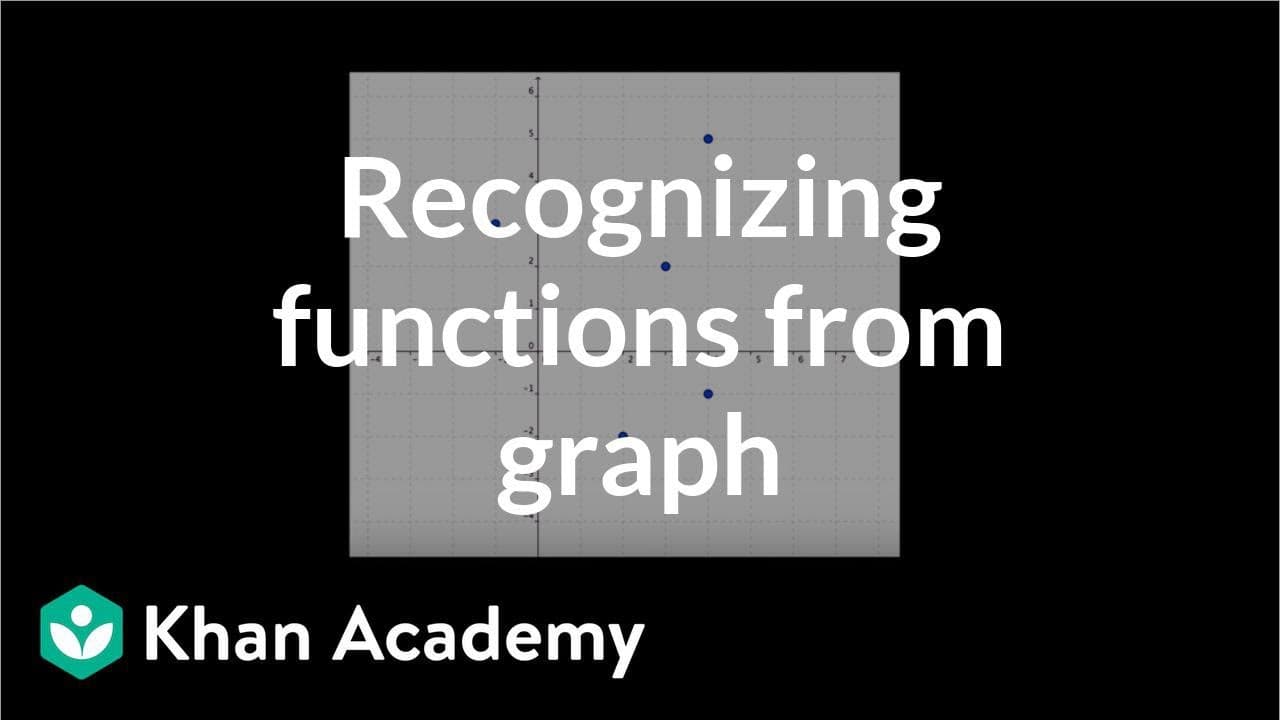
Determine if the points on a graph represent a function by checking if each input value has only one corresponding output value.
Transcript
Determine whether the points on this graph represent a function. Now, just as a refresher, a function is really just an association between members of a set that we call the domain and members of the set that we call a range. So if I take any member of the domain, let's call that x, and I give it to the function, the function should tell me what me... Read More
Key Insights
- 🔠 A function is an association between input and output values, where each input has a unique output value.
- 📈 To determine if a graph represents a function, check if every input value has only one corresponding output value.
- 📈 A graph is not a function if any input value is associated with multiple output values.
- 🫥 The vertical line test can be used to check if a graph represents a function.
- 🔂 Functions are considered well-behaved relations where each input has a single output.
- 💄 Relations can have multiple outputs for a single input, making them different from functions.
- 🧡 The domain represents the valid input values for a function, and the range represents the corresponding output values.
Install to Summarize YouTube Videos and Get Transcripts
Explore YouTube Video Summarizer or Get YouTube Transcript Extractor
Questions & Answers
Q: What defines a function?
A function is defined as an association between the members of a domain (input values) and the members of a range (output values), where each input has only one output.
Q: How can we determine if a graph represents a function?
By checking if each input value in the domain has a unique output value in the range. If any input value has multiple associated output values, the graph does not represent a function.
Q: Is it possible for a graph to represent both functions and relations?
Yes, a graph can represent both functions and relations. If each input value has a single corresponding output value, it is a function. If there are points where one input value has multiple output values, it is a relation but not a function.
Q: What is the vertical line test?
The vertical line test is a test used to determine if a graph represents a function. If a vertical line intersects the graph at only one point for each input value, it is a function. If it intersects at multiple points, it is not a function.
Summary & Key Takeaways
-
A function is an association between the members of a domain and the members of a range, where each input value has a unique output value.
-
For a graph to represent a function, each input value in the domain must have only one corresponding output value in the range.
-
If a graph has any points where multiple output values are associated with a single input value, it is not a function but a relation.
Read in Other Languages (beta)
Share This Summary 📚
Summarize YouTube Videos and Get Video Transcripts with 1-Click
Try YouTube Summary with ChatGPT & Claude or YouTube Transcript Generator
Explore More Summaries from Khan Academy 📚



Summarize YouTube Videos and Get Video Transcripts with 1-Click
Try YouTube Summary with ChatGPT & Claude or YouTube Transcript Generator