How to Calculate 2D Curl in Vector Fields
TL;DR
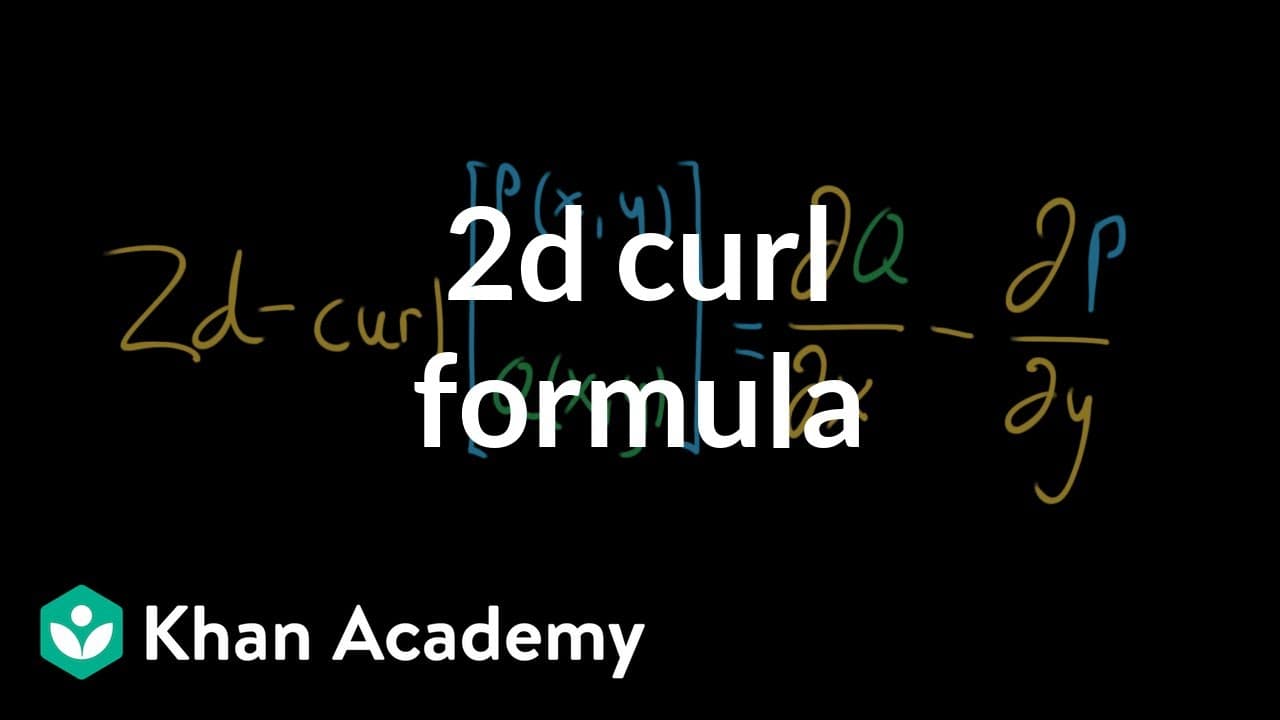
The 2D curl of a vector field measures rotation at a specific point, calculated as the partial derivative of q with respect to x minus the partial derivative of p with respect to y. Understanding this formula helps quantify the rotation in two-dimensional vector fields.
Transcript
- [Voiceover] So after introducing the idea of fluid rotation in a vector field like this, let's start tightening up our grasp on this intuition to get something that we can actually apply formulas to. So a vector field like the one that I had there, that's two-dimensional, is given by a function that has a two-dimensional input and a two-dimension... Read More
Key Insights
- 😀 A two-dimensional vector field is represented by functions p and q.
- 😥 The curl of a two-dimensional vector field is a scalar-valued function that measures rotation at each point.
- 😆 The curl formula involves taking the partial derivatives of p and q and subtracting them.
- 🔄 Positive curl indicates counter-clockwise rotation, while negative curl indicates clockwise rotation.
- 😆 The partial derivative of p with respect to y and q with respect to x determine the sign of the curl.
- 👻 The curl formula allows for quantifying the amount of rotation in a vector field.
- 😆 Understanding the partial derivatives of p and q is crucial in determining the curl of a two-dimensional vector field.
Install to Summarize YouTube Videos and Get Transcripts
Explore YouTube Video Summarizer or Get YouTube Transcript Extractor
Questions & Answers
Q: What is the difference between a vector field and its curl?
A vector field represents the magnitude and direction of vectors at each point in space, while the curl of a vector field measures the rotation of vectors around a point.
Q: How are the components of the vector field related to the partial derivatives in the curl formula?
The function q corresponds to the y-component of the vectors, while the function p corresponds to the x-component. The partial derivatives of q with respect to x and p with respect to y inform the curl calculation.
Q: Can you explain the scenario that demonstrates positive curl?
In the scenario described, the vectors to the right and below the point have positive q and p values, respectively, while the vectors to the left and above the point have negative q and p values. This configuration indicates positive curl.
Q: Why is the partial derivative of p with respect to y negative for positive curl?
The partial derivative of p with respect to y measures how p changes as the y-component increases. In the scenario with positive curl, p starts positive and decreases as y increases, resulting in a negative partial derivative.
Summary & Key Takeaways
-
A vector field in two dimensions is represented by functions p and q, which take in two variables as inputs.
-
The curl of a two-dimensional vector field is a scalar-valued function that measures rotation at a specific point.
-
The formula for two-dimensional curl is the partial derivative of q with respect to x minus the partial derivative of p with respect to y.
Read in Other Languages (beta)
Share This Summary 📚
Summarize YouTube Videos and Get Video Transcripts with 1-Click
Try YouTube Summary with ChatGPT & Claude or YouTube Transcript Generator
Explore More Summaries from Khan Academy 📚



Summarize YouTube Videos and Get Video Transcripts with 1-Click
Try YouTube Summary with ChatGPT & Claude or YouTube Transcript Generator