What Are the Key Features of OpenAI's GPT-4.1?
TL;DR
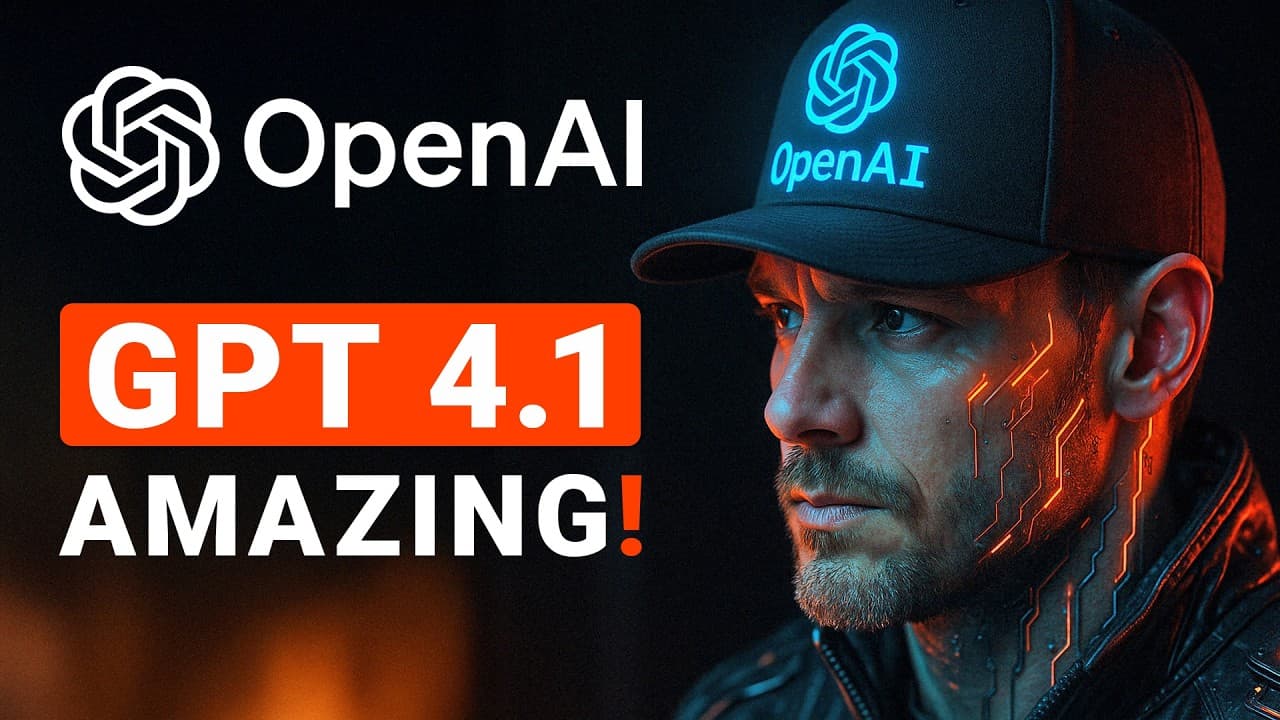
OpenAI's GPT-4.1 introduces significant advancements, including a context window of 1 million tokens and improved coding performance, outperforming previous models. This makes it more user-friendly for tasks like coding and content generation, although some accuracy challenges remain in complex problems. Competition from models like Google DeepMind's Gemini 2.5 Pro is pushing innovation forward.
Transcript
Alright, GPT 4.1. Three new models just appeared, 4.1, mini, and nano. This is a mainly coding-focused AI assistant, previously if you wanted to create a flash card app from just one text prompt, I mean, this is okay, it kinda works — you can create and review your flash cards. However, if you look at the new one, the bones are very simil... Read More
Key Insights
- 💋 The introduction of models like 4.1 and its variants marks a significant leap in AI usability and performance, especially in coding applications.
- 👻 A context length of 1 million tokens allows for more extensive data manipulation and improved query responses in AI systems.
- ⁉️ Benchmarks in AI performance assessment can become unreliable as models are exposed to vast amounts of training data, necessitating a shift to unseen question testing.
- 🛟 Humanity’s Last Exam serves as a baseline for evaluating AI models' problem-solving capacities, revealing stark contrasts between human intelligence and AI capabilities.
- 😀 AI development increasingly faces challenges in both training complexity and data efficiency as models grow in scale and need.
- ❤️🩹 The competition between AI firms promotes technological advancements, ensuring ongoing innovation and better options for end users.
- 👶 Google DeepMind's Gemini 2.5 Pro is a formidable new option in AI capabilities, showcasing the evolving landscape of AI technologies.
Install to Summarize YouTube Videos and Get Transcripts
Explore YouTube Video Summarizer or Get YouTube Transcript Extractor
Questions & Answers
Q: What are the key features of the new AI models introduced?
The new AI models, including 4.1, mini, and nano, emphasize usability and coding performance. Each model serves a unique purpose, with nano focusing on speed for tasks like auto-completion while 4.1 excels in complex coding tasks. Notable advancements include a context window capable of handling 1 million tokens, allowing for extensive data processing and usability improvements.
Q: How does the performance of GPT 4.1 compare to previous versions?
GPT 4.1 performs remarkably well compared to its predecessor 4.5, particularly in coding tasks. It has even outperformed slower thinking AIs, making it a noteworthy advancement in AI development. The extensive context window and optimizations have significantly improved its functionality and versatility in handling complex queries.
Q: What challenges do AI models face in training and performance evaluation?
AI models, particularly the newer ones, experience unique training challenges, including the need for immense computational power and data efficiency. As the amount of data increases, it becomes a bottleneck, necessitating innovative methodologies to maximize the benefits of existing datasets. Furthermore, traditional benchmarks can become obsolete as models can quickly learn from similar queries.
Q: What is Humanity’s Last Exam, and what does it reveal about AI capabilities?
Humanity’s Last Exam is a test designed to evaluate AI models based on questions created by the smartest individuals across various fields. The results show that even advanced models struggle with entirely new, obscure questions, indicating limitations in their reasoning and problem-solving capabilities compared to human intelligence and creativity.
Q: How can training data inefficiencies affect AI performance?
Training data inefficiencies can lead to limitations in AI performance, especially as systems grow increasingly complex. Just like a small flaw can become a critical failure in larger, intricate systems, small errors in AI training may magnify over time. This highlights the importance of optimizing data utilization to achieve better performance without overwhelming computational needs.
Q: Why does the competition among AI developers matter for consumers?
The competition among AI developers, such as OpenAI and Google DeepMind, benefits consumers by driving innovation and improvement in AI technologies. As companies strive to outdo each other, they frequently provide advanced models, tools, and capabilities at low or no cost, making these technologies accessible and continually improving the user experience.
Q: What unique position does Google DeepMind's Gemini 2.5 Pro hold compared to other models?
Google DeepMind's Gemini 2.5 Pro stands out for its exceptional performance across numerous benchmarks, often outperforming rivals like GPT 4.1 in various task assessments. This achievement signifies a resurgence in Google’s capabilities within the AI sector, positioning it as a strong contender in the ongoing race for AI supremacy.
Q: How can private datasets enhance the testing of AI models?
Utilizing private datasets in the testing of AI models can provide a more accurate measure of their capabilities, as these datasets are often curated to include difficult or unseen questions. This approach can help ensure that AI systems are evaluated on their true reasoning ability, rather than their performance on familiar content, giving a clearer picture of their potential limitations.
Summary & Key Takeaways
-
The latest AI models, including 4.1, mini, and nano, show tremendous advancements, particularly in coding tasks and usability, transforming previous functionalities into more user-friendly features.
-
OpenAI's 4.1 model boasts an impressive 1 million token context window and excels in coding performance despite some accuracy issues in complex multi-faceted tasks, compared to its competitors.
-
Benchmarks in AI performance are becoming less reliable as models have trained on vast datasets, leading to suggestions for private datasets being a potential solution for future assessments.
Read in Other Languages (beta)
Share This Summary 📚
Summarize YouTube Videos and Get Video Transcripts with 1-Click
Try YouTube Summary with ChatGPT & Claude or YouTube Transcript Generator
Explore More Summaries from Two Minute Papers 📚



Summarize YouTube Videos and Get Video Transcripts with 1-Click
Try YouTube Summary with ChatGPT & Claude or YouTube Transcript Generator