How to Build and Optimize Decision Trees in Python
TL;DR
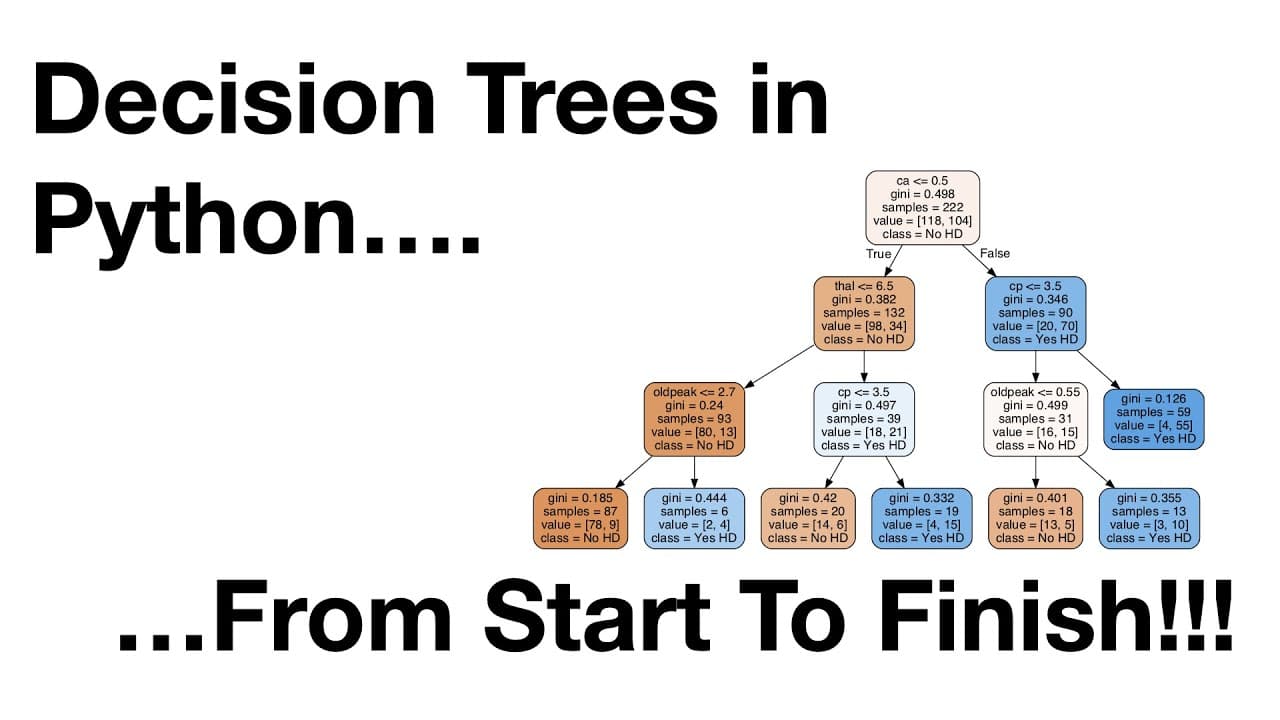
To build and optimize decision trees in Python, import your data, clean it, and handle missing values. Use scikit-learn for creating the decision tree, then apply cost complexity pruning to improve model accuracy and prevent overfitting by identifying the optimal alpha value through cross-validation.
Transcript
decision trees from stock to finch in python we're gonna do it today hip hip hooray stat quest great well thank you guys very much for joining me for my uh webinar in decision trees from start to finish in python i'm going to share the screen right here uh can you guys all see that i'm sharing the uh this jupiter notebook um i hope everyone can see... Read More
Key Insights
- 🌲 Decision trees provide interpretable insights into dataset features and classifications.
- 👋 Cost complexity pruning optimizes decision tree models by finding the best alpha value for improved accuracy.
- 😵 Cross-validation ensures rigorous evaluation of decision tree models on varied subsets of data.
- 😅 One hot encoding is essential for converting categorical data into binary form for effective decision tree analysis.
- 🌲 Pruned decision trees simplify structures, reduce overfitting, and enhance performance for predictive analytics.
- 🌲 Random forests offer complexity over decision trees, but decision trees are simpler and easier to interpret.
- 🌲 Machine learning in Python, using scikit-learn, provides powerful tools for developing decision tree models.
Install to Summarize YouTube Videos and Get Transcripts
Explore YouTube Video Summarizer or Get YouTube Transcript Extractor
Questions & Answers
Q: How does cost complexity pruning help to improve decision trees?
Cost complexity pruning optimizes decision trees by finding the right alpha value, reducing overfitting, and improving accuracy by simplifying the tree structure.
Q: What is one hot encoding, and why is it important in decision tree analysis?
One hot encoding is crucial for representing categorical data as binary values in decision trees, ensuring equitable comparisons between different categories for accurate predictions.
Q: How does cross-validation enhance the evaluation of decision trees' performance?
Cross-validation allows for better assessment of decision tree models by testing them on multiple folds of data, ensuring robustness and unbiased evaluation of performance.
Q: What is the significance of pruning decision trees in model optimization?
Pruning decision trees improves the model's generalization by reducing complexity, overfitting, and enhancing interpretability, leading to more accurate predictions.
Summary & Key Takeaways
-
The webinar covers importing and formatting data, dealing with missing data, and building a preliminary decision tree in Python for predicting heart disease.
-
Cost complexity pruning optimizes the tree for better performance and interpretation.
-
Using cross-validation ensures the optimal choice of pruning parameter for accurate predictions.
Read in Other Languages (beta)
Share This Summary 📚
Summarize YouTube Videos and Get Video Transcripts with 1-Click
Try YouTube Summary with ChatGPT & Claude or YouTube Transcript Generator
Explore More Summaries from StatQuest with Josh Starmer 📚

Summarize YouTube Videos and Get Video Transcripts with 1-Click
Try YouTube Summary with ChatGPT & Claude or YouTube Transcript Generator