How to Solve Triangle Problems and Calculate Angles
TL;DR
To solve triangle problems, remember that the sum of the interior angles is always 180 degrees. Use this property to find missing angles by setting up equations based on the known angles. Apply the exterior angle theorem and the mid-segment theorem for additional methods to calculate angles and segment lengths.
Transcript
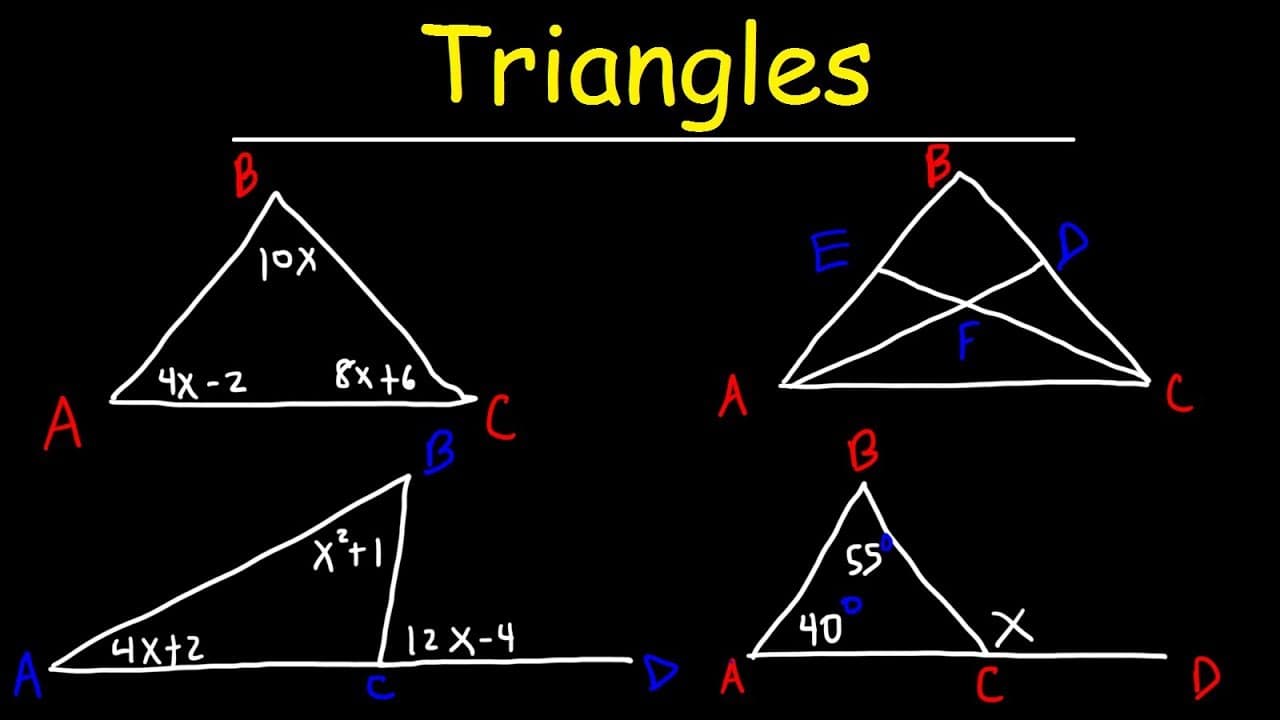
in this video we're going to focus on solving problems associated with triangles so let's start with the one in front of us what is the value of x in the figure below so we have the measure of angle a and b but we need to calculate the measure of angle c which is represented by x now what you need to know is that the three measures of a triangle th... Read More
Key Insights
- 🔺 The sum of the angles in a triangle is always 180 degrees.
- 🔺 The exterior angle of a triangle is equal to the sum of the remote interior angles.
- 🔺 In an isosceles triangle, the angles opposite the congruent sides are congruent.
- 🙃 The mid-segment theorem can be used to find the length of a segment in a triangle when it is parallel to one side and touches the midpoints of the other two sides.
- 🪜 The angles of a quadrilateral add up to 360 degrees.
Install to Summarize YouTube Videos and Get Transcripts
Explore YouTube Video Summarizer or Get YouTube Transcript Extractor
Questions & Answers
Q: How do you calculate the measure of angle C in a triangle when angles A and B are given?
To find the measure of angle C, subtract the sum of angles A and B from 180 degrees. For example, if angle A is 60 degrees and angle B is 70 degrees, angle C would be 180 - (60 + 70) = 50 degrees.
Q: How can you determine the measure of angle B in a triangle when the measures of angles A and C are given?
If angles A and C are known, subtract their sum from 180 degrees to find the measure of angle B. For example, if angle A is 4x - 2 and angle C is 8x + 6, you can solve the equation (4x - 2) + (8x + 6) = 180 to find the value of x, and then calculate the measure of angle B.
Q: How can you calculate the measure of angle A in an isosceles triangle?
In an isosceles triangle, the angles opposite the congruent sides are also congruent. To find the measure of angle A, set the measure of the other congruent angle (x) equal to the expression for angle A, and solve for x. For example, if x equals 65 degrees, then angle A would also be 65 degrees.
Q: How can you determine the measure of angle 5 in a figure where angles 2, 3, and 4 are known?
If angles 2, 3, and 4 form a triangle, subtract the sum of angles 2 and 3 from 180 to find angle 4. Then, subtract angle 4 from 180 to find angle 5. For example, if angle 2 is 120 degrees, angle 3 is 100 degrees, and angle 4 is 40 degrees, angle 5 would be 180 - 40 = 140 degrees.
Summary & Key Takeaways
-
The video provides step-by-step instructions on solving triangle problems and calculating missing angles.
-
It explains the concept of the angles of a triangle adding up to 180 degrees and demonstrates how to apply this concept to find missing angles.
-
The video also introduces the use of the exterior angle theorem and the mid-segment theorem to calculate angles and lengths in triangles.
Read in Other Languages (beta)
Share This Summary 📚
Summarize YouTube Videos and Get Video Transcripts with 1-Click
Try YouTube Summary with ChatGPT & Claude or YouTube Transcript Generator
Explore More Summaries from The Organic Chemistry Tutor 📚



Summarize YouTube Videos and Get Video Transcripts with 1-Click
Try YouTube Summary with ChatGPT & Claude or YouTube Transcript Generator