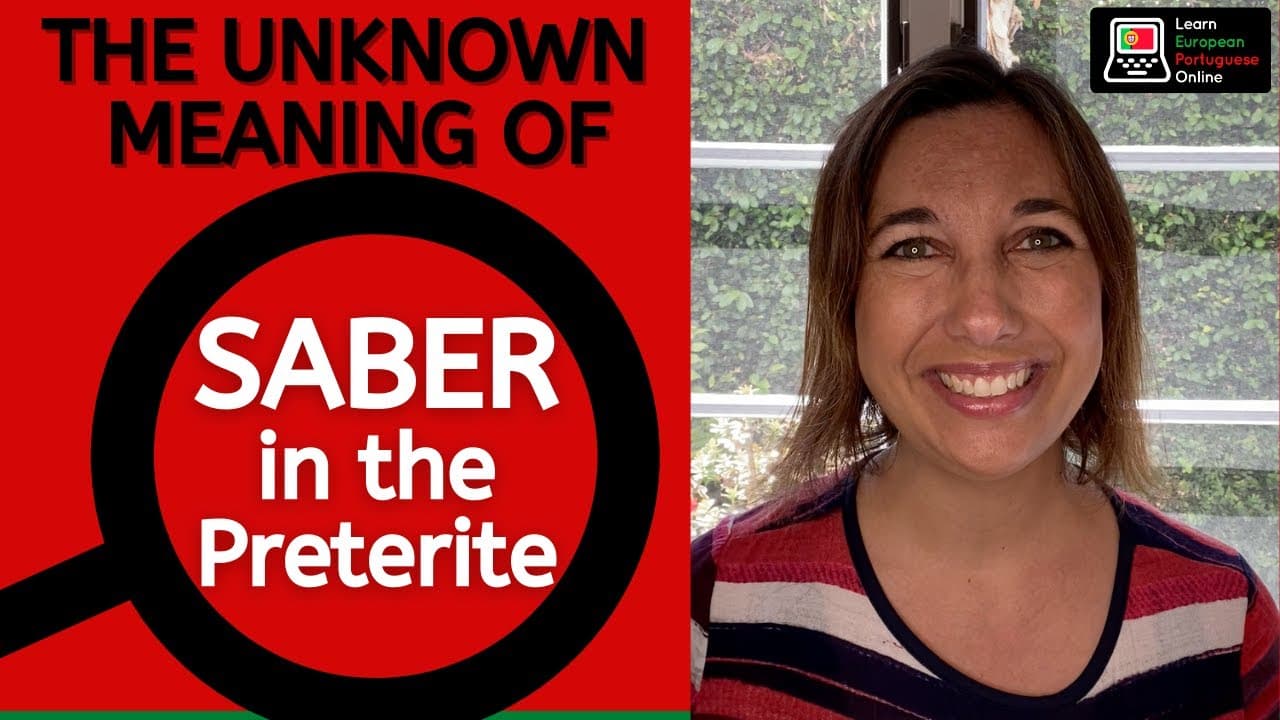
The mystery of the verb SABER. How to use SABER, DESCOBRIR and FICAR A SABER interchangeably!
TL;DR
Learn the diverse meanings of 'saber' in Portuguese.
Transcript
in today's episode i'm going to cover a very interesting topic did you know that there are portuguese verbs that depending on the verb tense the meaning can change when translated to english this difference happens mostly when we conjugate verbs in the preteri to purify to simples and input these tricky verbs can be very problematic for students to... Read More
Key Insights
- The verb 'saber' in Portuguese can change meaning based on the verb tense, particularly in the preterite perfect simple (PPS).
- 'Saber' typically means 'to know,' 'can,' or 'be able to,' but in PPS, it can also mean 'to hear,' 'to learn,' or 'to find out.'
- The video aims to clarify the use of 'saber' in PPS, ensuring learners can use it correctly in different contexts.
- Examples include 'Eu soube das notícias ontem,' which translates to 'I heard the news yesterday,' showcasing the verb's varied meanings.
- Other verbs like 'descobrir' and 'ficar a saber' can be used interchangeably with 'saber' in PPS to indicate discovering or finding out information.
- The video encourages learners to pay attention to verb conjugation to grasp the nuanced meanings of 'saber.'
- The presenter invites viewers to explore more about 'saber' and other common Portuguese verbs through additional resources.
- Engagement with the content is encouraged through likes, comments, and following on social media platforms for more learning materials.
Install to Summarize YouTube Videos and Get Transcripts
Explore YouTube Video Summarizer or Get YouTube Transcript Extractor
Questions & Answers
Q: What is the primary focus of the video content?
The primary focus of the video content is to educate viewers on the different meanings of the Portuguese verb 'saber' when used in the preterite perfect simple tense. The video aims to clarify how the verb's meaning can shift from 'to know' to 'to hear,' 'to learn,' or 'to find out,' depending on the context.
Q: How does the verb 'saber' change meaning in different tenses?
In Portuguese, the verb 'saber' typically means 'to know,' 'can,' or 'be able to.' However, when conjugated in the preterite perfect simple tense, its meaning can change to 'to hear,' 'to learn,' or 'to find out.' This shift in meaning is crucial for learners to understand to use the verb correctly in various contexts.
Q: What examples are provided to illustrate the use of 'saber'?
The video provides examples such as 'Eu soube das notícias ontem,' which translates to 'I heard the news yesterday.' This example illustrates how 'saber' in the preterite perfect simple tense can mean 'to hear' rather than its usual meaning of 'to know.' Such examples help learners grasp the verb's varied meanings.
Q: Are there alternative verbs that can be used similarly to 'saber'?
Yes, the video mentions alternative verbs like 'descobrir' and 'ficar a saber,' which can be used interchangeably with 'saber' in the preterite perfect simple tense. These verbs also convey the meanings of 'to discover' or 'to find out,' providing learners with options for expressing similar ideas in Portuguese.
Q: What advice is given for mastering the verb 'saber'?
The video advises learners to pay close attention to verb conjugations and the context in which 'saber' is used. Understanding these nuances is essential for mastering the verb's varied meanings. The presenter also encourages viewers to engage with additional resources and practice using 'saber' in different sentences.
Q: How does the video encourage viewer engagement?
The video encourages viewer engagement by inviting them to like, comment, and subscribe to the channel. It also suggests following the presenter on social media platforms like Facebook and Instagram for more content. Viewers are encouraged to explore additional resources and participate in discussions to enhance their learning experience.
Q: What additional resources are offered to viewers?
Viewers are offered additional resources such as links to the presenter's online store on Amazon, where they can purchase learning materials. The video also promotes a Patreon page for exclusive content and invites viewers to visit the presenter's website for more information about learning European Portuguese.
Q: What is the significance of understanding verb conjugations in Portuguese?
Understanding verb conjugations in Portuguese is crucial because it affects the meaning of verbs like 'saber.' Different tenses can change a verb's meaning entirely, which can lead to misunderstandings if not properly grasped. Mastery of conjugations allows learners to communicate more accurately and understand native speakers better.
Summary & Key Takeaways
-
The video explores the verb 'saber' in Portuguese, highlighting its different meanings when used in the preterite perfect simple tense. It can mean 'to know,' 'to hear,' 'to learn,' or 'to find out.' Examples and alternative verbs like 'descobrir' and 'ficar a saber' are discussed.
-
Learners are guided on how to use 'saber' correctly in various contexts, focusing on its nuanced meanings in different tenses. The presenter provides examples and encourages viewers to engage with additional resources for a deeper understanding.
-
The presenter emphasizes the importance of understanding verb conjugations to grasp the full range of meanings 'saber' can convey. The video serves as a practical guide for Portuguese learners, offering insights into common language pitfalls.
Read in Other Languages (beta)
Share This Summary 📚
Summarize YouTube Videos and Get Video Transcripts with 1-Click
Try YouTube Summary with ChatGPT & Claude or YouTube Transcript Generator
Explore More Summaries from Learn European Portuguese Online 📚




Summarize YouTube Videos and Get Video Transcripts with 1-Click
Try YouTube Summary with ChatGPT & Claude or YouTube Transcript Generator