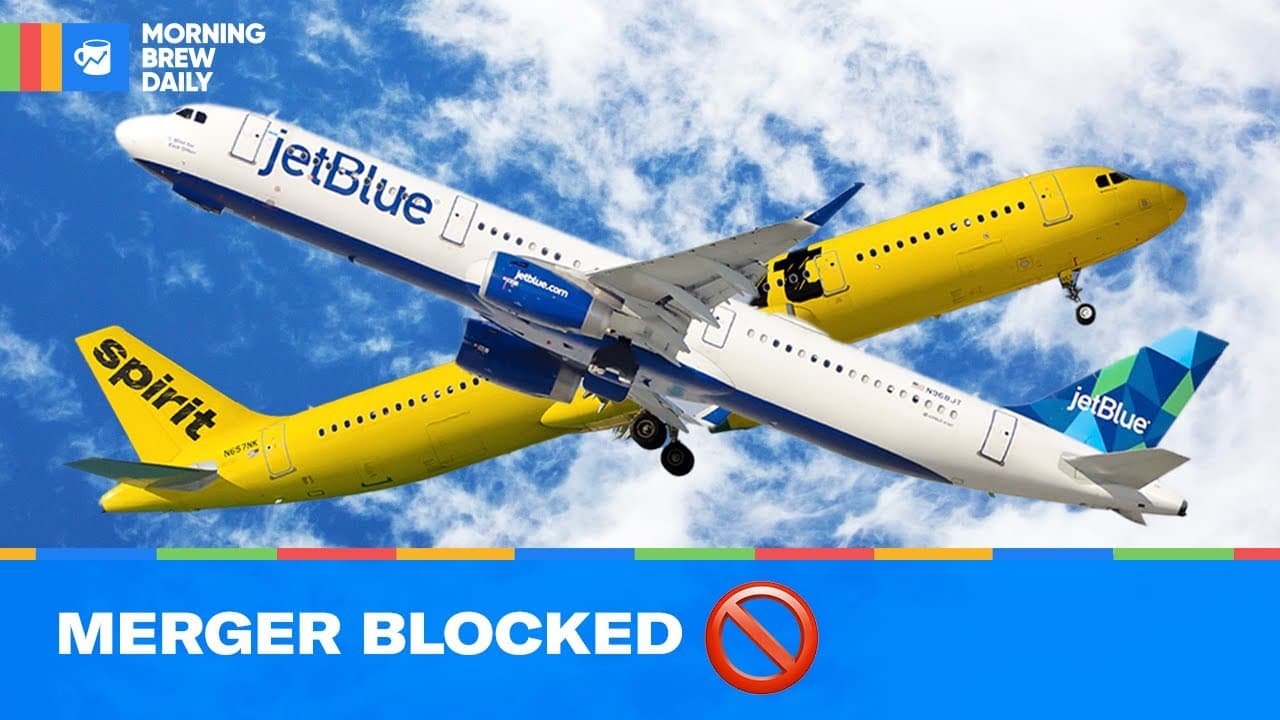
A Federal Judge BLOCKED The Merger Between Spirit and JetBlue
TL;DR
Federal judge blocks Spirit-JetBlue merger, citing competition concerns.
Transcript
Good Morning Brew Daily Show. I'm Neal Freyman. And I'm Toby Howell. Today, we'll explain how a TV drama exposed one of the biggest miscarriages of justice in British history. Then the Spirit Airlines JetBlue merger has been spirited away by a federal judge. It's Wednesday, January 17th. Let's ride. You know, Toby, I think I might buy a ticket to f... Read More
Key Insights
- A federal judge blocked the $3.8 billion merger between JetBlue and Spirit Airlines due to concerns about reduced competition and higher airfares.
- The decision is seen as a win for the Biden administration's efforts to prevent further airline industry consolidation.
- JetBlue and Spirit have both faced financial challenges, with significant losses since 2020, making the merger a strategic move for survival.
- The blocked merger opens the door for other carriers like Frontier to potentially acquire Spirit Airlines.
- The decision may impact other pending airline mergers, such as the Alaska Airlines and Hawaiian Airlines deal.
- A new bipartisan bill could expand the child tax credit and ease tax burdens for corporations, though its passage is uncertain due to other legislative priorities.
- The Supreme Court is revisiting the Chevron Doctrine, which could limit federal agencies' power to interpret ambiguous laws, affecting industries like crypto and AI.
- Uber is shutting down Drizly, an alcohol delivery service, integrating its features into Uber Eats amidst changing market dynamics.
Install to Summarize YouTube Videos and Get Transcripts
Explore YouTube Video Summarizer or Get YouTube Transcript Extractor
Questions & Answers
Q: Why did the federal judge block the Spirit-JetBlue merger?
The judge blocked the merger due to concerns that it would reduce competition in the airline industry, potentially leading to higher airfares. The Department of Justice argued that merging the largest low-cost carrier, Spirit, with JetBlue, which typically charges higher fares, would harm consumers by limiting budget-friendly options.
Q: What are the implications of the blocked merger for the airline industry?
The blocked merger is a significant victory for the Biden administration's efforts to curb consolidation in the airline industry. It may halt or influence other pending mergers, such as the Alaska Airlines and Hawaiian Airlines deal, and opens the possibility for other carriers like Frontier to acquire Spirit.
Q: How did the stock market react to the merger being blocked?
Following the judge's decision to block the merger, Spirit Airlines' stock fell by 47%, reflecting market concerns about the company's future without a merger partner. In contrast, JetBlue's stock rose slightly, indicating that shareholders were not entirely on board with the merger plan.
Q: What is the Chevron Doctrine and why is it significant?
The Chevron Doctrine is a legal principle that allows federal agencies to interpret ambiguous laws, granting them significant regulatory power. The Supreme Court's review of this doctrine could limit federal agencies' influence over industries, impacting how new technologies like crypto and AI are regulated.
Q: What potential legislative changes are being discussed in Congress?
Congress is discussing a bipartisan bill that could expand the child tax credit and ease corporate tax burdens. The bill aims to provide more relief to low-income families and facilitate tax deductions for corporations, though its passage is uncertain due to other legislative priorities and potential government shutdowns.
Q: Why is Uber shutting down Drizly?
Uber is shutting down Drizly to streamline its services, integrating alcohol delivery into the Uber Eats app. Despite acquiring Drizly for over $1 billion during the pandemic, Uber found that the alcohol delivery market was not as lucrative as expected and prefers a unified app strategy.
Q: What is the UK Post Office scandal about?
The UK Post Office scandal involved over 700 branch managers wrongfully convicted of theft due to a faulty I.T. system. Public outrage, fueled by a TV drama, has led to government promises of exoneration and compensation for the victims, highlighting the power of media in influencing justice.
Q: Why are humorous highway signs being banned?
The Federal Highway Administration is banning humorous highway signs, arguing they distract drivers. Despite their popularity and studies suggesting they increase message retention, the agency aims to standardize signage to avoid distractions and potential safety hazards caused by drivers stopping to photograph the signs.
Summary & Key Takeaways
-
A federal judge blocked the merger between JetBlue and Spirit Airlines, citing concerns over reduced competition and potential fare increases, marking a win for the Biden administration's regulatory efforts.
-
The decision may lead to other carriers like Frontier making acquisition attempts, with Spirit's stock plummeting and JetBlue's slightly rising as shareholders react to the news.
-
The Supreme Court is reviewing the Chevron Doctrine, which could significantly impact federal regulatory power, while Congress debates a bipartisan bill to expand child tax credits and ease corporate tax burdens.
Read in Other Languages (beta)
Share This Summary 📚
Summarize YouTube Videos and Get Video Transcripts with 1-Click
Try YouTube Summary with ChatGPT & Claude or YouTube Transcript Generator
Explore More Summaries from Morning Brew Daily 📚



Summarize YouTube Videos and Get Video Transcripts with 1-Click
Try YouTube Summary with ChatGPT & Claude or YouTube Transcript Generator