Interpreting change in speed from velocity-time graph | Differential Calculus | Khan Academy
TL;DR
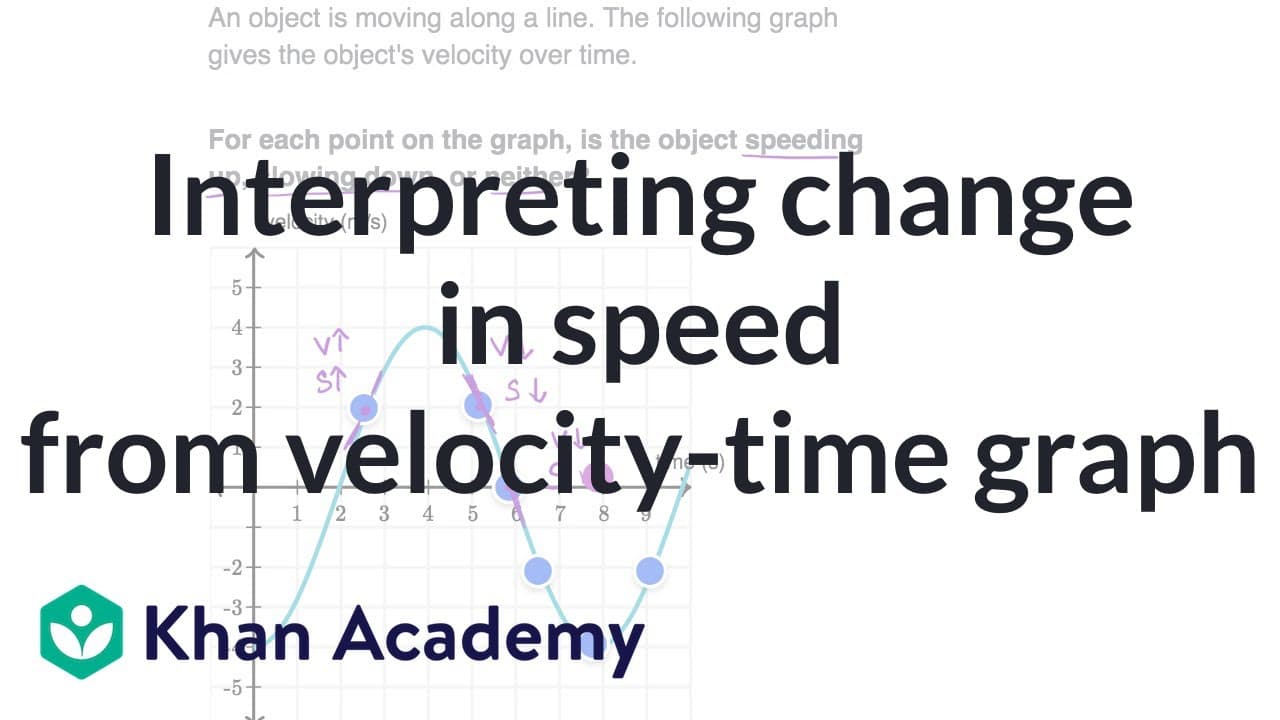
The video explains how to determine whether an object is speeding up, slowing down, or neither using its velocity-time graph.
Transcript
- [Instructor] An object is moving along a line. The following graph gives the object's velocity over time. For each point on the graph, is the object speeding up, slowing down, or neither? So, pause this video and see if you can figure that out. All right, now, let's do it together, and first, we need to make sure we're reading this carefully, 'ca... Read More
Key Insights
- 🐎 Speed refers to the magnitude of velocity and can be represented by the absolute value of velocity.
- 🐎 A positive slope on a velocity-time graph indicates both an increase in velocity and speed, while a negative slope suggests a decrease in both.
- ❎ Velocity and speed can change independently in certain scenarios, such as when the velocity is negative but becoming more negative.
- 🐎 A zero slope on a velocity-time graph signifies that the object's velocity is not changing, resulting in a constant speed.
Install to Summarize YouTube Videos and Get Transcripts
Explore YouTube Video Summarizer or Get YouTube Transcript Extractor
Questions & Answers
Q: How can we determine whether an object is speeding up, slowing down, or neither using a velocity-time graph?
By observing the slope of the velocity-time graph, a positive slope indicates speeding up, a negative slope means slowing down, and a zero slope implies neither. Additionally, analyzing the absolute value of velocity can give insight into the changing speed.
Q: Can velocity and speed change independently on a velocity-time graph?
Yes, sometimes velocity and speed can change independently. For instance, if the velocity is negative but becoming more negative, indicating slowing down, the absolute value of velocity (speed) actually increases.
Q: How can we interpret moments where the velocity-time graph shows a positive slope but the velocity is negative?
In these moments, the object is moving in the negative direction, but its velocity is increasing. The speed, which is the absolute value of velocity, will also be increasing.
Q: What does a zero slope on a velocity-time graph indicate about the object's speed and velocity?
A zero slope means that the object's velocity is not changing, and consequently, its speed remains constant. Therefore, neither speeding up nor slowing down is occurring.
Summary & Key Takeaways
-
The video explores the concept of speed, which refers to the absolute value of velocity, and velocity, by analyzing a velocity-time graph.
-
When the velocity-time graph has a positive slope, both the velocity and speed are increasing. Conversely, a negative slope indicates a decrease in both velocity and speed.
-
However, there are cases where the velocity and speed can change independently. For instance, when the velocity is negative but becoming more negative, the speed is actually increasing.
Read in Other Languages (beta)
Share This Summary 📚
Summarize YouTube Videos and Get Video Transcripts with 1-Click
Try YouTube Summary with ChatGPT & Claude or YouTube Transcript Generator
Explore More Summaries from Khan Academy 📚






Summarize YouTube Videos and Get Video Transcripts with 1-Click
Try YouTube Summary with ChatGPT & Claude or YouTube Transcript Generator