What Is Opportunity Cost and How Does It Work?
TL;DR
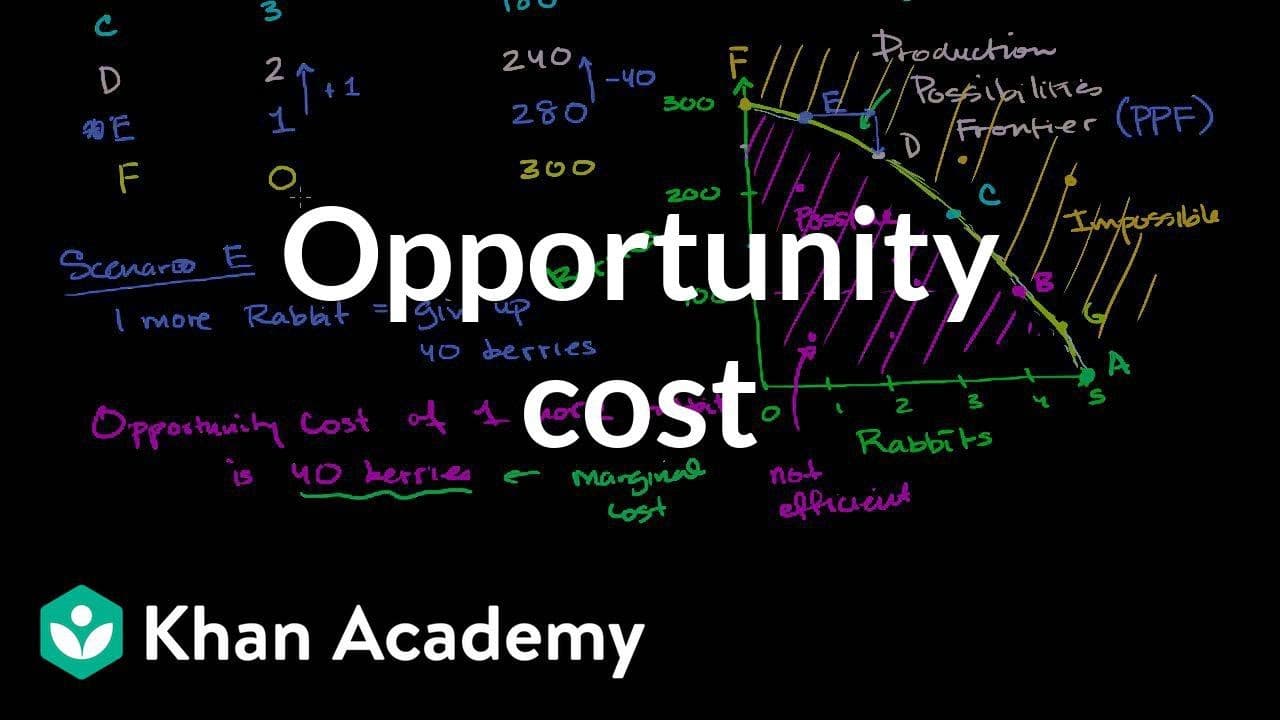
Opportunity cost is the value of what you give up when making a choice. For example, in scenario E, catching one more rabbit costs you 40 berries, while gaining 20 berries requires sacrificing one rabbit. Understanding opportunity cost helps evaluate trade-offs in decision-making.
Transcript
Let's say we've been hanging out in scenario E for a bunch of days. On average, we've been catching one rabbit, but gathering 280 berries. We were in, I guess, a berry mood. So this is scenario E right over here. But now all of a sudden, we're in the mood for more protein. So let me write down, we are in scenario E. And we're in the mood for more p... Read More
Key Insights
- 🐰 In scenario E, catching one more rabbit costs 40 berries in terms of opportunity cost.
- 🐰 The opportunity cost of gaining 20 more berries in scenario E is one rabbit.
- 🇨🇷 Opportunity cost represents the sacrifice of one option when choosing another.
- 🇨🇷 Marginal cost refers to the cost of producing one more unit.
- 🇨🇷 The opportunity cost and marginal cost can be calculated differently depending on the context.
- 🇨🇷 The opportunity cost of one more unit can be evaluated in terms of marginal cost.
- ⛔ The production possibilities frontier (PPF) limits the options available for production.
Install to Summarize YouTube Videos and Get Transcripts
Explore YouTube Video Summarizer or Get YouTube Transcript Extractor
Questions & Answers
Q: What is the opportunity cost of catching one more rabbit in scenario E?
In scenario E, catching one more rabbit would cost 40 berries. This is the amount of berries that would have to be given up.
Q: What is the opportunity cost of gaining 20 more berries in scenario E?
If we want to increase our berry production by 20, we would have to sacrifice one rabbit. So, the opportunity cost of gaining 20 more berries is one rabbit.
Q: How is the opportunity cost different from the marginal cost?
The opportunity cost is the cost of giving up one option to pursue another, while the marginal cost refers to the cost of producing one more unit of a good or service.
Q: Can the opportunity cost change in different scenarios?
Yes, the opportunity cost can change depending on the scenario. In this example, the opportunity cost of catching one more rabbit or gaining 20 more berries varies in different scenarios.
Summary & Key Takeaways
-
In scenario E, the average daily production is 1 rabbit and 280 berries.
-
Catching one more rabbit would require giving up 40 berries.
-
Gaining 20 more berries would mean sacrificing one rabbit.
Read in Other Languages (beta)
Share This Summary 📚
Summarize YouTube Videos and Get Video Transcripts with 1-Click
Try YouTube Summary with ChatGPT & Claude or YouTube Transcript Generator
Explore More Summaries from Khan Academy 📚



Summarize YouTube Videos and Get Video Transcripts with 1-Click
Try YouTube Summary with ChatGPT & Claude or YouTube Transcript Generator