What Is Mechanical Advantage in Simple Machines?
TL;DR
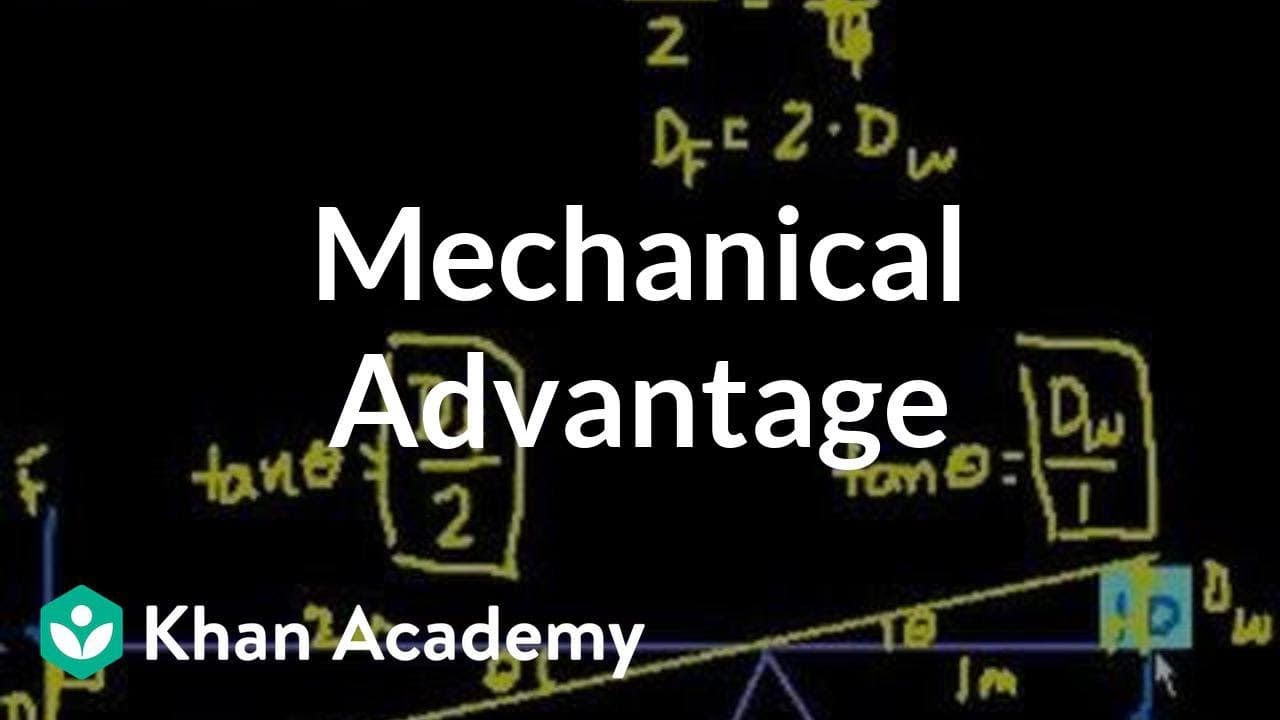
Mechanical advantage is the ratio of output force to input force in a simple machine, like a lever. It allows a smaller input force to lift a heavier load by applying the input force over a greater distance. Understanding mechanical advantage is crucial for grasping the principles of work and energy conservation in physics.
Transcript
Welcome back. We'll now use a little bit of what we've learned about work and energy and the conservation of energy and apply it to simple machines. And we'll learn a little bit about mechanical advantage. So I've drawn a simple lever here. And you've probably been exposed to simple levers before. They're really just kind of like a seesaw. This pla... Read More
Key Insights
- ❓ Simple levers have a fulcrum and can rotate when a force is applied.
- 🏋️ The distance the weight moves up is proportional to the distance the force is applied.
- 💦 Work is conserved in a lever through the principle of the conservation of energy.
- 🦾 Mechanical advantage is a measure of how much a force is multiplied or decreased in a machine.
- 🙃 The moment, or the product of force and distance, is equal on both sides of the lever.
- 🥳 The ratio of the distance of the force to the distance of the weight determines the mechanical advantage.
- 🏋️ Increasing the distance the force is applied decreases the force required but increases the distance the weight moves up.
Install to Summarize YouTube Videos and Get Transcripts
Explore YouTube Video Summarizer or Get YouTube Transcript Extractor
Questions & Answers
Q: How is a lever similar to a seesaw?
A lever is similar to a seesaw as both have a pivot point called a fulcrum and can rotate when a force is applied.
Q: What determines the distance the weight moves up?
The distance the weight moves up is determined by the ratio of the distance the force is applied to the fulcrum to the distance from the fulcrum to the weight.
Q: How is work conserved in a lever?
The work input (force times distance of the force) is equal to the work output (force of the weight times distance the weight moves up) in a lever.
Q: What is mechanical advantage?
Mechanical advantage is the ratio of the output force to the input force and represents how much a force is multiplied or decreased in a machine.
Summary & Key Takeaways
-
Simple levers, like a seesaw, have a pivot point called a fulcrum.
-
To keep a lever level or rotate it counterclockwise, a force must be applied.
-
The distance the weight moves up is proportional to the distance the force is applied.
Read in Other Languages (beta)
Share This Summary 📚
Summarize YouTube Videos and Get Video Transcripts with 1-Click
Try YouTube Summary with ChatGPT & Claude or YouTube Transcript Generator
Explore More Summaries from Khan Academy 📚



Summarize YouTube Videos and Get Video Transcripts with 1-Click
Try YouTube Summary with ChatGPT & Claude or YouTube Transcript Generator