How Google Search indexes pages
TL;DR
Google indexes pages by analyzing content and determining signals.
Transcript
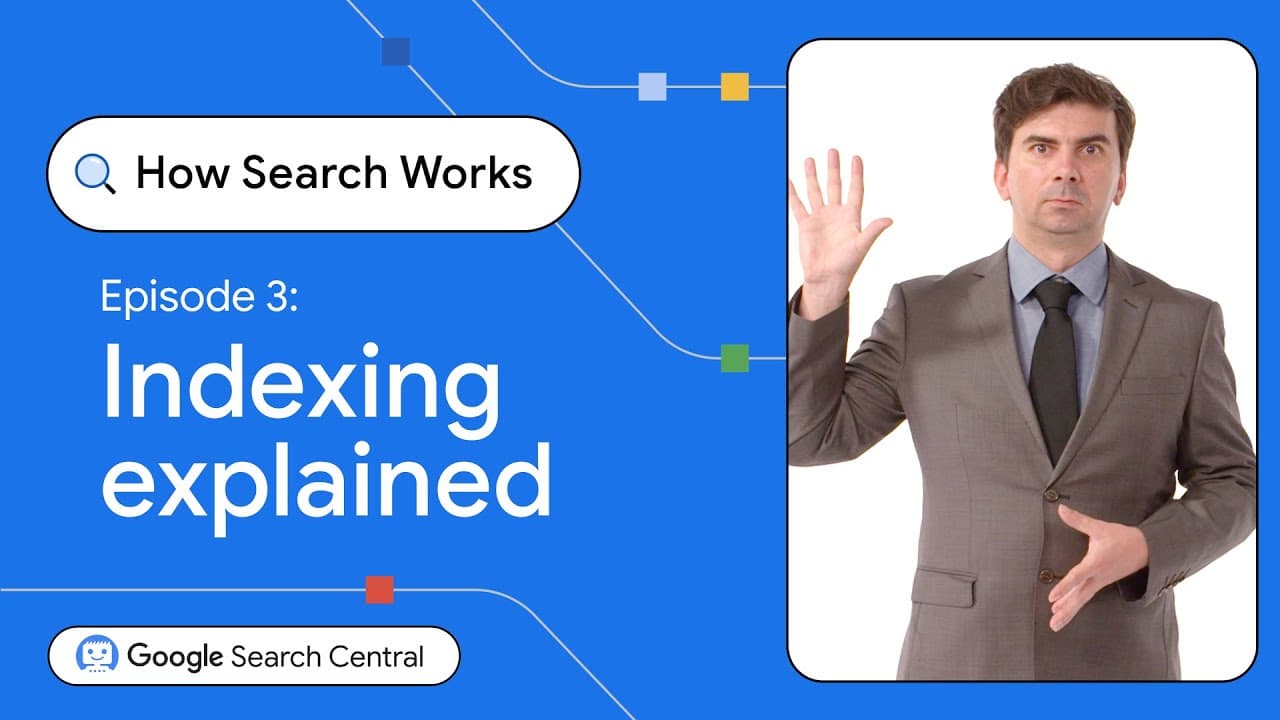
GARY ILLYES: Hey. Welcome back to How Search Works. I'm usually Gary, an engineer on the Google Search team. In our last episode, we explored how Google finds and downloads new and updated web pages, a method called crawling. In this video, I'll talk about the next stage in the process, indexing. [UPBEAT MUSIC] Once the page has been crawled and re... Read More
Key Insights
- Indexing is the process of analyzing a web page's content, including text, images, and videos, to determine its relevance and rank in search results.
- Google parses HTML to fix semantic issues, ensuring that metadata is correctly placed for effective indexing.
- Canonical pages are selected from duplicate content clusters to represent the group in search results, based on various signals.
- Signals, such as rel="canonical" tags and page importance, help Google decide which version of a page to index.
- Duplicate clustering involves grouping similar content pages and selecting a canonical version for indexing.
- Index selection is based on the quality of the page and the signals collected, determining if a page should be stored in Google's index.
- Google's index is a vast database distributed across thousands of computers, storing information about indexed pages.
- The next step after indexing is serving and ranking search results, which will be covered in the following episode.
Install to Summarize YouTube Videos and Get Transcripts
Explore YouTube Video Summarizer or Get YouTube Transcript Extractor
Questions & Answers
Q: What is the purpose of indexing in Google Search?
Indexing in Google Search serves to analyze a web page's content, including text, images, and videos, to determine its relevance and rank in search results. It involves processing the page to extract words and phrases, allowing users to find the page more easily through search queries.
Q: How does Google handle semantic issues in HTML during indexing?
Google parses the HTML of a page to fix semantic issues, ensuring that all HTML tags are in the correct place. This process is crucial for effective indexing, as it ensures that metadata is correctly placed and that unsupported tags do not interfere with the indexing process.
Q: What is the role of canonical pages in Google's indexing process?
Canonical pages are selected from groups of duplicate content to represent the group in search results. This selection is based on various signals collected by Google. Canonical pages ensure that the most relevant version of content is indexed and served to users, while alternate versions may appear in specific contexts.
Q: What are signals, and how do they affect indexing?
Signals are pieces of information collected by Google about pages and websites, used to determine which version of a page to index. They include straightforward annotations like rel="canonical" tags and more complex factors like a page's importance. Signals help Google decide the page's relevance and quality for indexing.
Q: What is duplicate clustering in the context of indexing?
Duplicate clustering involves grouping pages with similar content and selecting a canonical version to represent the group in search results. This process helps Google manage duplicate content effectively and ensures that users are directed to the most relevant page version when they search for related topics.
Q: How does Google decide whether to index a page?
Google decides to index a page based on its quality and the signals collected during the analysis process. This decision, known as index selection, involves determining if the page meets the criteria to be stored in Google's index, which is a vast database distributed across thousands of computers.
Q: What happens after a page is indexed by Google?
After a page is indexed, the information collected about it and its content cluster is stored in Google's index. The next step involves serving and ranking search results, where the indexed page's relevance and rank are determined for specific search queries. This process will be covered in the next episode.
Q: What is Google's index, and how is it structured?
Google's index is a large database that stores information about indexed pages. It is distributed across thousands of computers, allowing Google to efficiently manage and retrieve relevant search results. The index is structured to quickly return results that are highly relevant to users' search queries.
Summary & Key Takeaways
-
In this episode, Gary Illyes explains the indexing process, where Google analyzes a page's content to determine its relevance and rank in search results. He discusses how HTML parsing and semantic issue fixing are crucial for effective indexing.
-
Canonical pages are selected from duplicate content clusters based on signals like rel="canonical" tags. These pages represent the group in search results, while alternate versions may appear in specific contexts.
-
Index selection depends on page quality and collected signals, determining whether a page is stored in Google's index. This vast database across thousands of computers stores information about indexed pages.
Read in Other Languages (beta)
Share This Summary 📚
Summarize YouTube Videos and Get Video Transcripts with 1-Click
Try YouTube Summary with ChatGPT & Claude or YouTube Transcript Generator
Explore More Summaries from Google Search Central 📚





Summarize YouTube Videos and Get Video Transcripts with 1-Click
Try YouTube Summary with ChatGPT & Claude or YouTube Transcript Generator