How to Calculate Concentration Using the Beer–Lambert Law
TL;DR
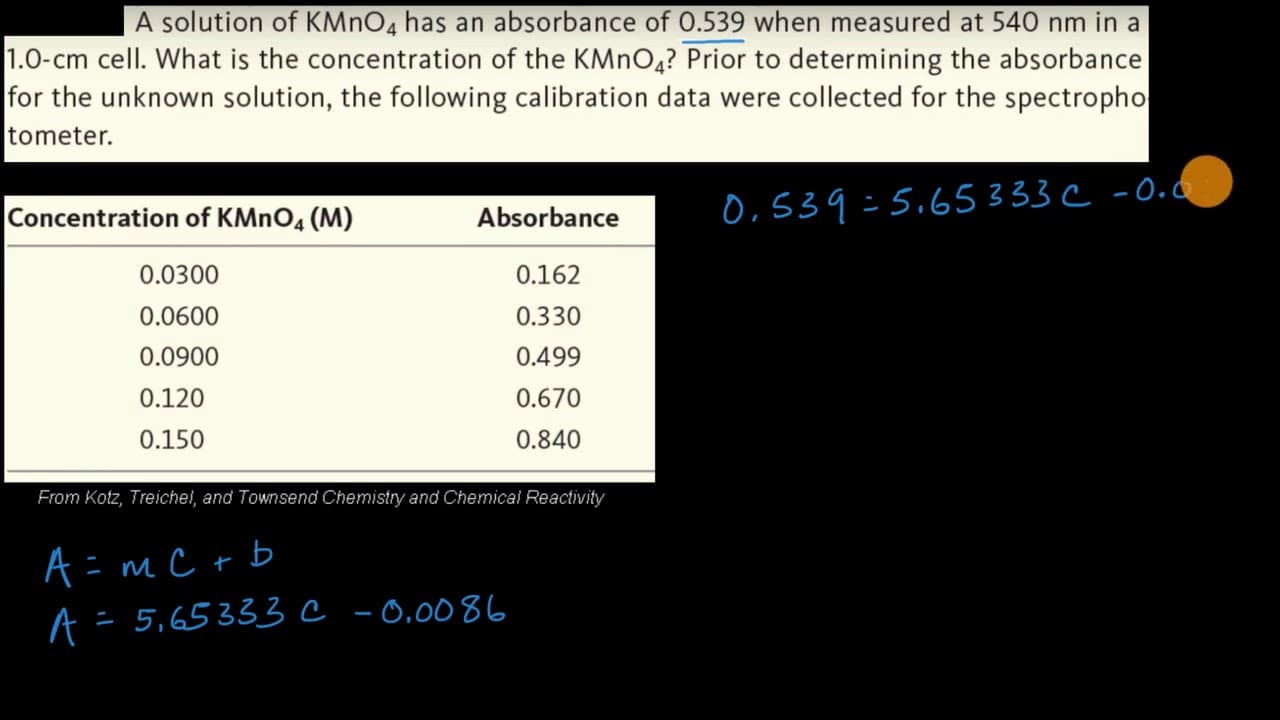
To calculate the concentration of a potassium permanganate solution using the Beer–Lambert law, input the absorbance value into the linear regression equation derived from calibration data. For an absorbance of 0.539, the concentration is determined to be approximately 0.0969 M by rearranging the equation and rounding to three significant figures.
Transcript
- [Instructor] So I have a question here from the Kotz, Treichel, and Townsend Chemistry and Chemical Reactivity book, and I got their permission to do this. And it says a solution of potassium permanganate has an absorbance of 0.539 when measured at 540 nanometers in a one centimeter cell. What is the concentration of the potassium permanganate? P... Read More
Key Insights
- ❓ Absorbance and concentration in a solution can be related through a linear equation.
- 🆘 Performing a linear regression analysis helps determine the slope and y-intercept values for the equation.
- 🔌 The absorbance value, when plugged into the equation, can be used to calculate the concentration of the solution.
- 🛝 Rounding to an appropriate number of significant figures is important for accurate reporting of the concentration value.
- 🎭 Computer programs like Desmos can be used to perform linear regression analysis.
- 👏 Chemists typically use computers for linear regression, but it can also be done by hand.
- 0️⃣ The absorption value of zero corresponds to a concentration of zero in the linear equation.
Install to Summarize YouTube Videos and Get Transcripts
Explore YouTube Video Summarizer or Get YouTube Transcript Extractor
Questions & Answers
Q: How is the relationship between absorbance and concentration described?
The relationship between absorbance and concentration is described using a linear equation, where absorbance is equal to the slope multiplied by concentration plus the y-intercept.
Q: Why is it necessary to perform a linear regression analysis?
Performaing a linear regression analysis helps determine the slope and y-intercept values accurately. It provides a more precise description of the relationship between absorbance and concentration.
Q: How can the absorbance value be used to calculate the concentration?
By plugging in the absorbance value into the linear equation, the concentration can be calculated by solving for the concentration variable.
Q: Why is rounding to three significant figures important?
Rounding to three significant figures ensures that the final concentration value is reported with the appropriate level of precision.
Summary & Key Takeaways
-
The video discusses the relationship between absorbance and concentration in a solution and how it can be described through a linear equation.
-
The narrator demonstrates how to use a computer program or by hand to perform a linear regression analysis to determine the slope and y-intercept values.
-
By plugging in the calculated absorbance value into the equation, the concentration of the potassium permanganate solution can be found.
Read in Other Languages (beta)
Share This Summary 📚
Summarize YouTube Videos and Get Video Transcripts with 1-Click
Try YouTube Summary with ChatGPT & Claude or YouTube Transcript Generator
Explore More Summaries from Khan Academy 📚



Summarize YouTube Videos and Get Video Transcripts with 1-Click
Try YouTube Summary with ChatGPT & Claude or YouTube Transcript Generator